Amazon 1P vs 3P: The Operator Playbook for Brands

Sarah Johnson
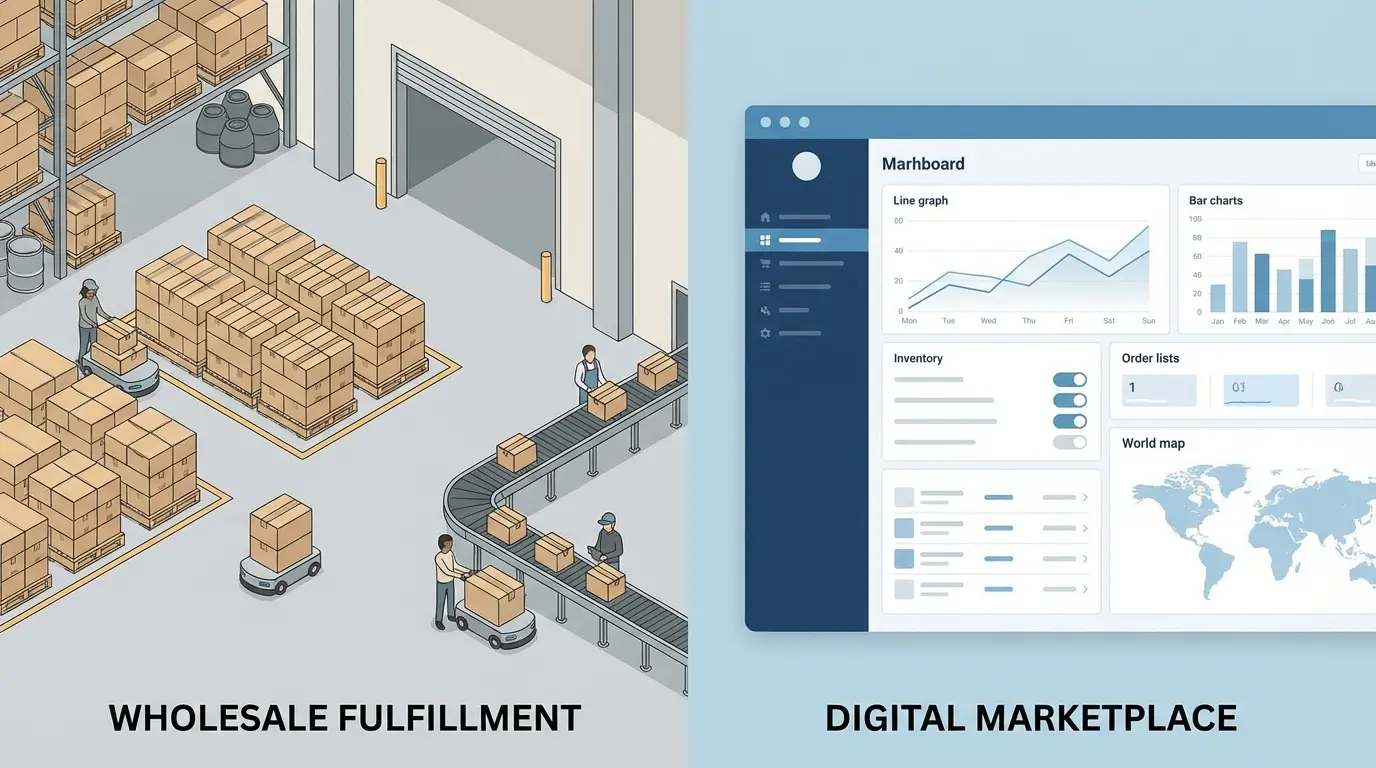
Amazon 1P vs 3P: the operator playbook nobody gives you
Imagine you finally get the email: Amazon wants to “work with you.” Vendor Central. Real grown-up stuff.
Half the brands I’ve met treat that moment like they just got promoted.
Then the first shortage claim hits, retail drops your price to a number you’d never approve, and your “promotion” starts feeling like a wholesale job… with a surprise finance department living inside it.
That’s the real amazon 1p vs 3p decision: not “which one sells more,” but which one you can actually operate without bleeding out in margin, cash flow, and control.
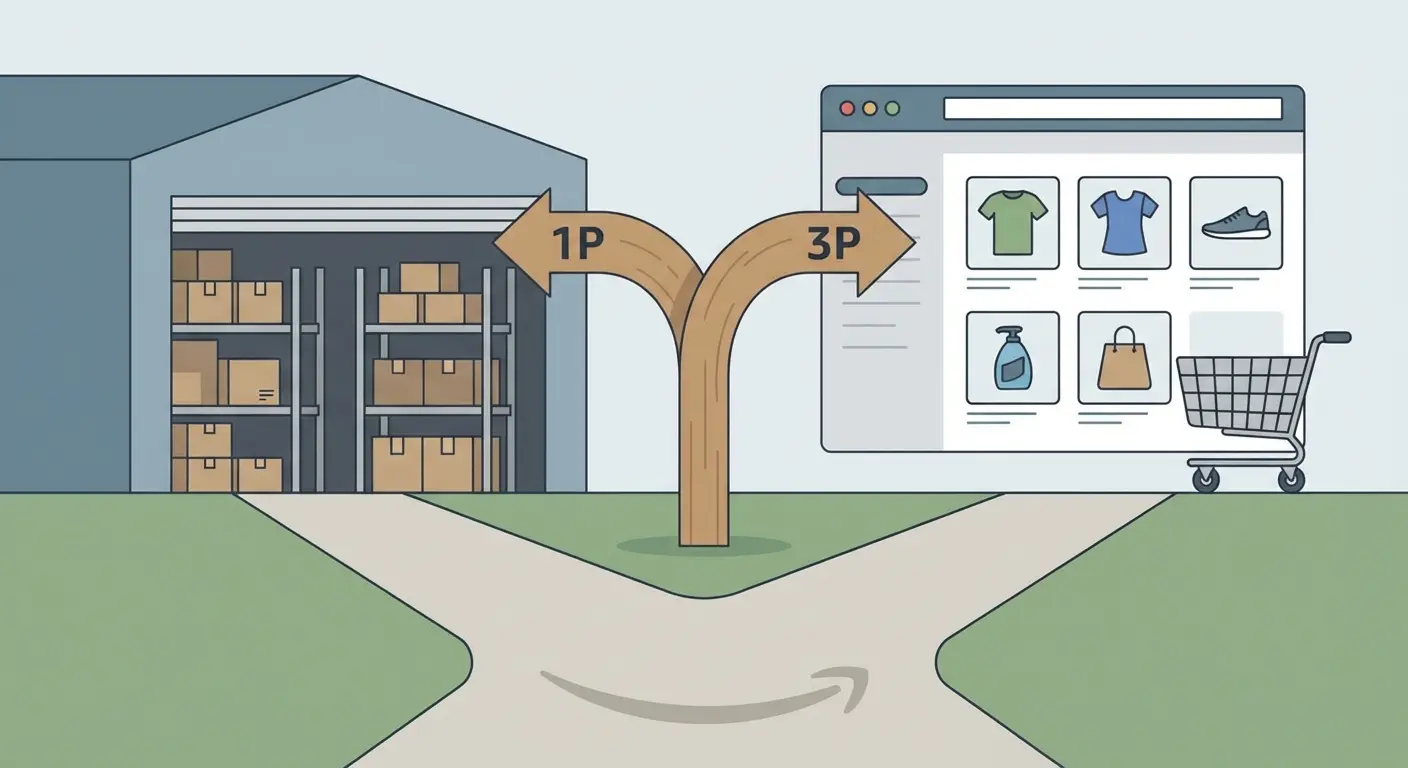
The relationship model is the product (and most sellers miss that)
Here’s the blunt translation:
1P (Vendor Central):you’re a supplier. Amazon buys from you (purchase orders), then Amazon retails it.
3P (Seller Central):you’re a merchant. You sell to the customer on Amazon, using FBA or FBM.
Experienced sellers already know that. The part that actually matters is what that relationship does to your day-to-day constraints.
Expectation vs Reality
Expectation:“1P is easier. Amazon handles everything.”
Reality:Amazon handlesretail operations… after you successfully handlewholesale reality.Forecasting misses, compliance requirements, routing/appointment rules, deductions, and never-ending reconciliation work tend to show up like uninvited guests.
Expectation:“3P is messy. Too many moving parts.”
Reality:3P is messy, yes. But the mess is at leastyourmess: your pricing, your inventory strategy, your ad dial, your listing iteration speed.
If you want a short way to remember it:1P optimizes for Amazon’s retail machine. 3P optimizes for your P&L.Often those goals overlap. Sometimes they absolutely do not.
Operator insight: decide based on what you can’t afford to lose
When sellers ask me “1p vs 3p amazon — which is better?”, I don’t start with margin.
I start withwhat failure mode would kill you fastest.
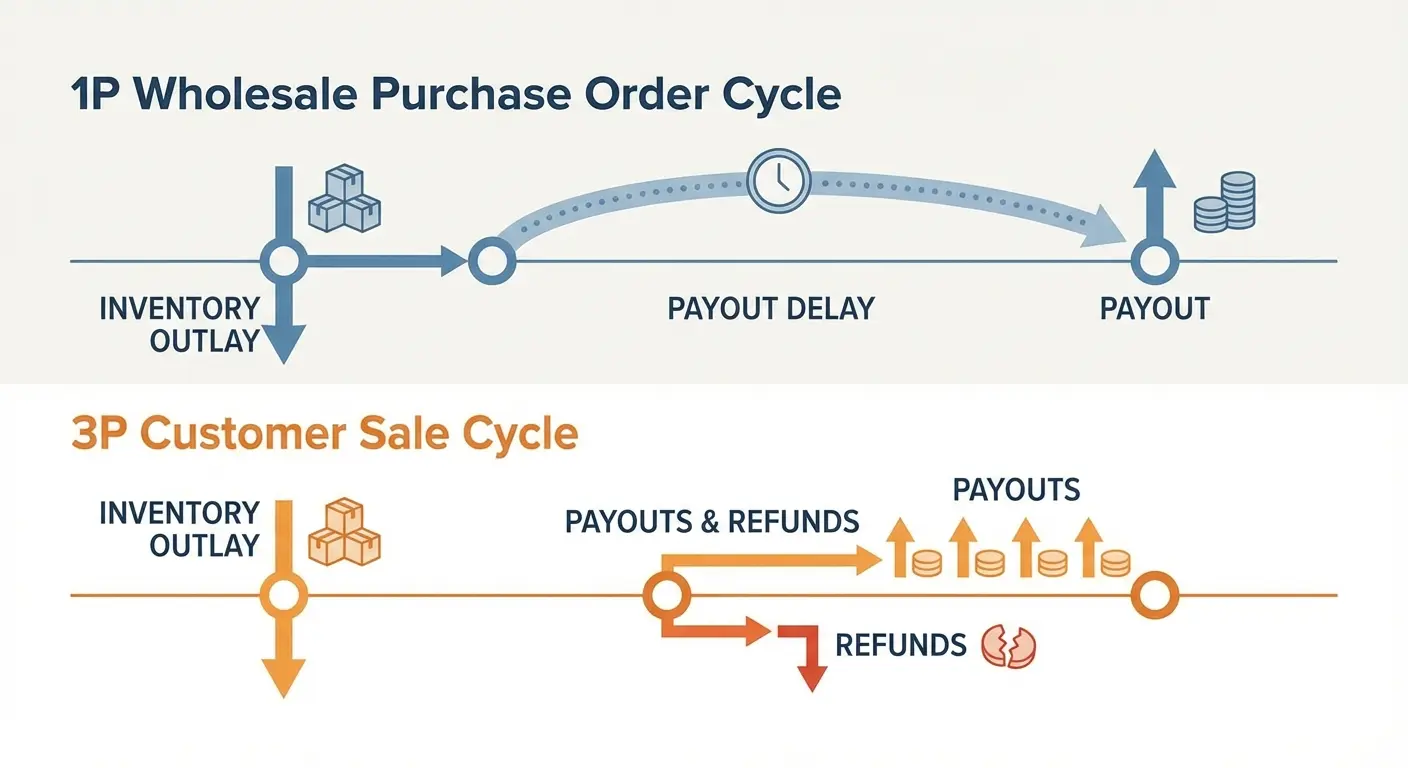
If cash flow fragility can kill you, be careful with 1P
In many 1P arrangements, payment terms and deductions timing can create a longer cash conversion cycle than sellers expect. That can be fine for a well-capitalized brand.
It can also quietly strangle a brand that’s scaling, buying inventory, and funding marketing elsewhere.
The gotcha isn’t that Amazon is “slow.”
It’s that 1P often comes with morereconciliation work(and potential disputes) between what you think you shipped/earned and what gets paid.
If price control is non-negotiable, 1P will test your religion
A lot of brands think they can “manage” retail pricing in 1P.
Sometimes you can influence it. Often you can’t enforce it the way you want. Amazon is the retailer, and retailers do retailer things.
That’s why the 3p vs 1p amazon debate is often just code for:
“Do I want to be a brand with a consistent price story?”
“Or do I want volume at whatever price the market (and retail) decides is convenient this week?”
There’s no moral win here. There’s only consequences.
If catalog and merchandising speed is your edge, 3P usually wins
On 3P, you can iterate fast: testing images, bullets, bundles, variations, and positioning.
On 1P, you can absolutely have great content—sometimes even advantages—but you’re operating inside a system where retail readiness, catalog authority, and internal processes can slow you down.
If your category is aggressive and your competitors ship new angles every month, speed matters.
The part nobody budgets for: “friction tax”
Every model has a friction tax. It’s just a different tax collector.
1P friction tax: deductions, disputes, and operational compliance
If you’ve never lived in 1P, here’s what tends to surprise strong operators:
You can ship correctly and still spend time proving you shipped correctly.
You can win a dispute and still wait to feel it in cash.
“Small” operational misses (packaging, labeling, routing, shortages, damage) can turn into meaningful dollars when scaled.
None of this is guaranteed doom. Plenty of brands run clean 1P programs.
But if you’re evaluating amazon 3p vs 1p, you need to price in the labor and process maturity required to keep the program tidy.
3P friction tax: account health and demand generation
On 3P, your friction tax comes from different angles:
Account health risk:you’re closer to the policy blast radius.
Demand generation:in many categories, you’ll pay to learn (PPC), and you’ll pay to stay visible.
Inventory risk:FBA storage/aged inventory pressure and forecasting errors.
Here’s the trade: you’re paying those taxes in exchange for control.
If you’re disciplined, 3P taxes can be forecastable.
If you’re chaotic, they’re the kind that shows up as “mystery margin loss” at month end.
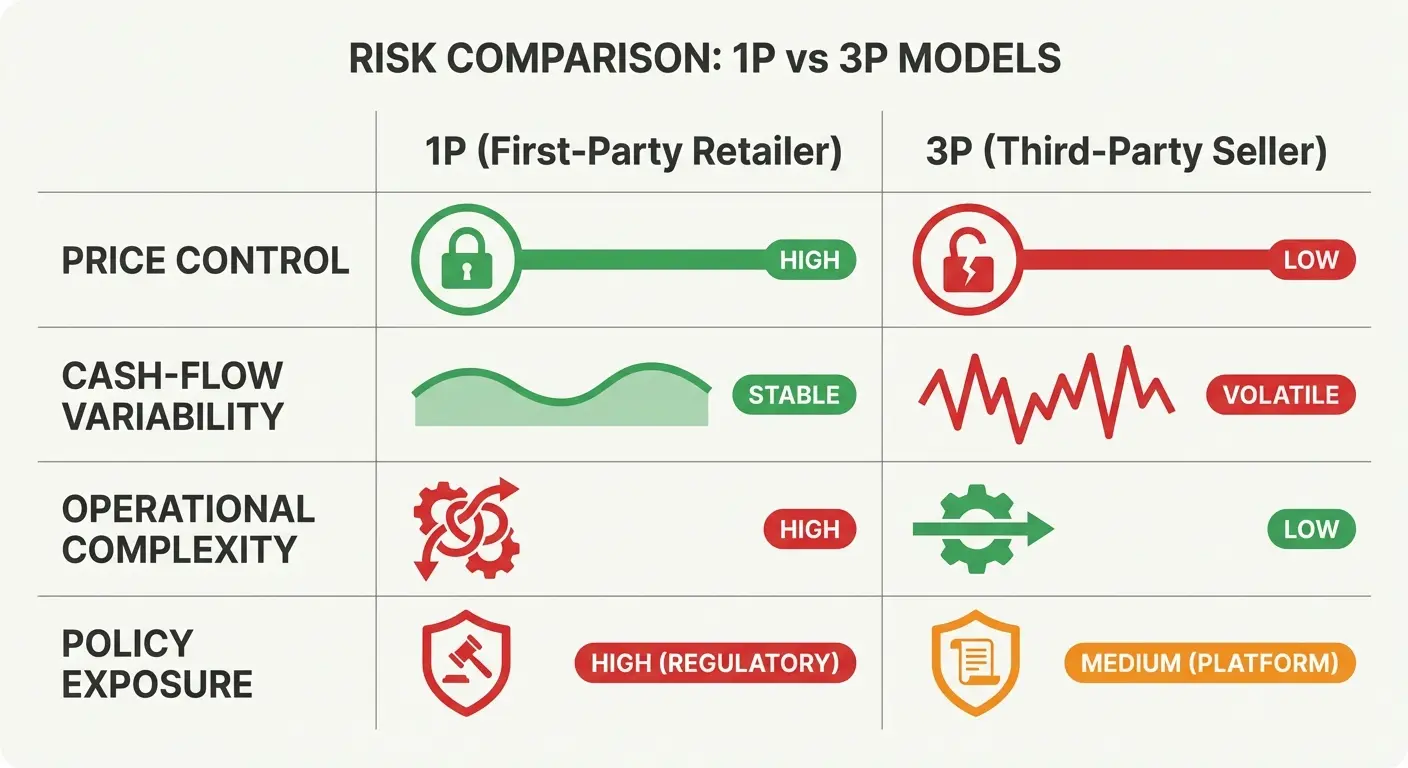
What people get wrong about Buy Box in 1P vs 3P on Amazon
Sellers love to reduce this to “Sold by Amazon always wins.”
Sometimes Amazon Retail is the dominant offer. Sometimes it isn’t. Sometimes it disappears for months and comes back like a ghost with a price you can’t live with.
The more useful framing:
1P is one offer type in the ecosystem. Powerful, but not omnipotent.
3P is the flexible layer that can keep your offer live, protect contribution margin, and let you steer price—until competition or your own resellers make it messy.
If you run both, you’re not choosing one. You’re managing an internal competition.
Operator heuristic: don’t run hybrid unless you can police your own channel conflict
Hybrid is attractive:
1P for broad retail reach and operational leverage.
3P for control, new item launches, bundles, and margin protection.
Hybrid also turns into self-sabotage when:
your 1P cost structure forces Amazon to retail below your 3P floor,
your 3P promos train Amazon’s retail team (or algorithms) to expect lower pricing,
your own distribution leaks create reseller offers that beat both.
If you can’t manage distribution discipline and SKU strategy, hybrid becomes “we compete with ourselves and call it diversification.”
“Bad advice” (and what to do instead)
Bad advice:“If you can get 1P, take it. It’s a flex.”
A flex isn’t a strategy.
Better operator move:Treat 1P as a separate business line with its own:
forecast discipline
routing/compliance SOPs
dispute and deduction workflow
contribution-margin targets that account for friction
If you can’t staff that, you don’t have a 1P program. You have a future headache.
The decision framework I actually use (in the room with adults)
When the conversation is serious, it stops being philosophical and becomes a set of bets.
Bet #1: Do you want Amazon to be your customer or your platform?
If you want Amazon to be your customer, you’re thinking 1P.
If you want Amazon to be your platform, you’re thinking 3P.
This sounds semantic until it hits your P&L.
As a supplier, you optimize for purchase orders, fill rates, and wholesale terms.
As a seller, you optimize for conversion, TACoS/ACoS discipline, inventory velocity, and customer experience metrics.
Bet #2: Where is your leverage?
Strong manufacturing, stable demand, and the ability to handle wholesale ops? 1P can fit.
Strong marketing, rapid iteration, and the ability to own fulfillment strategy? 3P can fit.
Most brands are not naturally good at both.
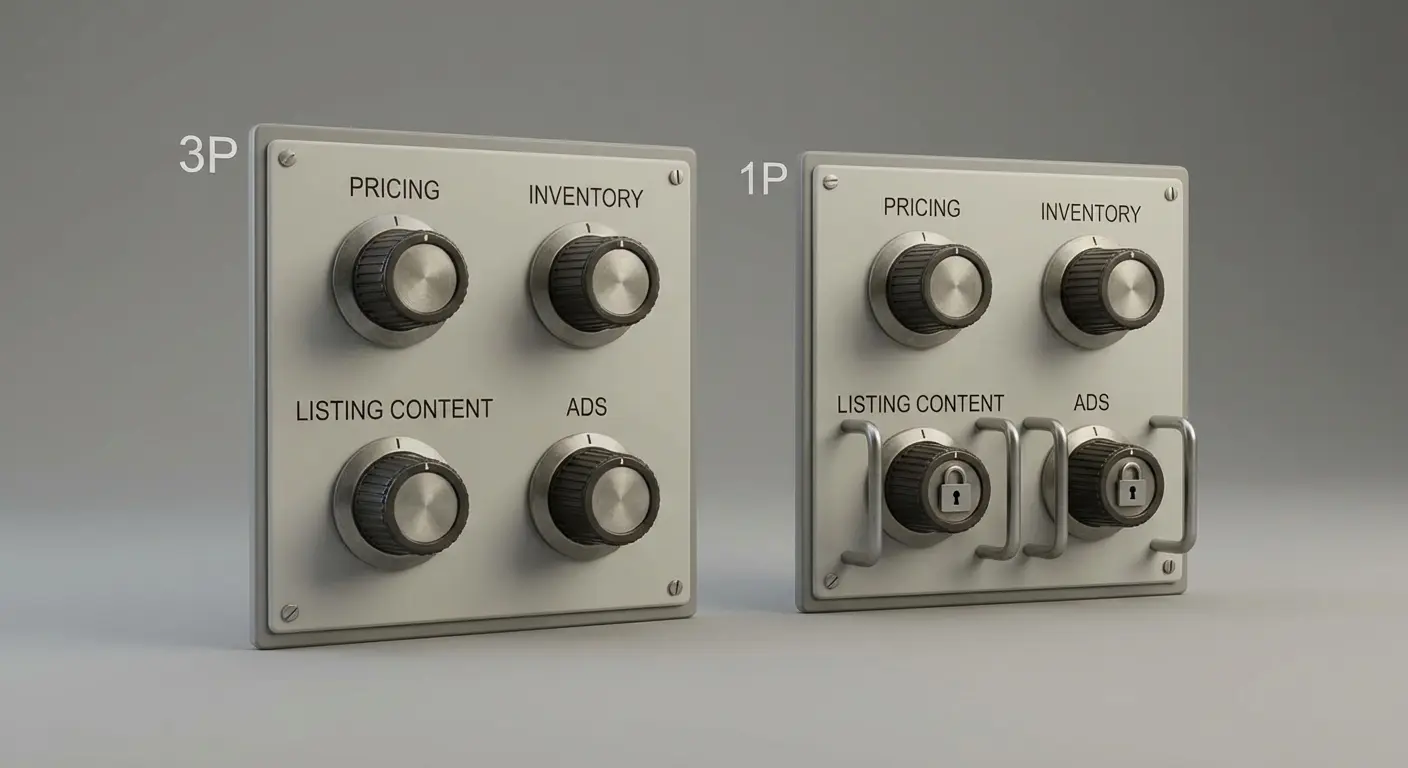
Bet #3: What is the “control surface” you require?
Control surface = the set of levers you must touch weekly to stay sane.
If you need to touch price weekly, 3P typically fits better.
If you don’t care about price as long as volume moves and you’re paid (and you can survive the terms), 1P might be acceptable.
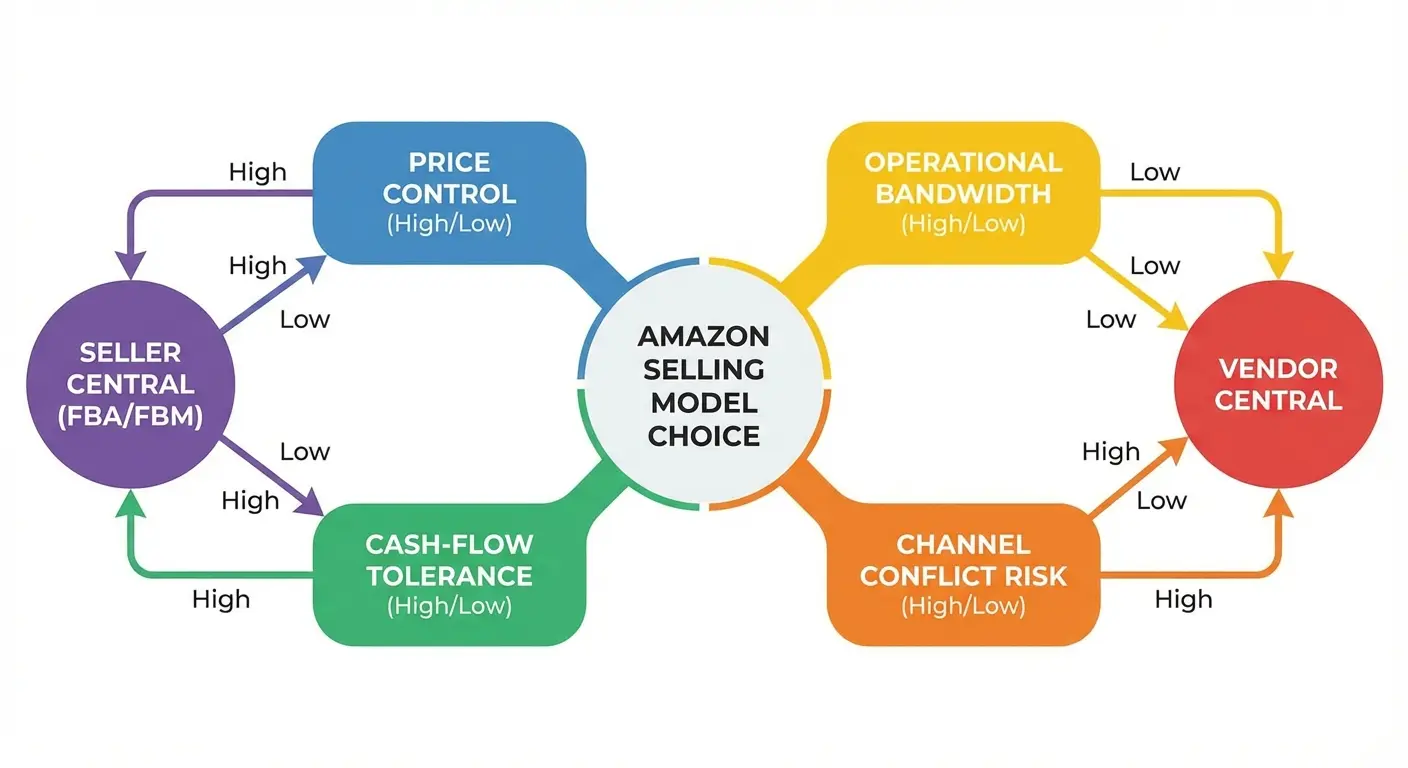
Running 3P like an operator (so it doesn’t eat you)
If you choose 3P, you already know the mechanics. Here’s what tends to separate pros from “busy” sellers:
Single source of truth for margin.Know your real landed cost, storage, returns drag, ad spend, and promo leakage.
Inventory policy with teeth.Decide your restock guardrails before you’re emotional about a stockout.
Listing governance.One owner. One change log. Fewer “quick edits” that you can’t undo.
Boring? Yes.
Also the reason you don’t wake up to a month of unprofitable sales because an ad campaign kept spending while your conversion fell off a cliff.
Running 1P like an operator (so it doesn’t eat you)
If you go 1P, the win condition is predictability.
Treat compliance as revenue protection.Routing, packaging, labeling, and appointment rules aren’t admin. They’re margin.
Reconcile like you mean it.Build a repeatable cadence for shortages/damages/deductions review. Don’t rely on vibes.
Separate “brand marketing” from “retail math.”Vendor conversations can feel like marketing conversations. Your P&L doesn’t care about feelings.
FAQ (yes, these are real search phrases)
Is there a clean winner in 1p vs 3p on amazon?
Not universally. In many categories, sellers end up with a mix over time, but “mix” only works if you can control channel conflict and your internal reporting is honest.
How should I think about 3p vs 1p amazon if I’m already successful on FBA?
Treat 1P as a wholesale expansion, not an upgrade. If your business is built on fast iteration, price testing, and ad-driven launches, 1P can feel slower and less controllable.
Why do people type amazon 3p vs 1p like it’s a boxing match?
Because both models can print money or create slow-motion disasters, depending on your cash position, operational maturity, and appetite for control.
Is it realistic to do amazon 1p vs 3p as a hybrid strategy?
Yes, but “hybrid” is not a default setting. You need SKU strategy, reseller management, and a clear rule for which channel owns which intent (launch vs replenishment vs bundle vs clearance).
What’s the practical difference between 1p vs 3p amazon and just being a reseller?
1P is a direct wholesale relationship with Amazon Retail. 3P is you (or someone else) selling on the marketplace. Resellers can exist in either world—and they’re often the reason your pricing story gets weird.
The uncomfortable truth
Choosing between 1P and 3P isn’t about what’s “better.”
It’s about what kind of problems you’d rather solve.
1P problems look like finance and wholesale ops.
3P problems look like marketplace competition and policy-driven risk.
Pick the problems you can win. Then build the machine that makes them boring.