What Is Amazon Attribution?

Sarah Johnson

A Seller’s Guide to Amazon Attribution Tags That Actually Hold Up
If you drive traffic from Google, Meta, influencers, affiliates, or email, Amazon’s default reporting can make the results look “organic” or lumped into buckets that aren’t useful for budgeting. That measurement gap is where amazon attribution helps: it links off-Amazon clicks to on-Amazon actions through trackable links.
At its core, what is amazon attribution? It’s a measurement tool within Amazon’s advertising ecosystem that helps eligible brand owners understand how external marketing contributes to Amazon outcomes such as product detail page views, add-to-carts, and purchases. Access, available destinations, and metrics can vary by account type, marketplace, and program eligibility.
What Amazon Attribution is trying to do
Amazon Attribution is designed for off-Amazon-to-Amazon measurement. It is not a replacement for Sponsored Ads reporting, not a full multi-touch analytics platform, and not a promise that Amazon will “credit” a sale the same way a third-party ad platform would.
A few definitions that matter in real seller workflows:
amazon attribution (the program/tool): A reporting and link-tagging system that connects external traffic sources to downstream activity on Amazon.
amazon attribution tags (the links): Unique URLs generated in the Attribution console (or links that include Amazon’s attribution parameters) used to identify the channel, campaign, and creative you want to measure.
What it typically reports: Clicks and downstream actions like detail page views, add-to-carts, purchases, and sales/revenue metrics, depending on what your account and marketplace make available.
What’s happening under the hood (and why tags matter)
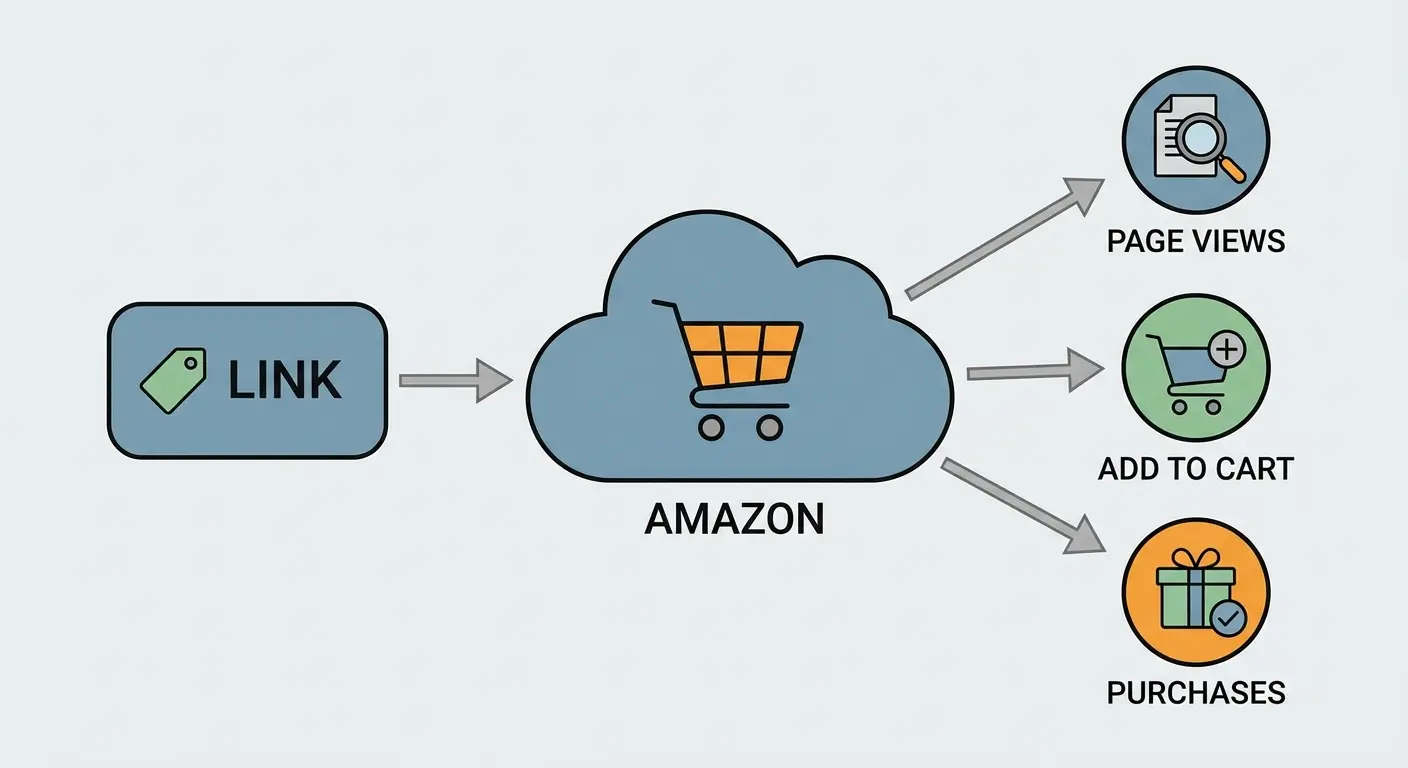
Amazon Attribution works similarly to UTM-style tracking in concept, but the key difference is that Amazon reads the attribution parameters and ties them to shopper behavior it can observe inside Amazon. You’re not installing your own pixel; you’re using Amazon’s measurement layer, with Amazon’s rules and reporting limits.
Here’s the practical flow most seller teams use.
1) Create a tag for a specific traffic source
Inside the Amazon Attribution console (typically accessed through Amazon Advertising), you choose:
Destination: a product detail page (ASIN), an Amazon Store, or other eligible Amazon destinations (availability varies by marketplace and account).
Publisher/channel: for example Google, Facebook/Instagram, TikTok, an influencer, an affiliate placement, or email.
Naming structure: campaign/ad set/creative fields so reporting is usable later.
Operational note: granularity is a tradeoff. If you generate a separate tag for every micro-variant, results become noisy and underpowered. A practical default is to tag at the level where you can actually change decisions: channel + campaign theme, or creator-level for influencer and affiliate work.
2) Place the tagged link wherever the external click happens
That link is what tells Amazon the shopper arrived from a specific external effort. If the external placement uses an untagged Amazon link, you may still get sales, but you lose the ability to measure them inside Amazon Attribution reporting.
Expectation vs. reality:
Expectation: “This will show exactly which ad caused the sale.”
Reality: It shows activity associated with tagged clicks within Amazon’s attribution window and matching logic, which can be affected by device/app behavior, user sign-in state, and other factors outside your control.
3) Amazon records downstream actions tied to that click
After a shopper lands on Amazon via the tagged link, Amazon can report what happens next, such as a product detail page view, add-to-cart, or purchase. Results are then shown by tag so you can compare channels, creators, and campaign angles.
Important nuance: this is Amazon-side measurement, which is valuable because purchases happen on Amazon, but it also means you should treat the data as platform-reported and directional rather than absolute.
4) Use reporting to decide what to scale, pause, or fix

Amazon Attribution is most useful when it drives action:
Which channels deliver high-intent traffic (adds-to-cart per click, detail page views per click)
Which creators or campaign themes produce profitable purchases (revenue per click, purchase rate)
Whether external traffic appears to contribute to new-to-brand behavior, where that metric is available in your account
The goal isn’t to “win” a crediting argument; it’s to improve spend allocation and landing page strategy.
Three realistic ways sellers use Amazon Attribution (hypothetical examples)
Case 1: Influencer traffic that looks organic inside Seller Central

A brand pays three creators to promote the same product with different angles. Without amazon attribution tags, the brand sees a sales lift but can’t reliably connect it to each creator.
With tags:
Creator A: high clicks, low add-to-cart (curiosity traffic)
Creator B: fewer clicks, stronger add-to-cart and purchase rate (message-market fit)
Creator C: decent clicks, weak conversion (audience mismatch)
Decision: shift budget toward Creator B and reuse their positioning in other placements.
Case 2: Google Ads to an Amazon Store vs. directly to a product detail page
A seller sends Google Search traffic to an Amazon Store because it feels like better brand experience, but performance is unclear.
They test two tags:
Tag 1 → Amazon Store
Tag 2 → a best-selling ASIN product detail page (or a tightly relevant collection page if eligible)
They find the product detail page converts better, while the Store generates more browsing with fewer purchases.
Decision: keep Store traffic for branded queries and send higher-intent product queries directly to the most relevant product detail page.
Case 3: Email traffic and the fear of “stealing” credit

A retention team worries that email simply captures repeat buyers who would have purchased anyway. They tag email links and compare tagged results against normal repeat-order patterns and other internal benchmarks.
They find email is most effective during promo windows and less incremental during non-promo weeks.
Decision: focus email on event-based pushes and avoid over-sending when intent is already high.
Mistakes sellers make with Amazon Attribution (even experienced ones)
Confusing attribution reporting with guaranteed ranking impact
Amazon Attribution reports what happens after a tagged click; it does not guarantee that external traffic will improve organic ranking. External traffic can coincide with improved performance signals, but outcomes depend on many factors and shouldn’t be treated as a guaranteed lever.
Treating tags as optional
If agencies, creators, affiliates, or internal teams don’t use the tagged link consistently, the data becomes incomplete. Measurement discipline needs to be part of the channel agreement, not an afterthought.
Tag sprawl that creates tiny sample sizes
Hundreds of tags with low volume can produce misleading conclusions. Start with a small number of tags that match the decisions you can make, then expand only when volume supports it.
Expecting true multi-touch paths
Sellers often want a stitched journey such as “Meta click → Google click → purchase.” Amazon Attribution is best used for evaluating external efforts in a practical, decision-oriented way, but it should not be assumed to deliver full multi-touch customer-journey reconstruction.
Ignoring the landing page effect
Two tags with the same spend can perform very differently based on destination: a parent vs. child variation, a Store vs. a product detail page, or a less relevant ASIN. Poor performance can be a landing page problem, not a channel problem.
Where Amazon Attribution can mislead you (and how to defend against it)

Attribution window and delayed purchases
Purchases don’t always happen immediately, especially in higher-consideration categories. Amazon uses an attribution window for matching downstream actions to tagged clicks, and the exact window and available reporting can vary by program, marketplace, and account.
Defense: don’t judge a channel only by purchases. Track leading indicators like detail page views and add-to-carts, and evaluate results over a time period that matches your buying cycle.
Cross-device and app behavior
If a shopper clicks from mobile social and later buys on desktop or in the Amazon app, matching may not always be complete. Some conversions may be underreported.
Defense: treat results as conservative and focus on consistent directional differences between channels and landing pages.
Redirect chains and parameter loss
Some redirects can strip parameters or change how the shopper lands on Amazon. Link shorteners, influencer “link in bio” tools, and certain tracking layers can interfere if not configured carefully.
Defense: test every link end-to-end and keep redirect chains minimal. If you must use a redirect, confirm the attribution parameters persist through the final Amazon landing page.
Variation switching and parent/child complexity
Shoppers may land on one variation and switch to another on-page. Reporting can reflect the entry point rather than the exact SKU you expected, depending on how your catalog is structured and what Amazon makes visible in reporting.
Defense: interpret results as performance of the landing experience and entry ASIN, and align tags with the destination you actually want to evaluate.
Correlation vs. incrementality
Amazon Attribution can show that purchases occurred after tagged clicks, but it does not, by itself, prove those purchases wouldn’t have happened without the external traffic.
Defense: when incrementality is the real question, use controlled tests where possible (time-boxed on/off tests, geo splits, or stable-budget experiments) and keep other variables as consistent as you can.
Practical reminders to keep attribution clean
Use amazon attribution tags consistently across every external placement you want to evaluate.
Tag at an actionable level (channel, campaign theme, creator), not every micro-variant.
Treat destination selection as part of the experiment, not a fixed constant.
Use purchases for profitability decisions, but watch add-to-cart and detail page views for early signal.
Validate technical setup (redirects, link tools, app handoffs) before trusting the numbers.
Use amazon attribution to decide where to spend next, not just to justify spend already made.
If you share your traffic mix (Google Search, Meta prospecting, affiliates, email) and whether you’re sending shoppers to product detail pages or an Amazon Store, you can build a tag structure that stays readable and still answers the questions you actually make decisions from.