Amazon CTR Playbook: Benchmarks, Placement, Profit

Sarah Johnson
Amazon CTR: The Operator’s Playbook for Amazon Click Through Rate (and the Only “Good” Benchmark That Matters)
A few years back, I watched a smart seller torch a perfectly healthy product because he panicked over amazon ctr.
His Sponsored Products were sitting at what he called a “terrible” click-through rate. So he rebuilt the main image three times, rewrote the title twice, and kept “optimizing” until the listing looked like a ransom note. CTR went up a bit. Sales didn’t. TACoS got worse. Reviews slowed down. He didn’t have a CTR problem—he had a decision-making problem.
Here’s the simple version: amazon click through rate is useful, but it’s easy to worship the wrong number.
This is the operator playbook I use to keep CTR in its place—important, but not in charge.
First, keep the definition short: what Amazon CTR actually measures
Amazon CTR (click-through rate) is clicks ÷ impressions. That’s it.
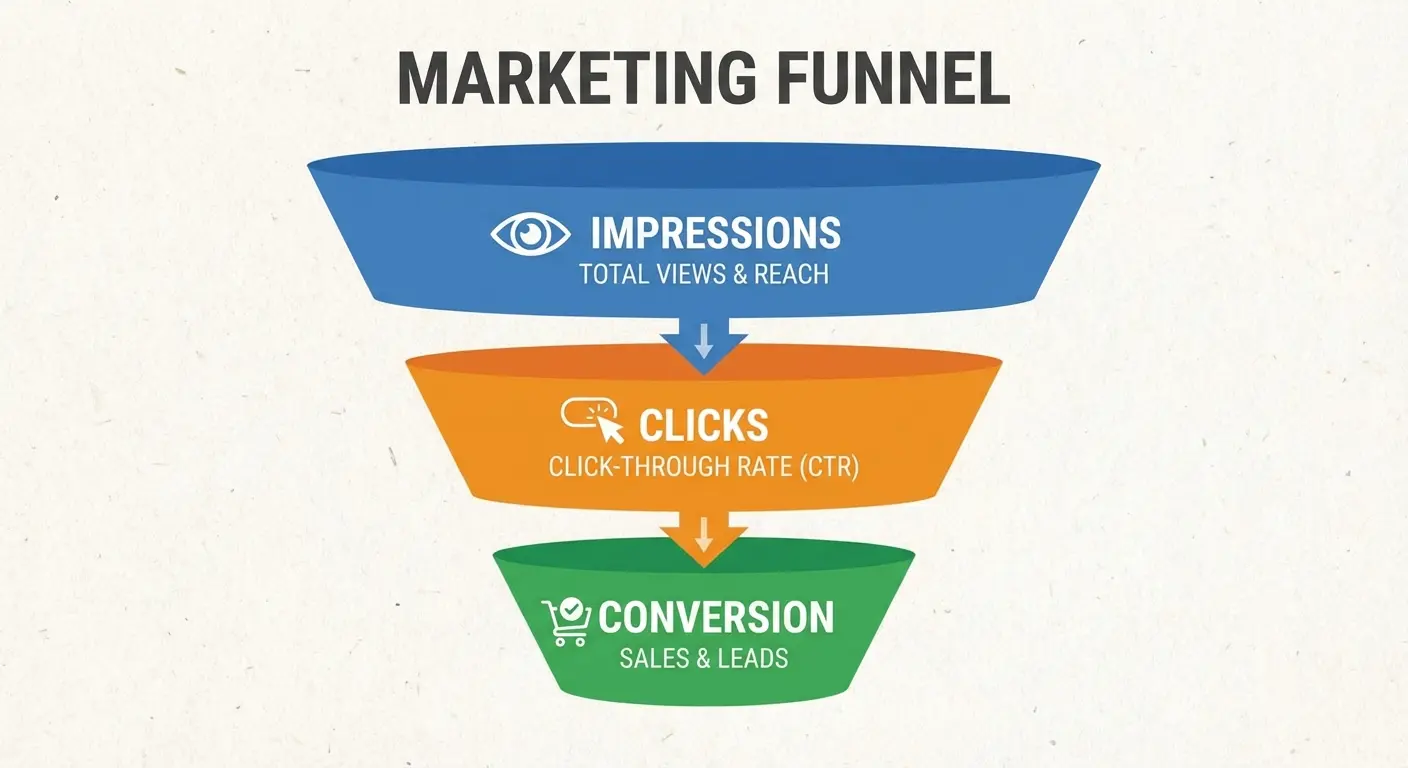
Impressions: how often your ad was shown. (For organic placements, Amazon doesn’t give sellers a universal “impressions” number in the same way, so CTR there is usually inferred from tools like Brand Analytics, Search Query Performance, or tests—not a single, consistent CTR metric across all listings.)
Clicks: how often shoppers chose to click after seeing you.
CTR answers one question: “When shoppers see me, do they choose me?”
It does not tell you:
whether they’ll buy,
whether your price is right,
whether your reviews are strong enough,
whether you’re profitable.
CTR is the “door opening.” Conversion is “money on the counter.”
Expectation vs Reality #1: “High CTR means I’m winning”
Expectation: High CTR = listing is great, sales will follow. Reality: High CTR can mean you’re tempting, not trustworthy.

A high CTR with low conversion is often a mismatch:
The main image/title implies one thing
The detail page delivers another (price shock, weak reviews, unclear variation structure, missing critical info, weak merchandising)
You can also get low-quality clicks from broad targeting, loosely related keywords, or auto campaigns casting too wide a net.
Operator rule: If CTR is high but conversion is weak, don’t celebrate. Tighten relevance and/or fix the detail page so it fulfills the promise made on the search results page.
The question everyone asks: what is a good click through rate amazon?
You asked the right question, but in the wrong form.
There isn’t one “good” number that travels across:
categories,
price points,
seasons,
placements (top of search vs rest of search),
traffic type (brand vs non-brand),
ad type (Sponsored Products vs Sponsored Brands),
device mix (mobile vs desktop).
So here’s the only benchmark that matters:
A “good” CTR is one that supports profitable sales at your current position and targeting.
Sellers still need a way to sanity-check without lying to themselves, so use relative benchmarks instead of internet averages.
Use relative benchmarks you can actually trust
Compare CTR against: 1) Your own history (same ASIN, same campaign type, similar placement mix) 2) Your peer ASINs (if you run multiple products in the same niche) 3) Your keyword segments (brand vs non-brand; exact vs phrase; proven terms vs exploration terms)
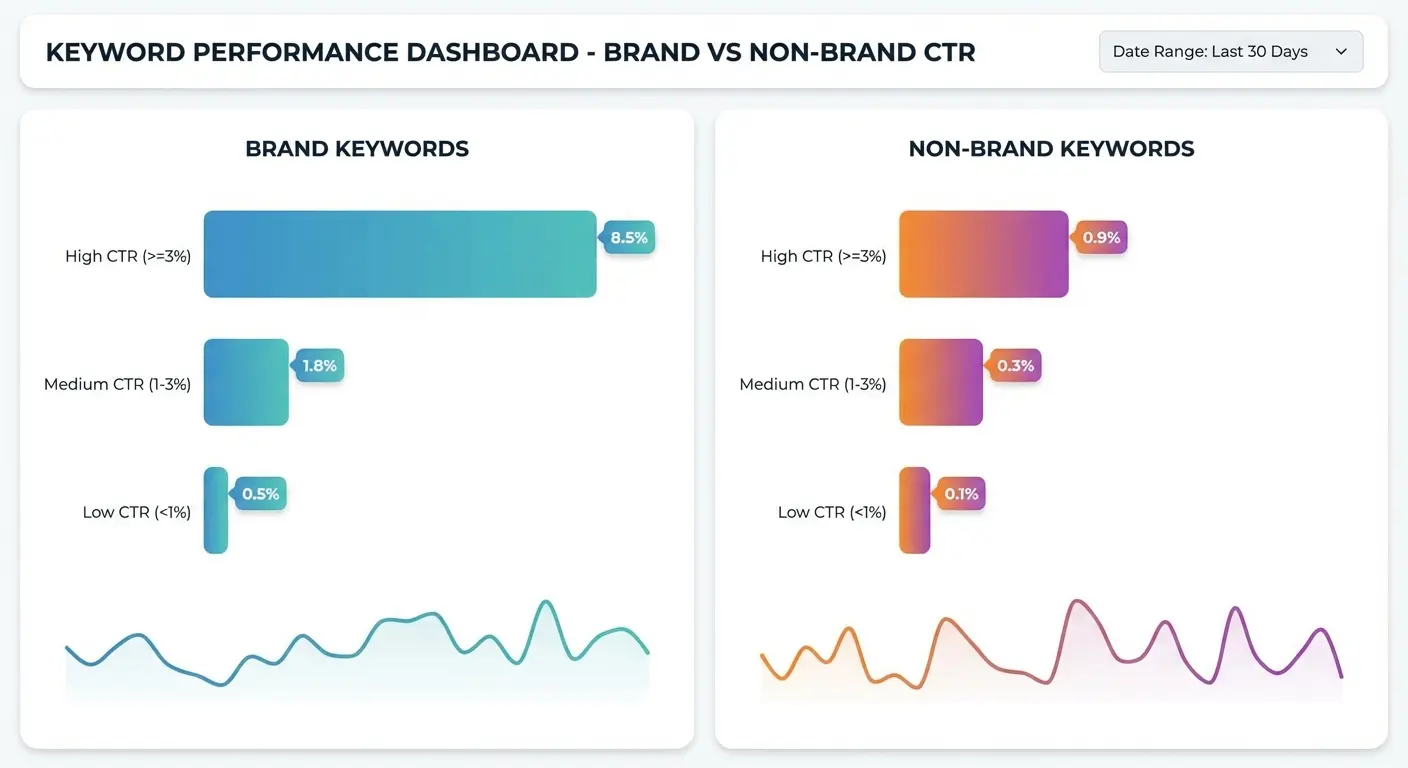
As a practical anchor, non-brand terms typically generate lower CTR than brand terms, and top-of-search CTR tends to behave differently than rest-of-search. That’s normal—and it’s why blended campaign averages are often the wrong “benchmark.”
The metric stack: where CTR sits (and where it doesn’t)
When diagnosing performance, treat metrics like a funnel with pressure points:
Impressions (eligibility, bids, budgets, indexing, competition)
CTR (search results choice)
CVR (detail page trust + offer strength)
AOV / profit / TACoS (business health)
CTR is the bridge between visibility and sales. It’s not the destination.
Peace-of-mind move: Stop making big changes because of CTR alone. Require at least one supporting signal (conversion rate, CPC movement, search term quality, or a meaningful change in placement mix).
Expectation vs Reality #2: “My CTR dropped, so my listing got worse”
Expectation: CTR down = creatives/listing are failing. Reality: CTR down often means your traffic changed.
Common real-world causes:
You expanded targeting (auto/phrase/broad) and started showing on less-relevant terms
Your placement mix shifted (more “rest of search,” fewer premium placements)
Competitors got more aggressive with price, coupons, or other promotions
Seasonality changed shopper intent
The fastest way to avoid a fake diagnosis
Break CTR down by:
Search term (not just campaign-level averages)
Match type (exact vs phrase vs broad)
Placement (top of search vs product pages vs rest of search)
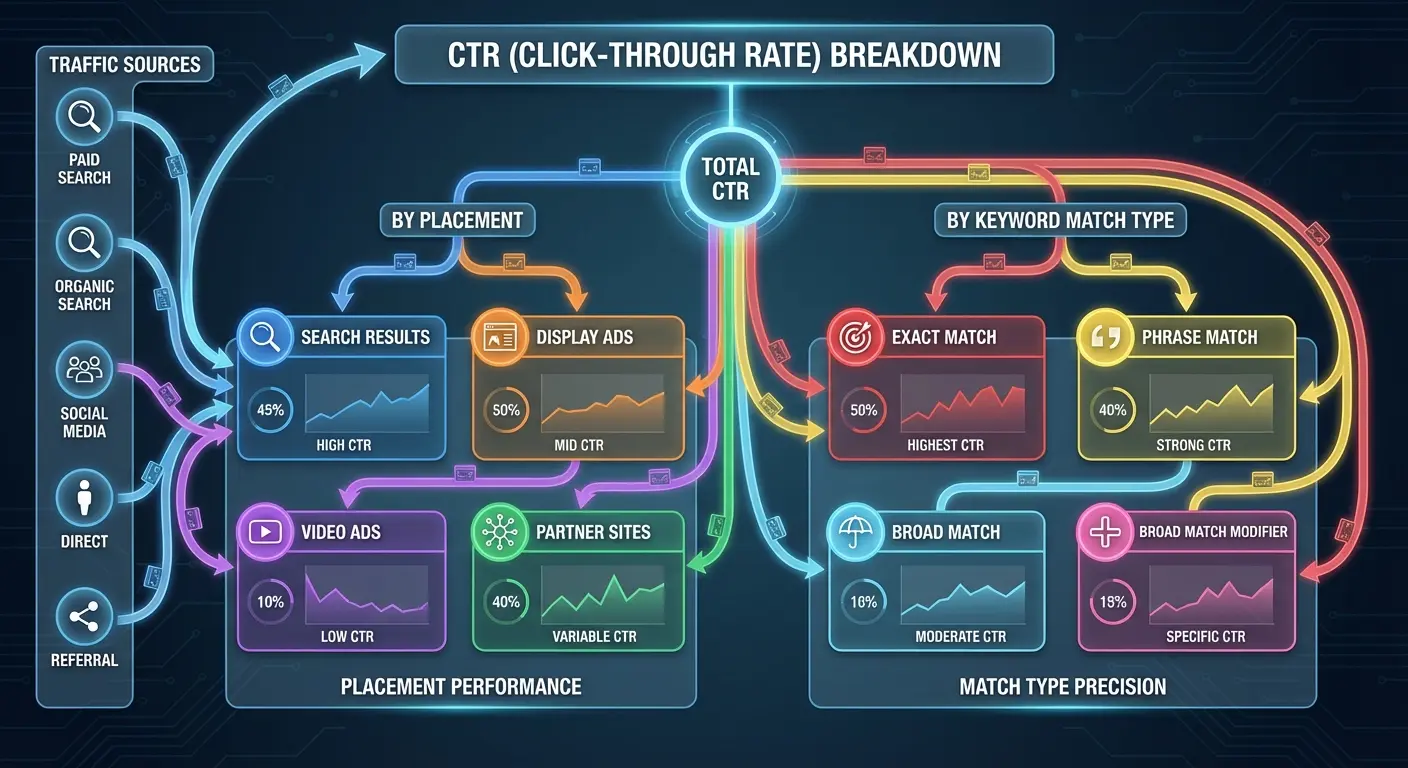
If overall CTR is down but your best exact terms are stable, the listing may not be the problem. The expansion strategy probably is.
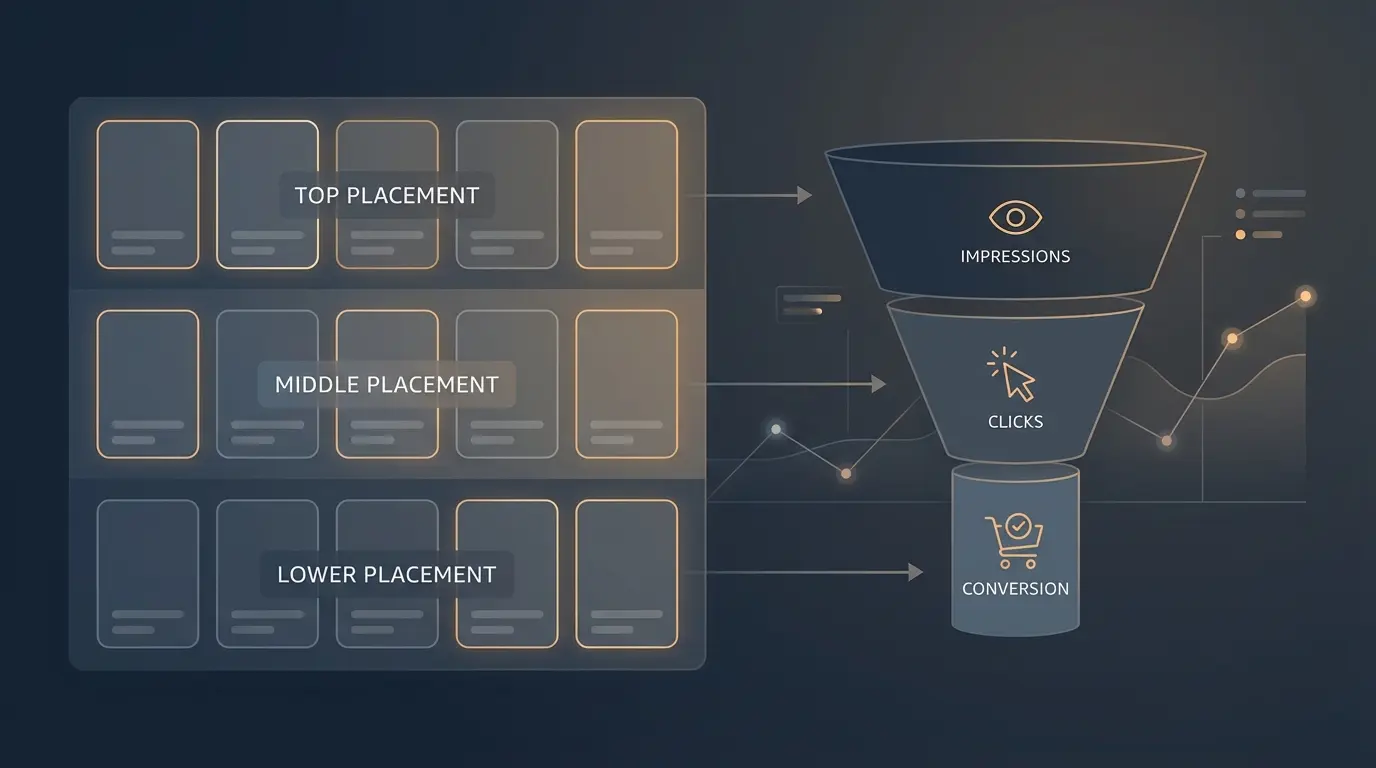
The lever most sellers ignore: placement is a different game
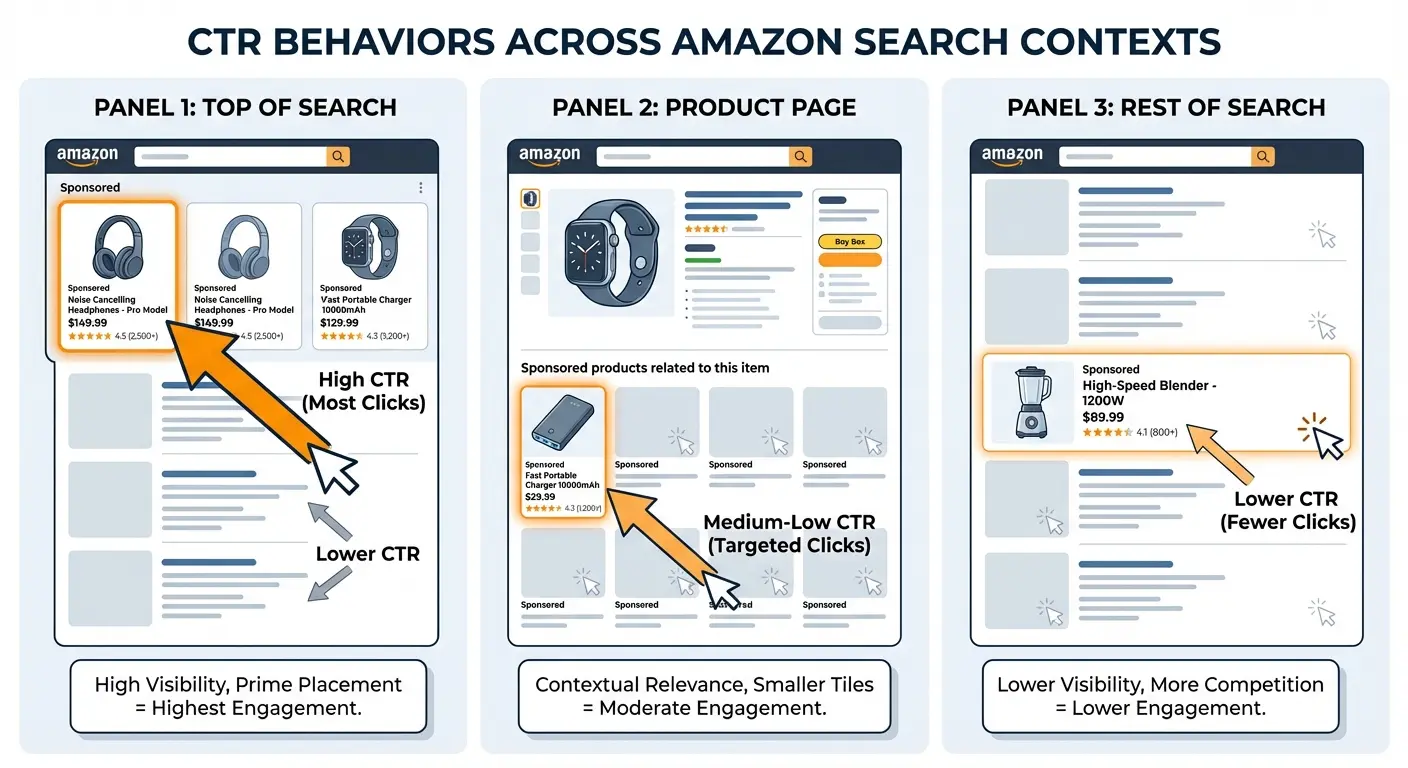
CTR isn’t one behavior. It’s several behaviors disguised as one number.
Top of Search: shoppers are comparing. CTR is strongly influenced by main image clarity, price, rating, review count, and visible offer signals (Prime eligibility, coupon badge when applicable).
Product Pages: shoppers are browsing alternatives. CTR often depends on price gap, review count, and whether you look like a safe substitute.
Rest of Search: a lot of drive-by visibility. Expect lower CTR—don’t panic.
Operator insight (decision rule): If CTR is weak only on top of search, the issue is often competitive packaging (image, price positioning, rating/reviews, offer signals). If CTR is weak everywhere, the issue is often relevance (keyword targeting, product/keyword mismatch, or poorly controlled expansion).
What actually moves CTR without breaking your business
You don’t “hack” CTR. You make the search result tile do its job.
1) Main image: clarity beats creativity
Your main image should answer, in half a second:
What is it?
What size/quantity is it?
What makes it distinct?
CTR improvements often come from removing confusion, not adding flair. If shoppers have to think, they scroll.
Stay inside Amazon policy and common enforcement patterns: avoid misleading imagery, inaccurate implied quantities, unapproved claims, or bundle-style visuals that don’t match what the shopper receives. When in doubt, choose a conservative, accurate representation.
2) Price and offer structure (often the biggest CTR lever)
People click when the math feels safe.
Even without changing your base price, offer structure influences CTR:
coupon badge visibility (when a coupon is active and displayed)
Prime eligibility and delivery promise
variation price spread (a low-priced variation can pull clicks that don’t convert)
shipping cost visibility where applicable
Gotcha: A low-priced variation can lift CTR and crush conversion if shoppers land on the wrong option or feel bait-and-switched. That’s not “bad shoppers.” That’s offer design and variation hygiene.
3) Title: front-load what matters in the search result
In the search tile, the title does two jobs:
confirm relevance (“yes, this is what I searched for”)
signal fit (“this is the size/material/version I want”)
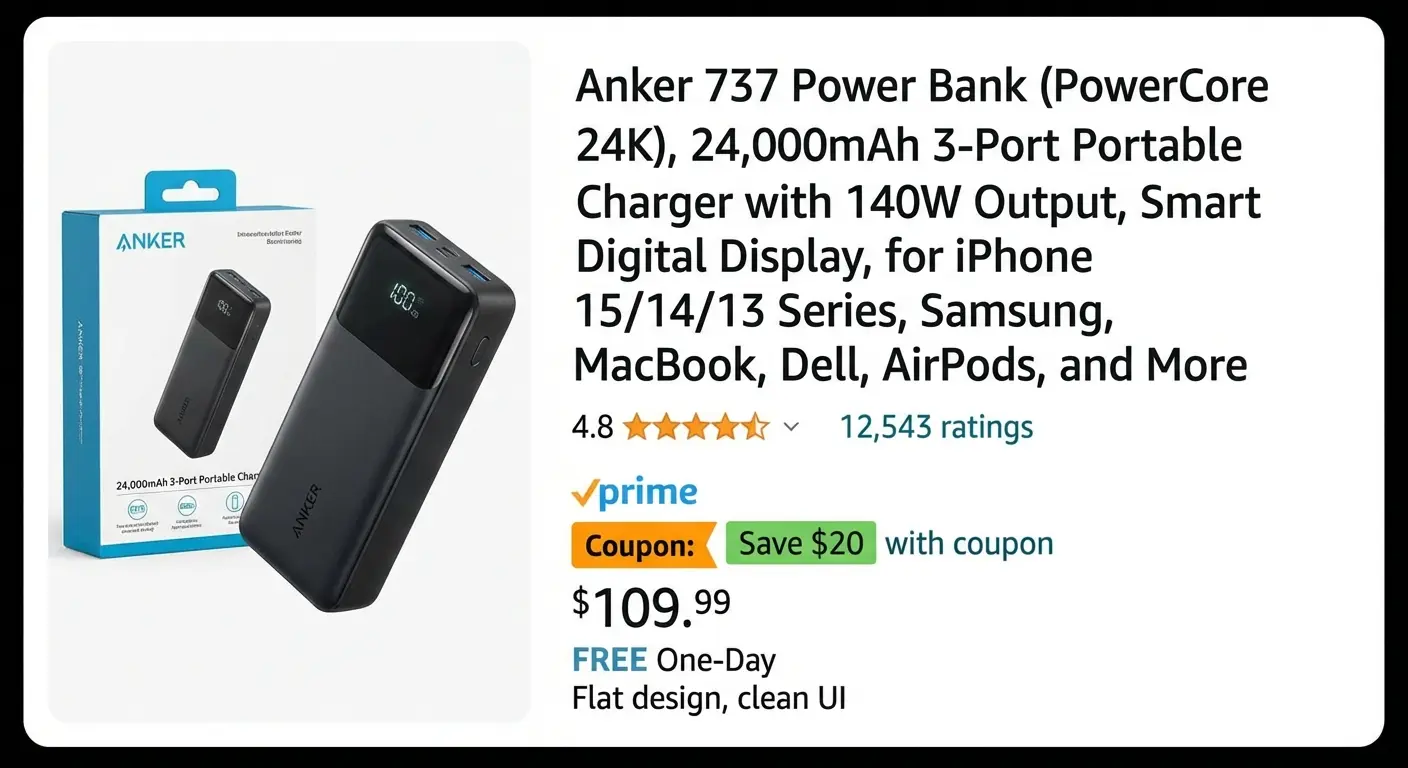
Front-load the differentiator that reduces return risk (size, count, compatibility, material, model fit). Keep it readable and accurate; Amazon’s style guidance and category rules can constrain what you can include and how it’s formatted.
4) Ratings and review count: CTR isn’t separate from trust
CTR is trust at a glance. Ratings aren’t just conversion assets—they’re click assets.
If you’re at a rating disadvantage, you can still win clicks with:
a clear main image
a clean, specific title
a compelling offer structure (without racing to the bottom)
But don’t expect CTR to override trust forever. Sometimes the correct move is to protect margin and let the listing mature instead of paying for attention you can’t yet convert.
Expectation vs Reality #3: “Fix CTR first, then conversion”
Expectation: CTR is upstream, so always fix it first. Reality: Sometimes you shouldn’t chase CTR.
When not to chase CTR
You’re already converting well from the clicks you get
Your bottleneck is impressions (ranking, indexing, bids, budget)
Your clicks are expensive and you need to protect profitability
Your category is research-heavy and shoppers click fewer listings before deciding
When CTR is worth your attention
You have plenty of impressions but weak clicks on relevant exact terms
You’re in premium placements and still not getting chosen
Your main image/price/reviews are clearly out of step with competing tiles
Operator rule: If you’re profitable, don’t optimize yourself into chaos. Improve CTR only when it’s the limiting factor—not when it’s merely imperfect.
A simple CTR diagnostic checklist (the one I’d actually use)
Use this sequence so you don’t treat symptoms as causes:
1) Is CTR weak on your best exact keywords?
If no: stop obsessing. Expansion traffic is dragging averages.
2) Is CTR weak mainly in top of search?
If yes: focus on tile competitiveness (main image, price positioning, rating/review strength, coupon visibility if used).
3) Is CTR weak across placements and terms?
If yes: relevance/indexing/targeting issue. Tighten targeting, clean up keyword mapping, confirm the listing matches the query intent.
4) Did conversion also drop?
If yes: something in the offer, detail page, or competitive set likely shifted. Audit price, promotion strategy, variation structure, and the on-page value proof.
5) Did CPC jump while CTR fell?
If yes: you’re paying more to be ignored. Reduce exposure on weak terms, reallocate budget to proven queries, and rebuild exploration with controls.
A quick hypothetical so you can see how this plays out
Hypothetical: You sell a mid-priced kitchen accessory.
CTR drops 30% week-over-week
Conversion stays flat
Search term report shows you added broad targeting and auto started picking up loosely related terms
Diagnosis: Not a listing crisis. It’s traffic-quality dilution. Move: Split campaigns—keep exact “money terms” clean, put exploration in a controlled budget bucket, and judge those terms by downstream performance (conversion, ACoS/TACoS contribution), not by blended CTR.
That’s how you keep sanity.
The calm takeaway
amazon ctr is a useful indicator of whether your search result tile and offer are getting chosen. But it’s not a trophy, and it’s not a panic button.
If what is a good click through rate amazon is still the question, ask it like an operator:
Good for which keywords?
Good for which placement?
Good relative to conversion and profit?
Good compared to your own baseline?
Keep CTR in the toolbox. Don’t let it drive the truck.
If you want to pressure-test your situation, separate whether you’re looking at ad CTR (Sponsored Products/Sponsored Brands reporting) or organic click behavior (where available through Amazon reporting). Then compare like with like—same ASIN, similar placements, similar query intent—before you touch the listing.