nIXD (National Inbound Cross Dock) - Amazon Glossary
What is nIXD?
National Inbound Cross Dock (nIXD) is an Amazon fulfillment network node that receives seller inventory at a central facility and redirects it to multiple regional fulfillment centers (FCs) without long-term storage. Rather than routing shipments directly to a single FC, the nIXD acts as a sorting and redistribution hub, enabling Amazon to strategically place inventory closer to end customers across the country.
Why Does nIXD Matter for Amazon Sellers?
Understanding nIXD is essential for sellers using Amazon's Inventory Placement Service or Amazon Warehousing & Distribution (AWD). When your inventory routes through an nIXD node, Amazon controls the downstream distribution - meaning your stock may split across multiple FCs automatically. This directly affects how quickly your listings qualify for Prime delivery badges, which in turn drives conversion rate and Buy Box eligibility. Sellers who ignore nIXD routing often misdiagnose stockout events, delayed replenishment windows, or unexpected stranded inventory as errors, when they are actually expected outcomes of cross-dock redistribution.
How Does nIXD Fit Into Amazon's Fulfillment Network?
The diagram below shows how an nIXD node sits between a seller's shipment origin and Amazon's regional fulfillment centers:
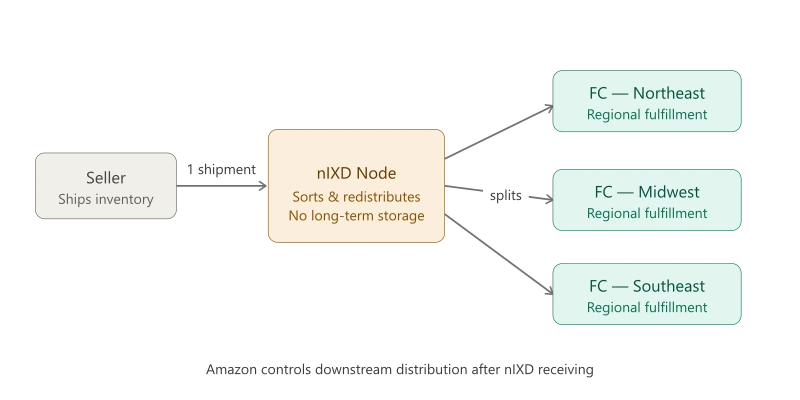
Amazon's fulfillment network uses several node types. The nIXD sits upstream of regional FCs and downstream of the seller's warehouse or prep center.
What Actually Happens at an nIXD Facility?
When your FBA shipment is directed to an nIXD node, the process follows a tight sequence:
Receiving: Your pallet or carton arrives and is scanned into Amazon's system.
Sorting: Units are sorted by ASIN, destination FC, and regional demand signals pulled from Amazon's inventory optimization algorithms.
Cross-docking: Product moves from inbound dock to outbound dock with minimal dwell time - typically 24 to 72 hours, not weeks.
Redistribution: Units ship outbound to two or more regional fulfillment centers, often in split quantities determined by Amazon's placement logic.
The key distinction from a standard FC: no long-term storage occurs. The nIXD is a pass-through node, not a storage node, which is why standard FBA storage fees do not apply while inventory is in transit through it.
Is There a Formula for nIXD Cost Impact?
The nIXD itself does not carry a separately published per-unit fee in the way that fulfillment fees or storage fees do. However, the total landed cost impact of routing through an nIXD node can be expressed as:
$$Total Inbound Cost=Shipping to nIXD+Amazon Placement Fee (if applicable)+Downstream FC Transfer Cost (Amazon-absorbed)\text{Total Inbound Cost} = \text{Shipping to nIXD} + \text{Amazon Placement Fee (if applicable)} + \text{Downstream FC Transfer Cost (Amazon-absorbed)}$$
For sellers using Inventory Placement Service (IPS) to send all units to a single node (which often resolves to an nIXD), Amazon may charge a per-unit placement fee depending on the program terms and product size tier. If using Distributed Inventory Placement, the seller absorbs the cost of shipping to multiple FCs directly, bypassing the nIXD route.
In Practice: A Real-World nIXD Scenario
Correct approach: A seller ships 500 units of a lightweight kitchen gadget (under 1 lb, standard size) to Amazon using Inventory Placement Service. Amazon directs the shipment to an nIXD node in Ohio. Within 48 hours, Amazon splits the inventory: 180 units to a New Jersey FC, 170 to a Texas FC, and 150 to a California FC. The seller pays a per-unit placement fee but avoids the logistics complexity of managing three separate inbound shipments. All 500 units become Prime-eligible within 3–5 business days of nIXD receiving.
Common mistake: A seller sees their shipment status show "Received at [nIXD facility code]" and expects all inventory to be immediately available for sale in one location. They panic when units appear across multiple FCs and open a Seller Central case assuming a receiving error. This wastes time and creates confusion - the split is intentional and expected behavior of the nIXD routing model.
How Does nIXD Differ for FBA vs. FBM Sellers?
FBA sellers are the only sellers directly affected by nIXD routing. When you create an FBA shipment plan and opt into Inventory Placement Service, Amazon may route your inventory through an nIXD before final FC placement. This is entirely within Amazon's control once the shipment is accepted.
FBM (Fulfilled by Merchant) sellers have no exposure to nIXD. Since FBM sellers ship directly to customers from their own facilities or third-party logistics (3PL) providers, Amazon's internal fulfillment network - including nIXD nodes - is irrelevant to their operations.
For sellers using Amazon Warehousing & Distribution (AWD), nIXD routing is also relevant: AWD replenishment flows can pass through nIXD nodes before stock is pushed to FBA FCs, creating an additional transit leg that affects replenishment lead time planning.
SoldScope Expert Tip: Track Inbound Transit Time, Not Just "In Stock" Date
Most sellers measure inventory availability by the date Amazon marks units as "Available" in Seller Central. But when nIXD is in the routing path, there is a hidden transit window between "Received at nIXD" and "Available at FC." This gap - typically 1 to 4 days, but sometimes longer during peak periods like Q4 - is not reflected in standard inventory reports.
The non-obvious move: Build a 5–7 day buffer into your reorder point calculation specifically for SKUs that historically route through nIXD nodes. You can identify these by reviewing your Shipment Summary reports in Seller Central and noting which shipments had a receiving facility code that does not match a standard FC code. Sellers who account for this transit buffer avoid the costly stockout window that kills organic rank and Best Seller Rank (BSR) momentum right when it matters most.
Frequently Asked Questions
What is the difference between an nIXD and a standard Amazon fulfillment center? An nIXD (National Inbound Cross Dock) is a sorting and redistribution hub, not a storage facility. Inventory passes through quickly - typically within 24–72 hours - and is then split and sent to multiple regional FCs. A standard FC receives inventory, stores it, and fulfills customer orders directly.
Does shipping to an nIXD cost more than shipping directly to an FC? Not necessarily. If you are using Inventory Placement Service, Amazon charges a per-unit placement fee to manage the redistribution, but you only pay for one inbound shipment. With Distributed Inventory Placement, you avoid the per-unit fee but must ship to multiple FCs yourself, which often costs more in aggregate freight.
Why does my inventory show as received but not available after arriving at an nIXD? This is expected behavior. When Amazon confirms receipt at an nIXD, units are not yet stocked at a fulfillment center. They are in transit to one or more regional FCs. Availability typically updates within 1–5 business days after nIXD receiving, depending on network volume.
Can I choose which FCs my inventory goes to after nIXD routing? No. Once inventory enters the nIXD routing path, Amazon's placement algorithm determines which regional FCs receive units and in what quantities. This is based on demand forecasting, current FC inventory levels, and geographic proximity to customer demand.
How does nIXD routing affect my FBA restock limits or storage utilization? Inventory in transit through an nIXD may temporarily appear under a different status in your inventory reports. It generally does not count against your storage volume limits while in the nIXD facility itself, but sellers should verify current inventory accounting rules in Seller Central, as Amazon updates these policies periodically.
Definitions are aligned with official documentation, professional e-commerce benchmarks, and real marketplace usage across Amazon listings and tools.
Ready to Put Your Knowledge to Use?
Now that you understand the terminology, start using SoldScope to research products, analyze keywords, and grow your Amazon business.
Try for Free