Amazon FBA Cost Control & Margin Guide 2026

Olivia Reyes

Amazon Seller Cost Management in 2026: How to Reduce FBA Storage Fees, Audit Hidden Costs, and Protect Margin
why is my amazon fba profit margin so low when sales are stable, ad performance looks acceptable, and nothing seems obviously broken?
Usually because margin leaks do not show up in one place. They sit across storage, inbound placement, reimbursement gaps, packaging, returns, and PPC decisions that looked reasonable in isolation but expensive in combination. A useful hidden costs of selling on amazon fba guide starts with that reality: most profit erosion is cumulative, not dramatic.

The real margin decision most sellers are making
For experienced sellers, cost control is rarely about “spend less” in the abstract. The actual decision is which costs are structural, which are negotiable, and which are self-inflicted by the way the account is being run.
Amazon seller economics are often driven by interactions, not single line items. A lower inbound placement cost can trade off against different shipment requirements, receiving speed, or operational workload, depending on the program options available in your account at the time. Leaner inventory can reduce storage but also increase stockout risk. Aggressive PPC cuts can improve contribution margin this month while shrinking organic volume next month.
The job is not to chase the cheapest-looking option. It is to decide which configuration produces the most durable profit after second-order effects.
A practical example: sellers looking up how to reduce amazon fba storage fees 2026 often focus only on aged inventory removal. That helps, but storage fees are usually an output of three upstream choices: order cadence, SKU assortment discipline, and how long underperforming variations are allowed to sit before someone updates the demand assumption.
Seller insight: when margin falls unexpectedly, start with costs that compound silently. Storage, placement-related inbound complexity, reimbursement misses, and blended ad spend often deserve review before renegotiating small supplier concessions.
What deserves attention first when profit is under pressure
Start with contribution margin by SKU, not account-level averages
Account-level profitability can hide weak ASINs for months. A handful of winners can subsidize poor inventory decisions elsewhere, which makes the business look healthier than it is.
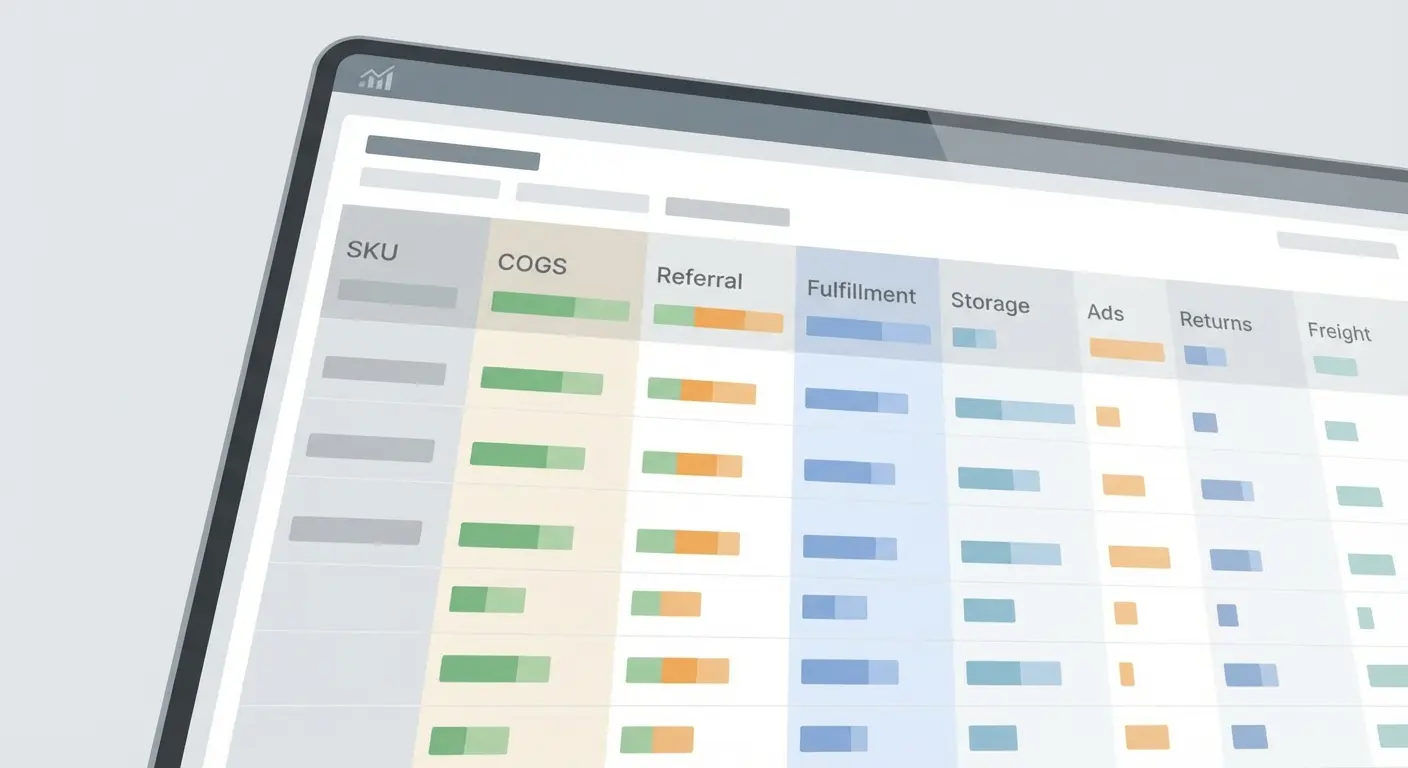
The ranked priority is usually SKU-level contribution margin after referral fees, fulfillment fees, storage impact, ad spend, returns, promos, and freight. If the SKU economics are not clear, every later decision is guesswork.
This is where amazon seller expenses and cogs tracking becomes non-negotiable. Many sellers track landed cost loosely and operational expense broadly, but they do not assign enough of those costs back to the SKU. That is how “profitable” products tie up cash while producing weak net dollars.
Next, separate controllable fees from less controllable fees
Referral fees are generally known by category. FBA fulfillment fees are also more predictable once dimensions and weights are stable. The bigger opportunities tend to come from semi-controllable areas: storage, inbound shipment options and placement-related costs, prep, packaging compliance, removals, returns handling, and certain billing errors.
If you are trying to improve profit quickly, target line items where process changes can actually change the outcome.
This is also why an amazon fba fee calculator for professional sellers is only useful if it goes beyond the standard visible fees. A serious model should account for expected storage burden, inbound costs, return rate assumptions, promo rate, and ad-to-organic dependency. Otherwise it can produce a clean-looking number that does not match operational reality.
Then review inventory age before ad efficiency
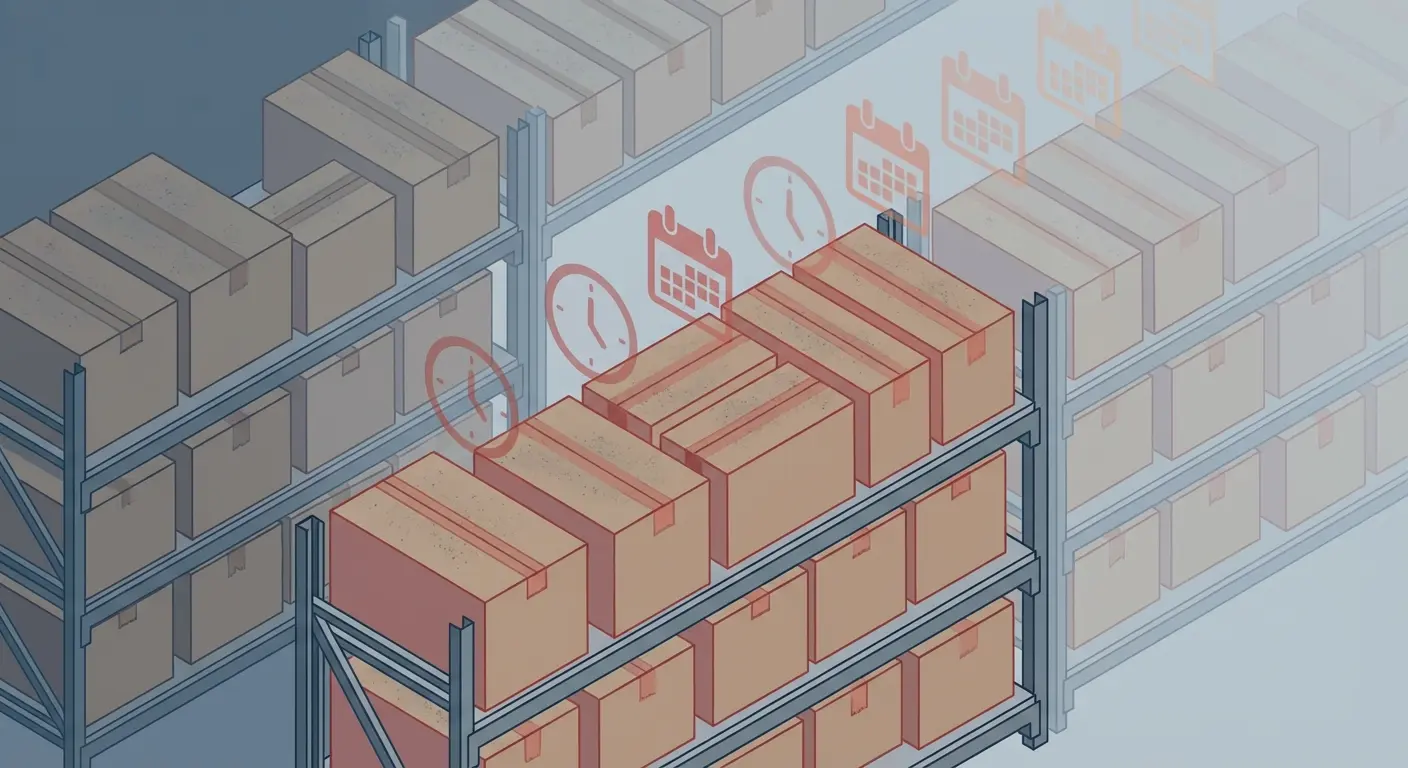
A lot of sellers jump straight to PPC because it is visible and easy to change. Inventory age often matters more. If stock is aging, you are paying for a forecasting mistake every month. Ads may be masking the problem, not solving it.
This is especially important when evaluating handling amazon fba long term storage fees. The wrong response is to keep supporting stale inventory with broad PPC just to delay a write-down. If the product is not recovering, the better decision may be to liquidate, remove, bundle, or relaunch with a different positioning strategy, based on what your brand and category can support.
Finally, look at overhead that grew quietly with the business
As brands scale, operating expense creeps in through software, agencies, VAs, prep complexity, warehouse touches, and internal labor dedicated to fixing avoidable issues. Your amazon seller overhead expenses checklist should include anything that exists because Amazon operations are messy, not because it directly creates profitable demand.
That distinction matters. Good overhead increases control or throughput. Bad overhead compensates for avoidable process failure.
Where the biggest cost decisions usually live
Storage is less about fees and more about inventory design
If a seller asks how to reduce amazon fba storage fees 2026, the answer is rarely “send less inventory” as a blanket rule. The better question is whether inventory depth matches demand variability, replenishment lead time, and the cost of a stockout.
Expectation vs reality:
Expectation: More units at FBA creates stability. Reality: Excess FBA depth can hide weak forecasting, create aged inventory risk, and reduce pricing flexibility.
A reliable pattern is to hold more inventory upstream when possible, push less into FBA when demand is uncertain, and keep ASIN-level reorder logic tied to lead time and sales volatility, not a fixed weeks-of-cover target applied to the whole catalog.
Placement costs versus fulfillment economics need to be judged together
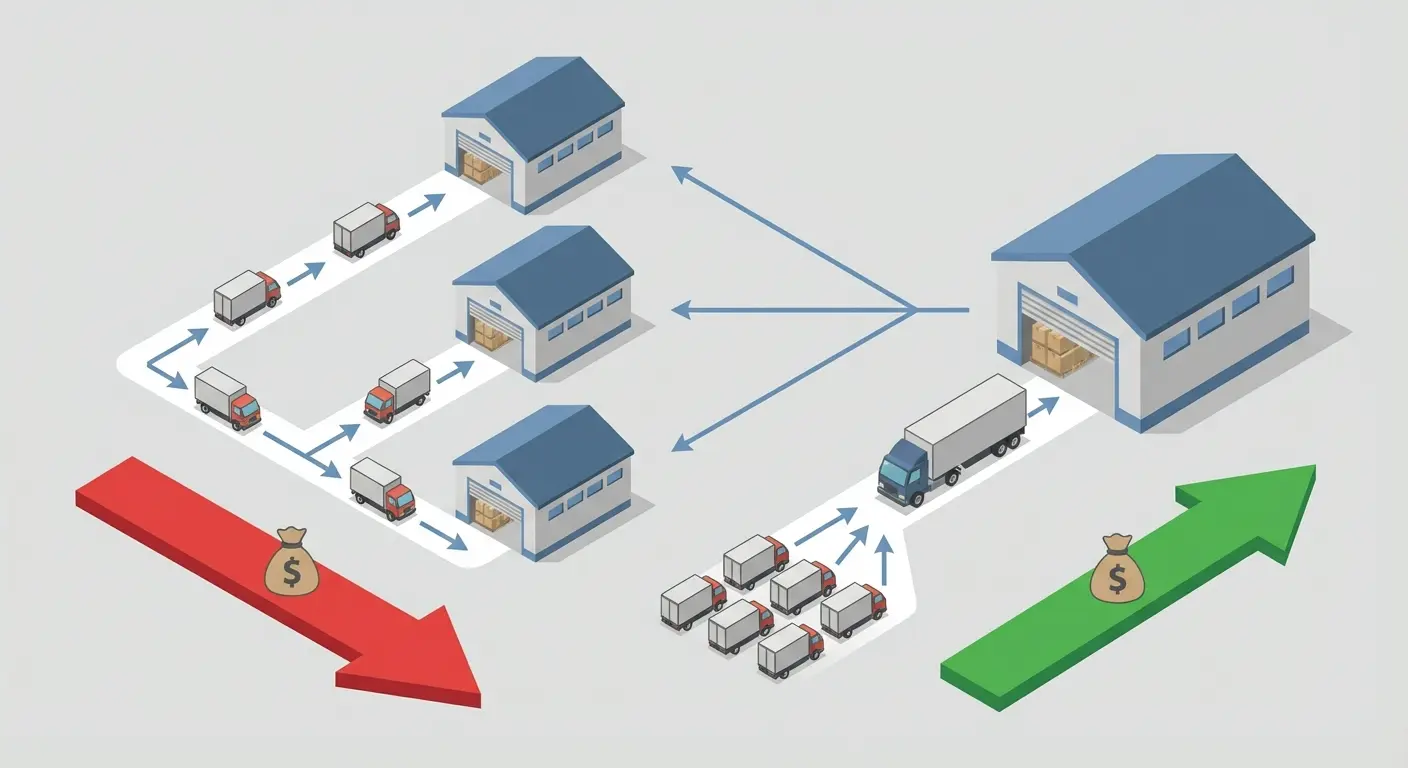
The amazon inventory placement fee vs fulfillment fee question is often framed too narrowly. Sellers compare one fee line to another without modeling labor, inbound freight, receiving delays, and regional stock positioning.
In some catalogs, paying a placement-related cost can be rational if it simplifies prep, improves speed to check-in, or reduces your own logistics handling. In others, optimizing shipment splits and carton plans can save enough per unit to matter materially.
The mistake is assuming the cheapest invoice line creates the cheapest delivered unit. It often does not.
Fulfillment savings are often packaging and dimension problems in disguise
When sellers focus on reducing amazon fulfillment and shipping costs, the highest-leverage move is often dimensional discipline. Small packaging changes can affect size tier, dimensional weight, carton efficiency, and prep requirements.
Packaging engineering often produces cleaner savings than aggressive pricing or ad cuts. If a product sits near a fee threshold, remeasuring the actual product-packaging stack and validating what is in Seller Central can be worth more than most listing tweaks.

PPC should be judged against total margin, not campaign vanity
Experienced sellers know this, but it still gets ignored in practice. managing amazon ppc spend vs organic profit is not only about lowering ACOS. It is about understanding whether advertising is creating incremental total profit or taxing demand that would have arrived anyway.
A SKU with acceptable campaign metrics can still be margin-destructive if ad dependence is too high relative to contribution profit. Likewise, a SKU with worse-looking ad efficiency may still be healthy if ads are supporting ranking and blended profitability.
A cleaner lens is TACoS trend plus SKU contribution margin. If TACoS improves because you cut discovery spend and organic falls weeks later, the short-term win was expensive.
How different seller situations change the right answer
If cash is tight but demand is healthy
In this case, the temptation is to cut all discretionary spend, especially ads and inbound complexity. Sometimes that works, but often the better move is to shrink working capital trapped in low-turn SKUs first.
That means pruning variation depth, accelerating liquidation decisions, and moving toward tighter reorder discipline. A seller in this situation should also review amazon seller expenses and cogs tracking carefully because inaccurate landed cost can lead to reordering products that are only “gross margin positive” on paper.
If sales are stable but net profit keeps slipping
This is the classic hidden-loss scenario. It often points to fee creep, return drift, packaging changes, or catalog mix shift rather than demand weakness.
Here, how to audit amazon fba fees for overcharges becomes highly relevant. Fee audits are not only about reimbursements for lost and damaged inventory. They can also catch dimensional misclassification, incorrect weight assumptions, and inventory reconciliation discrepancies that quietly reduce net margin. Not every discrepancy is recoverable, and outcomes can depend on policy requirements, documentation, and timeliness, but enough issues can be worth finding.
If inventory turns are slowing after a growth phase
A lot of brands overbuy after a strong period, then discover that the next cycle normalizes while purchase orders are already committed. In that scenario, pushing harder on PPC can make the problem worse if demand is not truly there.
Better options often include assortment reduction, better variant rationalization, price architecture changes, and reallocating ad spend only to SKUs with proven post-ad margin. This is also the point where handling amazon fba long term storage fees should become an active operating process, not an occasional cleanup project.
If margins are thin because the product is physically inefficient
Some catalogs are simply expensive to move and store. Heavy, bulky, fragile, or prep-sensitive products can work on Amazon, but they require tighter operational engineering than many standard-size products.
In that situation, the biggest opportunity often sits in packaging redesign, prep simplification, shipment planning, and carton efficiency. Sellers searching for reducing amazon fulfillment and shipping costs often underestimate how much of that battle is won before the product ever reaches FBA.
Common ways sellers make the problem worse
Using one blended margin target across the catalog
A blended target sounds disciplined but can produce bad SKU decisions. It allows weak products to survive because the account average still looks acceptable.
The fix is not more reporting. It is better reporting. Each SKU should earn its right to stay in the catalog based on net dollars, capital efficiency, and operational burden, not just revenue share.
Treating FBA fees as fixed and unauditable
Many sellers accept fee outputs as immutable. That is risky. If you are not periodically checking dimensions, weights, and billed fees against reality, you are assuming the system is always correct.
A proper process for how to audit amazon fba fees for overcharges includes verifying current size tier inputs, checking reimbursement cases, reconciling lost or damaged units, and reviewing return-related anomalies. Not every discrepancy is recoverable, but enough can be worth investigating.
Confusing high sales with healthy unit economics
Revenue growth can hide poor unit contribution for a long time, especially when ad-attributed sales are rising. This is why why is my amazon fba profit margin so low is often answered with “because the account optimized for volume before it optimized for net.”
The anti-pattern is scaling a SKU before fully understanding all-in costs after returns, discounts, and ad support. Once volume grows, those mistakes become harder to reverse.
Letting ad budgets compensate for assortment problems
Ads are often used to support too many weak ASINs at once. That spreads data thin, delays learning, and keeps stale products alive longer than they deserve.
A better pattern for managing amazon ppc spend vs organic profit is to consolidate budget around SKUs that can hold margin after accounting for organic halo, and reduce support for products that need constant ad subsidy without ranking durability.
Two short margin walkthroughs
Walkthrough one: the “growing but poorer” standard-size brand
Hypothetical case: a seller has stable revenue, rising ad spend, and lower profit than last year. Nothing seems broken at the account level.
On review, the issue is not one major fee increase. The margin leak comes from three interacting factors: too much FBA stock on slower variants, growing storage burden, and PPC still supporting those same variants despite low post-ad contribution.
The right move is not an account-wide ad cut. It is variant rationalization, tighter replenishment rules, and moving ad support toward proven winners. A fee audit also checks whether dimensions and billed fulfillment logic are accurate. This is a classic ways to improve amazon business profitability scenario where operational pruning beats tactical optimization.
Walkthrough two: the bulky-item seller chasing lower fees
Hypothetical case: a seller wants to reduce per-unit costs and is focused on the amazon inventory placement fee vs fulfillment fee tradeoff.
A quick model shows placement-related costs matter, but packaging and compliance status can matter more. The product is near a dimensional threshold, and current packaging also creates extra handling cost. Fixing packaging can improve fulfillment economics more than optimizing inbound routing alone.
In this case, the smartest sequence is packaging review first, placement strategy second, and PPC changes last. The seller was looking in the right area, but at the wrong layer.
What usually improves profit fastest
If you want a workable rule set, use this:
Build SKU-level profitability that includes COGS, freight, referral, fulfillment, storage burden, ad spend, promo impact, and expected returns.
Treat amazon seller expenses and cogs tracking as an operating system, not a bookkeeping task.
Review aged and slow-moving inventory before making broad PPC cuts.
Use an amazon fba fee calculator for professional sellers that reflects operational reality, not just visible fees.
Run periodic checks for how to audit amazon fba fees for overcharges, including reimbursements and dimension accuracy.
Compare amazon inventory placement fee vs fulfillment fee in the context of labor, inbound freight, receiving speed, and packaging complexity.
If you are focused on reducing amazon fulfillment and shipping costs, inspect packaging and size-tier exposure first.
Approach managing amazon ppc spend vs organic profit with TACoS and contribution margin, not campaign metrics alone.
Keep an active process for handling amazon fba long term storage fees so old inventory does not become a recurring tax on forecasting mistakes.
Use an amazon seller overhead expenses checklist to identify costs that exist only because processes are inefficient.
If the question is why is my amazon fba profit margin so low, assume multiple small leaks before assuming one big cause.
The most reliable ways to improve amazon business profitability are usually operational: better SKU pruning, tighter inventory flow, better packaging, cleaner fee audits, and more disciplined ad allocation.
Most sellers do not have a revenue problem first. They have a cost visibility problem, then an allocation problem, then a discipline problem. Fix those in that order, and margin becomes easier to defend.