Amazon PPC Optimization Strategies for 2026

Sarah Johnson

Amazon PPC Optimization Strategies 2026: Cutting Waste Without Slowing Growth

Is your account actually overspending, or are you cutting bids on terms that may be contributing to ranking or customer acquisition in ways your current reporting does not fully capture?
That distinction sits at the center of most amazon ppc optimization strategies 2026 discussions. Experienced sellers rarely lose margin because they lack reports. They usually lose it because they react to ACoS in isolation, suppress useful discovery traffic, or scale campaigns that look efficient only because they are under-delivering. If the real goal is how to lower acos on amazon sponsored products while protecting total profit and organic visibility, the task is less about "optimizing ads" and more about separating waste from strategic spend.
What is really being decided inside a PPC account
Most PPC decisions are not about whether a keyword is good or bad. They are about role, timing, and replacement cost.
A search term with weak direct ACoS may still be acceptable if it helps acquire relevant traffic, supports organic visibility on a core query, or converts well in one placement but poorly in another. A term with strong ACoS may still be a weak scaling candidate if impression volume is thin, the listing cannot convert broader traffic, or the campaign is not reaching enough demand to matter.
This is why reducing wasted ad spend on amazon fba ppc starts with a narrower question: where is spend failing without producing either immediate profit or a clear strategic upside? In practice, that usually means evaluating four layers together:
search term economics
campaign structure
bid and placement behavior
account-level contribution, including TACoS and inventory realities

The same logic matters for fixing high tacos on amazon private label. High TACoS is not always a PPC problem. It can reflect weak conversion rate, poor pricing, seasonality, stock constraints, or catalog sprawl. If ad spend is driving gross sales but organic sales are not keeping pace, the issue may be traffic quality or retail readiness. If ad spend is flat and TACoS rises, the issue may be declining total revenue rather than runaway advertising.
A useful operating rule is to treat ACoS as an advertising efficiency metric and TACoS as a broader business signal. They answer different questions, and confusing them often leads to bad decisions.
What deserves the most weight when deciding what to change
Search term outcome matters more than campaign averages
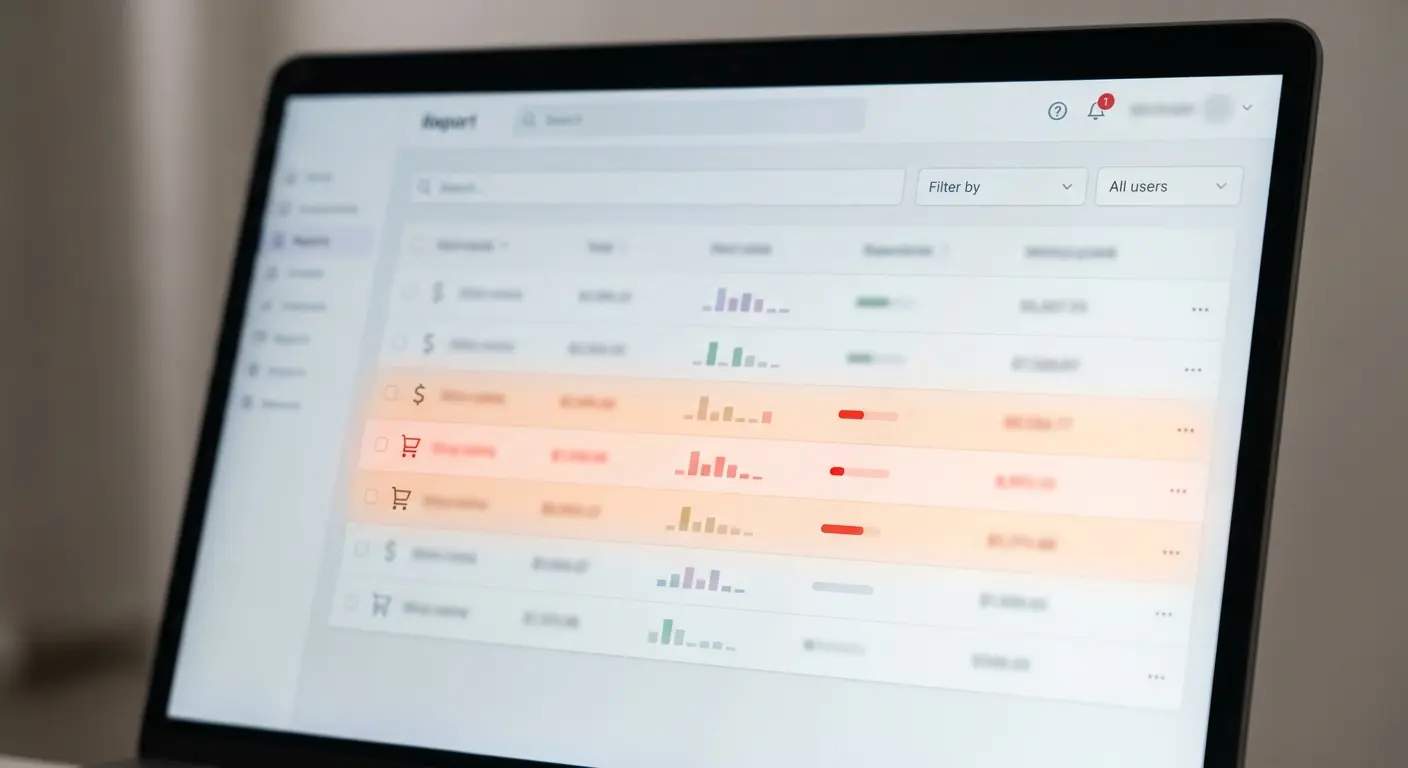
Campaign-level metrics hide useful detail. A campaign can look healthy while a handful of terms consume most of the waste, or look unhealthy while one or two terms are doing useful discovery work. Search term analysis remains the best starting point if the goal is how to find negative keywords in search term report data without over-pruning.
The strongest negative candidates tend to share one of two patterns: meaningful spend with no attributed orders, or poor conversion economics across enough clicks to suggest low relevance. The caveat matters. A term with high spend and several orders is not automatically waste. It may simply need lower bids, better placement control, or a separate campaign.
Bid control usually beats budget control
When sellers see overspend, they often lower campaign budgets first. That can reduce daily spend, but it rarely fixes the underlying problem. It also forces profitable and unprofitable traffic to compete inside a smaller cap.
If a campaign is expensive because bids are too high, the budget is not the root cause. If a campaign is profitable but under-spending, budget can become the limiting factor. Those are opposite situations, and the fix should reflect that.
Placement behavior can change the economics of the same keyword
Many accounts treat a keyword as one performance unit, but Amazon does not price or convert every placement equally. A term can lose money on product pages and work well at top of search. Before pausing or negating, it is worth checking whether the problem is the keyword itself or where Amazon is serving it.
This becomes more relevant in competitive niches, where amazon ppc bidding strategy for competitive niches is often less about pushing bids higher everywhere and more about selectively paying for placements that convert well enough to justify the auction.
Listing quality still constrains advertising outcomes
PPC can amplify demand capture. It does not repair weak conversion economics. If click-through rate is acceptable but conversion lags category expectations, higher bids usually magnify waste. That matters for optimizing amazon ads for rufus ai search as well. Amazon has introduced AI shopping features, including Rufus, and sellers should expect product relevance, content clarity, and customer signals to matter. Public guidance from Amazon does not provide a separate ad format built specifically for Rufus, so the safer assumption is that better listing quality and clearer query coverage improve the odds that ads and product detail pages perform well in AI-assisted shopping contexts.
The practical implication is simple: if the listing does not answer the shopper's intent clearly, paid traffic usually gets more expensive over time.

Account access and operating model matter more than sellers admit
This is less glamorous than bid strategy, but it matters. If an agency or contractor is involved, access design affects both performance and risk. safe access for ppc agencies should allow operational execution without handing over unnecessary control over unrelated business assets. Sellers often underestimate this until reporting breaks, permissions become tangled, or no one can identify who changed what.
Where different account situations call for different choices
Most accounts do not need a universal aggressive or defensive PPC posture. They need different rules for different traffic types.
If the account has rising ACoS but stable or improving TACoS, the spend may be less efficient at the keyword level without harming the business overall. In that case, the better move is often tighter search term pruning and more selective bid reductions rather than broad cuts. The account may be paying too much for some traffic, not necessarily buying the wrong traffic overall.
If TACoS is rising along with ACoS, and total sales are not growing proportionally, the account is more likely carrying true waste. That is where reducing wasted ad spend on amazon fba ppc becomes urgent. Search terms with repeated spend and no attributed orders belong under review first, especially in auto, broad, and phrase campaigns where discovery noise tends to accumulate.
If the account is in a competitive niche, higher ACoS alone does not prove the bidding strategy is wrong. Expensive categories often force a choice between margin and visibility. amazon ppc bidding strategy for competitive niches usually works best when hero terms are split by intent and role. Some terms deserve room for rank defense or share capture. Others should be held to tighter profit thresholds. One target ACoS across all campaigns usually creates the wrong pressure.
If branded traffic looks efficient while non-branded traffic bleeds, blended account performance can hide the problem for months. Brand defense often subsidizes broad inefficiency. In that situation, segmented readouts matter more than overall averages.
If auto campaigns are generating converting queries, harvesting profitable search terms from auto campaigns makes sense, but not by reflexively isolating every winner and blocking it from the source campaign. Duplicating a strong term into exact can improve control. Negating it from auto only makes sense if there is a clear cannibalization issue or the original traffic source is materially less efficient. Otherwise, the seller may remove a working stream and replace it with a more fragile one.
If the account is trying to adapt to newer shopping behavior, optimizing amazon ads for rufus ai search is less about a special campaign type and more about input quality. Search intent matching, detail page clarity, structured keyword coverage, and customer-facing language all matter more when Amazon systems interpret shopper questions semantically rather than as simple exact strings. PPC still matters, but weak product understanding becomes more expensive when discovery broadens.
The account patterns that create waste fast

One common anti-pattern is using campaign averages to make keyword decisions. This leads to cutting useful terms because the campaign looks expensive, or preserving waste because a campaign contains one or two profitable anchors.
Another is overusing negatives in manual exact environments. If an exact target is not working, bid control or pausing is usually cleaner than negative logic. Negative keywords are more useful for cleaning discovery pathways than for solving problems inside tightly controlled campaigns.
A third issue is overreacting to fresh data. Attribution lag, reporting delays, and daily volatility can make yesterday's decisions look smarter or worse than they are. Frequent bid swings create noise and make diagnosis harder. Deliberate changes based on a stable lookback window are usually easier to evaluate.
Sellers also hurt themselves by forcing all ASINs into the same campaign sophistication. fixing high tacos on amazon private label often requires accepting that most catalog items do not deserve equal engineering effort. Hero products can justify tighter segmentation, placement adjustments, and active search term harvesting. Tail SKUs often need leaner structures and lower-maintenance discovery coverage.
A more subtle anti-pattern is treating profitable search terms as automatically scalable. harvesting profitable search terms from auto campaigns is useful, but a term with one profitable order is not yet a growth engine. Before moving budget aggressively, check whether it has enough click volume, whether conversion holds at higher placement share, and whether the listing supports broader exposure.
Agency management creates its own failure mode. Poor access hygiene causes operational risk, especially when multiple parties touch ads, catalog, and reporting. safe access for ppc agencies should be granular and reversible. The goal is enough permission to run campaigns and pull required data, without unnecessary dependency or unrestricted control across the account.
Two short walkthroughs from the field
Private label supplement with rising TACoS

Hypothetical case: a supplement brand sees TACoS climb over several weeks while ad-attributed sales remain flat. Sponsored Products ACoS is also worsening, but branded campaigns still look excellent.
The first pass would separate branded and non-branded performance. Branded efficiency is likely hiding acquisition waste. The next pass would review Search Term reports from auto, broad, and phrase campaigns to identify no-sale spend and high-cost, low-order queries. That is often the practical path for how to find negative keywords in search term report analysis without disturbing exact campaigns that are already intentional.
Suppose the report shows several symptom-related broad queries spending consistently with no attributed orders, while a handful of precise ingredient terms convert profitably from auto. The likely move is to negative the repeated no-sale queries in discovery campaigns, then launch or strengthen exact coverage for the profitable ingredient terms. The converting terms do not need to be removed from auto unless there is clear overlap inefficiency.
If TACoS remains elevated after keyword cleanup, the diagnosis shifts toward retail conversion. The ads may not be the main issue anymore.
Established home goods ASIN in a crowded niche
Hypothetical case: a home goods seller wants to scale but sees mediocre ACoS on generic category terms. Exact branded and long-tail campaigns are profitable, while broad campaigns fluctuate.
In this setting, amazon ppc bidding strategy for competitive niches is less about forcing all generic traffic into strict efficiency and more about splitting intent. Generic category terms may deserve separate campaigns with dedicated budgets, stricter placement review, and explicit expectations that their ACoS target will be worse than branded defense.
Suppose placement data shows top of search converts well but product pages do not. The seller may accept a higher bid path specifically where conversion justifies it, while reducing exposure elsewhere. At the same time, profitable long-tail queries from auto and broad can be promoted into exact for cleaner budget allocation. This is harvesting profitable search terms from auto campaigns in a controlled way, not as a mass migration.
If those generic terms still fail after placement and listing review, the conclusion may be that the market is too expensive for profitable scale at current retail conditions. That is useful information, not a failure of optimization.
The operating rules that hold up under pressure
The most durable amazon ppc optimization strategies 2026 are usually the least theatrical. They are built around cleaner diagnostics, narrower interventions, and better separation between waste reduction and growth spending.
A few principles tend to survive account complexity:
Diagnose at the search-term level before acting on campaign averages.
Use ACoS for tactical ad efficiency, and TACoS to judge broader business contribution.
Lower bids to fix bad economics. Use budgets mainly to prevent caps on campaigns that can profitably spend more.
Apply negatives primarily to discovery campaigns, not as a substitute for managing exact targets.
Treat placement data as part of the keyword decision, especially in expensive categories.
Separate branded, non-branded, and competitor logic so one traffic type does not hide another.
For fixing high tacos on amazon private label, check conversion rate, pricing, and inventory health before blaming PPC alone.
When harvesting profitable search terms from auto campaigns, duplicate carefully and avoid unnecessary isolation.
For optimizing amazon ads for rufus ai search, strengthen relevance signals on the listing and align ads with actual shopper language, not just legacy keyword lists.
Give agencies only the permissions required to operate. safe access for ppc agencies protects continuity when relationships change.
The broad pattern is straightforward: efficient accounts do not eliminate every bad-looking metric. They distinguish between spend that is temporarily inefficient but strategically useful, and spend that has stopped earning the right to continue.
For teams focused on how to lower acos on amazon sponsored products, the most reliable gains usually come from better query control, more disciplined placement decisions, and stronger retail conversion. For teams trying to improve account health more broadly, how to find negative keywords in search term report workflows should be tied to click volume, spend thresholds, and clear evidence of low relevance. That is the practical path to reducing wasted ad spend on amazon fba ppc without shutting off the discovery that still matters.