Amazon FBA Reimbursement Software vs Service

Sarah Johnson

Amazon FBA Reimbursement Software vs Service in 2026: Which Actually Works Better?
Are you missing reimbursements because Amazon is not paying, or because your process is too light to catch, document, and push valid claims through?
That is the real decision behind amazon fba reimbursement software vs service 2026. Most experienced sellers already know reimbursements exist. The harder question is which system recovers enough money, with acceptable effort and account risk, to be worth running at scale. In practice, the answer is rarely "software is better" or "service is better" in the abstract. It depends on claim complexity, internal bandwidth, fee tolerance, and how disciplined your operations team is.
If you want how to get amazon fba refunds without commission, the path is usually software plus internal process, or fully manual work if your volume is low enough. If you care more about depth of recovery and appeals, a service can outperform software in some cases, but the fee structure and access model matter more than many sellers expect.

The four real ways sellers handle reimbursements
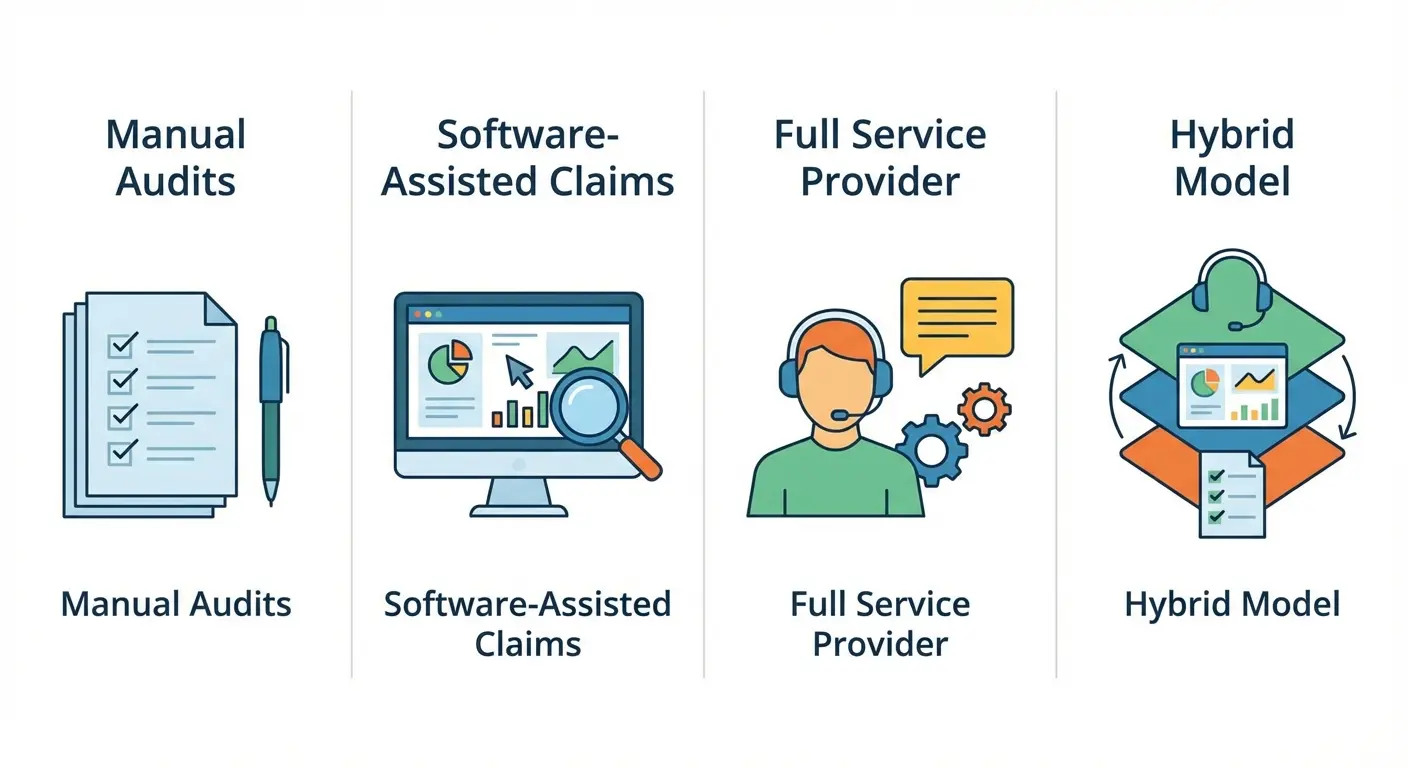
Most sellers end up in one of these operating models:
Manual in-house audits You or your team pull reports, investigate discrepancies, file cases, and track outcomes inside Seller Central.
Software-assisted in-house claims A tool identifies likely reimbursement opportunities, but your team still reviews and submits claims.
Done-for-you reimbursement service A third party audits the account, submits claims, follows up, and usually charges a percentage of successful recoveries.
Hybrid setup Software catches routine issues, while a specialist or internal senior operator handles appeals and edge cases.
This matters because the debate is not just manual vs automated amazon fba reimbursement claims. It is also about judgment versus automation, fixed cost versus commission, and control versus convenience.
What experienced sellers should judge before choosing
Before comparing options, use criteria that reflect how reimbursements work in real life:
Recovery depth
Can the method catch only obvious cases, or can it surface messy issues like multi-step warehouse adjustments, reconciliation gaps, and denied claims that may deserve escalation?
Internal time cost
How much operator time is required each week to review, document, submit, and follow up? A cheap option becomes expensive if your ops team is spending high-value hours chasing small claims.
Claim quality and compliance risk
Amazon may reimburse valid losses, but it also rejects weak, duplicate, premature, or unsupported claims. Aggressive filing can create friction. Good reimbursement systems are not just good at finding claims. They are also good at filtering bad ones.
Visibility into inventory discrepancies
The best setup should help with how to find discrepancies in amazon fba inventory, not just submit tickets. If a method recovers money but teaches you nothing about recurring operational leakage, it is incomplete.
Cost structure
This is where many sellers get sloppy. Fixed subscription, success fee, minimum monthly charges, setup fees, appeal fees, and lock-in periods all change the economics.
Suitability for account size and complexity
A seller with a tight catalog and predictable inbound flow has different needs than a large brand managing many ASINs, removals, international marketplaces, and layered prep workflows.
Manual audits: lowest cash cost, highest discipline requirement
For sellers building a diy amazon fba reimbursement audit checklist, manual can still work well, but only under specific conditions.

Where manual audits shine
Manual reimbursement work gives you maximum control. You decide what qualifies, how often to audit, and how aggressively to pursue appeals. For sellers with strong operations teams, this can be the cleanest path to how to get amazon fba refunds without commission.
It also forces process visibility. If your team manually traces inbound discrepancies, damaged inventory, or customer refund anomalies, you often uncover upstream issues in prep, carton labeling, receiving, or returns handling.
A manual approach is also useful when your volume is not high enough to justify software or service fees. If reimbursements are infrequent, paying a monthly platform fee or a recovery commission may not make economic sense.
Where manual breaks down
Manual audits usually fail from inconsistency, not lack of knowledge. Teams start with good intentions, then reimbursement review becomes an afterthought behind stockouts, listing issues, and replenishment fires.
The bigger weakness is evidence management. Some claims are easy, but many require date ranges, shipment references, reconciliation logic, and persistence after first denial. That work is repetitive and easy to defer.
Expectation versus reality:
Expectation: "We will check reports once a month."
Reality: Claim eligibility periods matter, report structures can change, and unresolved cases need follow-up. Miss one cycle and the backlog compounds.
The real cost of manual work
The cash cost is low, but labor cost can be high. If a senior ops person is doing reimbursement audits, you are paying with attention that could be used on forecasting, stranded inventory, or margin work.
Manual also needs a checklist. A practical one usually includes:
Lost inventory events
Damaged warehouse items
Inbound shipment shortages
Customer refunds where return status or reimbursement does not reconcile
Removal and disposal discrepancies
Fee-related adjustments that merit review
Cases where Amazon closed a claim without clear resolution
That is the core of a workable amazon fba lost inventory recovery guide when done in-house.
Failure modes to watch
Claim eligibility periods missed because no one owns the process
Duplicate claims submitted by multiple team members
Weak documentation on inbound shortages
Time spent chasing low-value claims while larger discrepancies sit untouched
Team assuming Amazon already reimbursed that without verifying ledger impact
Manual works best when one person owns it, reporting is standardized, and claim review happens on a calendar, not when someone has time.
Reimbursement software: efficient for detection, limited for judgment
For many sellers, software is the middle ground in comparing amazon fba audit services and software.

What software does well
Software is strongest at systematic detection. It scans account data and flags probable reimbursement opportunities faster than a human manually pulling reports. That is why it is often the best answer for sellers who want scale without paying commission.
Good tools are especially useful for straightforward categories such as:
Lost inventory
Damaged inventory
Simple inbound receiving mismatches
Refund anomalies with clear system indicators
This is also why large operators often evaluate the best amazon reimbursement tools for large sellers. At scale, visibility matters as much as claim submission. Software can centralize alerts, case history, and unresolved discrepancies across a broad catalog.
What software usually misses
Software follows rules. That is its strength and its limit. It can flag patterns, but it does not always know when a claim should be reframed, appealed, delayed, or dropped. Complex discrepancies often need human interpretation.
Examples include situations where:
Inventory moved through several adjustment states before disappearing
A reimbursement appears issued, then offset later
A damaged item claim overlaps with another inventory event
Inbound losses involve partial receives, later corrections, and support responses that contradict reports
In these cases, software may identify the issue, but a person still has to build the argument.
Is it safe to use FBA refund software?
Usually, yes, if the software connects through Amazon-approved methods, uses limited permissions, and your team understands what it is filing. But the safer question is not just is it safe to use fba refund software. It is whether the output encourages low-quality claim behavior.
A tool becomes risky when sellers treat every alert as a case that must be filed. Not every discrepancy is claim-ready. Some are pending resolution, already credited elsewhere, outside the relevant claim window, or too weakly supported to submit yet.
Seller insight: software should be treated as a discrepancy radar, not an auto-approval engine.
Cost and effort profile
Most software uses a subscription model, which can be much cheaper than a service if your recoveries are significant. It also fits sellers who want how to get amazon fba refunds without commission, because the fee is not tied to recovered dollars.
But software is not hands-off. Someone must:
Review flagged cases
Validate evidence
Submit claims
Track denials and follow-ups
Prevent duplicate or unnecessary tickets
If no one owns that workflow, software becomes a dashboard full of unrealized potential.
Common failure modes
Teams over-trust alerts without validating them
Claims are filed too early, before Amazon's internal resolution cycle completes
Tool coverage does not match the seller's actual problem areas
Operators assume software handles appeals when it only detects issues
Reporting gaps create false confidence
For disciplined operators, software is often the best cost-to-control tradeoff. For undisciplined teams, it becomes shelfware.
Full-service reimbursement providers: best for outsourced persistence, not automatically best for profit
A service provider can be the right answer when reimbursement work is too detailed, too neglected internally, or too inconsistently executed.

Where services tend to outperform
A good service usually beats software in three areas:
Appeals and persistence When Amazon rejects a potentially valid claim, an experienced operator can often reframe the evidence and continue the process.
Edge-case interpretation Humans can connect transaction history in ways software often cannot.
Execution consistency The provider wakes up every day to do reimbursement work. Your team probably does not.
This matters for recovering fba profit from damaged items and other gray-area cases where the issue is not simply detection, but proving entitlement and staying organized through multiple support interactions.
Why services often recover more, but not always more profit
Services often uncover or successfully pursue claims that internal teams miss. That said, gross recovery is not the same as net recovery. A commission-based provider may recover more dollars while leaving you with less incremental profit than a software setup would have.
This is where sellers need to look closely at hidden fees in amazon fba refund services. The obvious fee is percentage of recovered funds. The less obvious issues are:
Minimum monthly fees
Setup or onboarding fees
Fees on credits Amazon may have issued anyway
Long contract terms
Fees on reopened or appealed claims
Broad definitions of recovered funds
The best providers are transparent about what counts as a recovery and what they need from your team.
Account access and operational tradeoffs
Services typically need secondary user permissions to do the work efficiently. That is practical, but it creates governance questions. Experienced sellers should define:
Which permissions are truly necessary
Who on the provider side has account access
How case quality is reviewed
How duplicate filing is prevented if internal staff also open cases
This is one reason some larger brands prefer a hybrid model instead of full outsourcing.
Risks and failure modes
The biggest risk is misaligned incentives. If a provider earns only on recoveries, they may be tempted to file aggressively. That does not mean they will, but the incentive exists, and support quality can degrade if your account generates too many weak cases.
Another risk is opacity. Some providers report only wins, not the quality of submissions, rejection rates, or categories they are ignoring.
A final risk is strategic dependence. If all reimbursement knowledge lives outside your business, you lose operational learning that could reduce future discrepancies.
Hybrid models: often the best answer for mature operators
The most practical answer in amazon fba reimbursement software vs service 2026 is often not either-or.

Why hybrid works
A hybrid model uses software for broad discrepancy detection and internal visibility, while reserving a specialist, either internal or external, for:
High-value cases
Appeals
Repeated denials
Complex inventory history
Issue categories that need judgment
This keeps commission spend focused on hard cases while letting your team retain control over routine work. It also reduces the chance that valid claims sit untouched because the process depends entirely on one outsourced partner or one overloaded ops manager.
Where hybrid makes the most sense
Hybrid is especially strong for:
Multi-SKU sellers with moderate to high FBA volume
Teams that already have ops staff but limited investigative bandwidth
Sellers who want better discrepancy visibility without outsourcing everything
Larger accounts comparing best amazon reimbursement tools for large sellers but still wanting human support for edge cases
The drawback is management overhead. Someone still has to define claim ownership and avoid overlap between software alerts, internal case submission, and provider activity.
Matching the model to your business constraints
If you are deciding between manual vs automated amazon fba reimbursement claims, start with your limiting factor.
Choose manual if:
Your FBA volume is manageable
You already have a detail-oriented operator
You want zero commission
You need tight internal control over every claim
Your account complexity is relatively low
Choose software if:
You want how to get amazon fba refunds without commission
Your main issue is missed detection, not lack of judgment
Your team can review and file consistently
You care about operational visibility into discrepancy patterns
You want better scalability than manual work
Choose a service if:
Claims are being ignored internally
Your catalog and transaction history are messy
Appeals and case handling are where money gets stuck
You are comfortable paying for outsourced execution
You want less daily involvement
Choose hybrid if:
You have scale and enough complexity to justify systems
You want software visibility plus human escalation
You want to keep routine recoveries in-house
You want to limit commission fees to hard cases
You care about both profit recovery and process learning
A note on policy and claim safety
Before you outsource or automate anything, understand the amazon fba reimbursement policy for professional sellers well enough to spot bad advice. Amazon's policies, claim windows, and required evidence can change. You should verify current rules in Seller Central help content and reimbursement reports, especially for lost, damaged, returned, and disposal-related cases.
The safest operating principle is simple: file only supportable claims, keep documentation organized, and reconcile reimbursements against actual account activity.
My recommendation for most professional sellers
If you are a serious seller with consistent FBA volume, start with software unless one of two things is true: your team is already overloaded, or your reimbursement history is complex enough that appeals are the main source of missed value.
That recommendation holds because software usually gives the best balance of control, cost efficiency, and visibility. It also supports broader operational diagnosis, especially for sellers trying to improve how to find discrepancies in amazon fba inventory before they become recurring leakage.
Use a service when the bottleneck is execution, not awareness. If your team already knows discrepancies exist but still does not file, follow up, or appeal effectively, outsourcing can be rational. Just be strict about fee definitions and access controls.
For larger operators, I would lean hybrid. Let software surface routine opportunities and trend lines, then use expert human review for contested, high-value, or ambiguous cases. That is usually the cleanest answer to comparing amazon fba audit services and software without overpaying for simple work.
One practical rule: if your internal owner cannot review alerts and act on them every week, software alone will underperform. If your provider cannot clearly explain its fee logic and claim standards, the service model will eventually irritate you.
A compact decision grid
| Approach | Best for | Main upside | Main downside | Cost style | Biggest risk | |---|---|---|---|---|---| | Manual in-house | Lower complexity accounts | Full control, no commission | Time-heavy, easy to neglect | Internal labor | Missed claim windows and inconsistency | | Software | Sellers with disciplined ops teams | Fast detection, scalable, lower cost than commission | Still needs human review and filing | Subscription | False confidence, underused alerts | | Service | Busy teams, complex claim histories | Outsourced execution and appeals | Commission and less control | Percent of recoveries, sometimes extra fees | Aggressive or opaque filing behavior | | Hybrid | Mature, higher-volume sellers | Balance of visibility and expertise | More process coordination | Mixed | Overlap and duplicate workflows |
The bottom line
The best reimbursement setup is not the one that finds the most cases. It is the one that turns valid discrepancies into net profit without creating operational drag or unnecessary account friction.
If your goal is a practical amazon fba lost inventory recovery guide, think beyond ticket filing. Reimbursement is an operating system: discrepancy detection, evidence quality, claim timing, follow-up discipline, and post-mortem learning. Build that system around your actual bottleneck.
For some sellers, that means a spreadsheet and rigor. For others, it means software. For larger or more complex accounts, it often means software plus selective human expertise. The wrong choice is usually not choosing the inferior option. It is choosing a method that your team will not consistently execute.