Amazon Medical Supplies Compliance Guide

Olivia Reyes

Selling Medical Supplies on Amazon: The Rules That Actually Decide Whether You Scale or Get Stuck
If your medical ASINs keep getting suppressed, your category application stalls, or you are unsure whether a product crosses the line into a regulated claim, the problem usually is not demand. It is fit. Selling medical supplies on Amazon requires a tighter match between product classification, listing language, documentation, inventory controls, and fulfillment setup than most sellers expect. Small mismatches can create outsized problems.

Why this category feels harder than it should
Medical supplies can attract steady demand, repeat purchase behavior, and stronger buyer intent than many general consumer categories. That is the upside. The tradeoff is that Amazon often applies higher scrutiny here because product safety, labeling, buyer trust, and regulatory exposure matter more than they do in many ordinary retail categories.
For experienced sellers, the important shift is this: medical is not just another niche with stricter keywords. It is a category where operational decisions and compliance decisions are tied together. A listing issue can become an inventory issue. A packaging issue can become an inbound problem. A casual claim in bullets can trigger suppression or a document request, even if the product itself may be sellable.
That is why the sellers who do well here tend to think less like marketers first and more like risk managers who also know how to merchandise.
Before you list anything, know what Amazon thinks you are selling
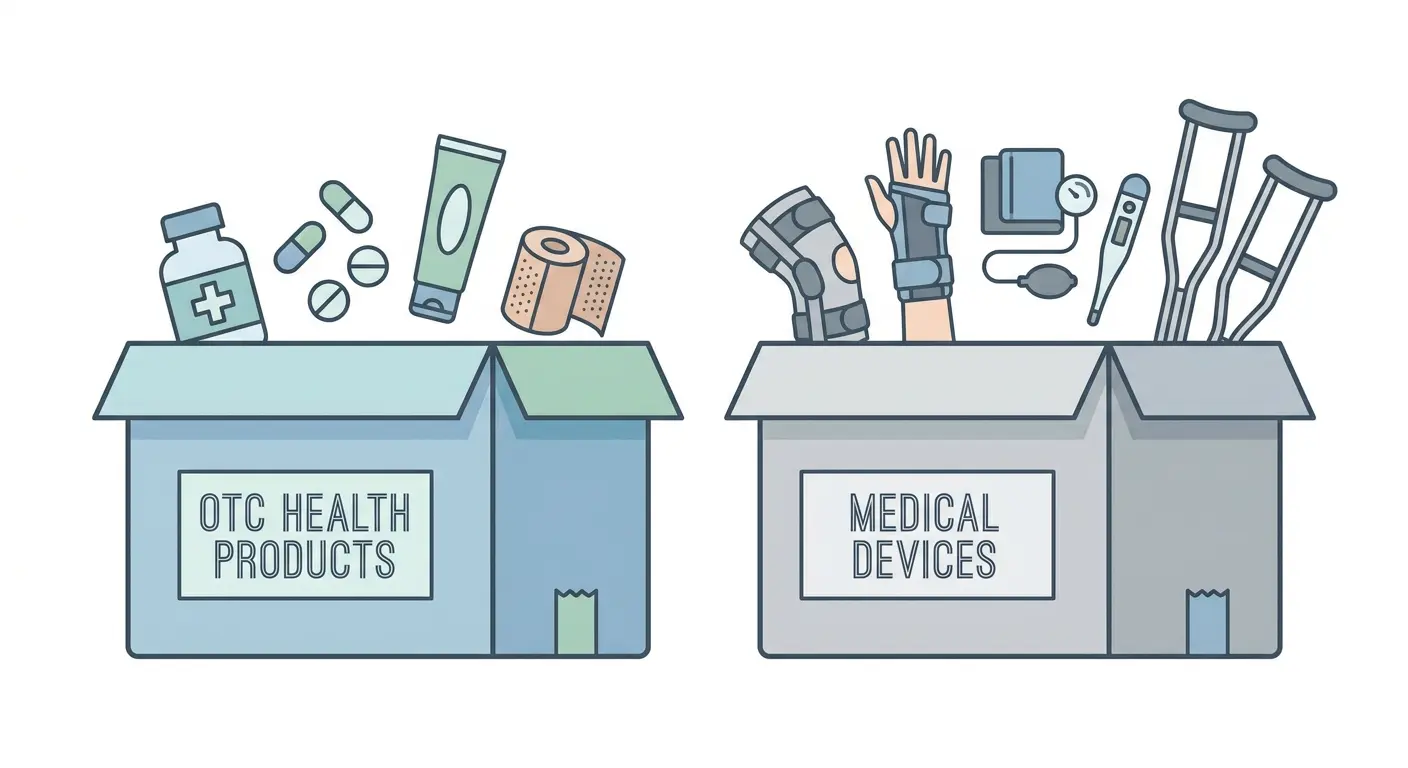
A large share of avoidable problems starts with classification. Sellers often use “medical supplies,” “healthcare products,” “OTC,” and “medical devices” as if they are interchangeable. They are not.
A practical way to separate them:
OTC products are not the same as medical devices
When sellers ask about selling otc medical products on amazon guidelines, they are usually talking about over-the-counter health items intended for consumer purchase without a prescription. These products can still face ingredient, labeling, and claims scrutiny, but they are not automatically treated the same way as devices.
Medical devices are a different risk bucket. If a product is intended to diagnose, cure, mitigate, treat, or prevent disease, or to affect the structure or function of the body, Amazon may evaluate it more cautiously, especially if the listing language makes explicit medical claims. This is where amazon fba fda compliance for medical devices becomes a real operational issue, not a theoretical one.
The seller insight here is simple: your product classification is shaped not only by what the item is, but also by what your listing says it does.
Restriction status can change based on language, not just product type
A brace, support, monitor, first aid item, or wellness tool may look straightforward, but wording can push it into a more restricted review path. “Supports comfort” may be treated differently from “treats tendonitis.” “Designed for daily support” may survive where “reduces inflammation” gets flagged.
This is why many sellers end up searching for an amazon restricted products medical devices fix when the real issue is not always the item itself. It is the claim stack in title, bullets, A+ content, images, or backend attributes.
Professional healthcare use is its own lane
Some products are sold to consumers. Some are positioned for professional use. Some sit awkwardly in between. If you are dealing with products intended for clinics, practitioners, or regulated professional workflows, you may run into amazon professional health care program requirements. Amazon has used additional review, eligibility controls, or listing restrictions for certain healthcare products sold into professional channels.
The practical takeaway is not to assume your supplier’s product sheet will map cleanly to Amazon’s internal category logic. It often does not.
Getting approved is less about the form and more about the file quality
When sellers ask how to get ungated in medical supplies amazon 2026, they often expect a checklist. There may be category-specific document requirements, but approval quality usually depends on whether your documents tell one clean story.
Amazon commonly looks for consistency across invoices, brand identity, packaging, labeling, and product detail pages. Problems tend to arise when one piece says “wellness support,” another says “orthopedic treatment,” and the invoice uses a generic distributor description that does not clearly connect to the product you want to sell.
Expectation vs. reality:
Expectation: if you have invoices, you can get approved.
Reality: if your invoices, packaging, and intended listing language do not align, approval may stall or be reversed later.
Strong approval files usually have three things:
Recent invoices from a credible supplier or manufacturer
Packaging and label images that clearly match the product
Listing copy that stays inside supportable claims
If you are applying in a higher-risk subcategory, adding more documents than requested is not always helpful. Certificates that do not directly prove authenticity, identity, or compliance can create noise. Clean, relevant documents usually beat large uploads.

FDA compliance matters, but Amazon enforcement is often the immediate problem
Sellers often frame medical category issues as a pure regulatory question, but the day-to-day pain point is usually Amazon enforcement. That distinction matters.
When people mention amazon fba fda compliance for medical devices, they are usually dealing with two overlapping systems:
Actual regulatory obligations tied to the product
Amazon’s own marketplace rules, document requests, and listing standards
Those systems are related, but they are not identical. A product can be lawful to sell in a broader sense and still get suppressed on Amazon because the platform does not like the claim language, image treatment, or missing attribute fields. Amazon approval also should not be treated as legal clearance or regulatory confirmation.
If you use FBA, this gets even more practical. FBA does not remove the seller’s responsibility for product accuracy, labeling, shelf life handling, or authenticity support. It just changes who physically handles the inventory.
A good internal rule is to treat Amazon approval as selling permission on the platform, not as compliance confirmation.
Expiration dates are not an inventory footnote in this category
For many medical and health-related products, shelf life is a central operational variable. Sellers who come from hard goods often underestimate this until they start seeing stranded inventory, disposal risk, or customer complaints.
Expiry management has to start before inbound
Managing expiration dates for fba medical supplies is not something you solve inside Seller Central after units arrive. It starts with purchasing and prep. If your inbound stock has mixed lot ages, weak date visibility, or inconsistent prep labeling, you are already giving up control.
At a minimum, you want lot-level awareness before shipment creation, enough remaining shelf life for Amazon acceptance under current policy, and a process for rotating stock outside Amazon if older units are still sellable but no longer ideal for FBA.

A reimbursement strategy matters, but it is not the whole answer
Some sellers look for refund software for expired inventory no commission because unsellable or aging inventory losses add up. Software may help identify reimbursement opportunities when inventory is lost, damaged, or incorrectly accounted for. That can be useful.
But do not confuse reimbursement recovery with expiry management. Recovery tools address what already went wrong. They do not fix poor lot rotation, weak inbound controls, or overbuying long-tail SKUs with limited sell-through.
The better decision rule is this: in medical supplies, buy inventory according to realistic velocity under compliance constraints, not according to supplier MOQ logic alone.
Most listing suppressions come from language drift, not dramatic violations
Many sellers dealing with fixing suppressed amazon listings for medical claims assume they need a full relaunch. Often they need a careful edit and a cleaner evidence chain.
Suppression usually happens when Amazon systems or manual review detect language that suggests unsupported medical efficacy, prohibited disease claims, or inconsistent product identity. This can appear in obvious places like the title, but it also appears in image text, A+ modules, comparison charts, and product documents attached to the listing.
A practical triage process looks like this:
Start with the claim map
Pull every customer-visible statement from the listing and group them into categories:
Functional description
Comfort or convenience benefit
Clinical or therapeutic claim
Disease-specific language
Comparative superiority claim
Your goal is to identify which statements are likely supportable and which ones are doing the damage. Many suppressions are caused by just a few phrases repeated across multiple content areas.

Then check for hidden mismatch points
The problem may be in places sellers forget to audit:
Backend attributes
Image overlays
Old A+ content still attached to variations
Parent-child relationships where one child carries restricted language
Packaging photos that display claims removed from the copy
This is especially common when brands have revised language over time but did not update every asset.
Appeals succeed when they explain control, not when they argue innocence
If a listing or account issue escalates, sellers search how to appeal amazon medical claims suspension. The hard truth is that a good appeal is not mainly about insisting the product is safe or misunderstood. It is about showing Amazon that you understand the cause and have changed the process that allowed it.
A workable appeal usually includes three parts:
Identify the exact cause without being vague
Avoid generic lines like “we reviewed our listing and corrected issues.” Amazon wants to see that you know whether the problem was disease language, unsupported therapeutic claims, image text, incorrect categorization, or a documentation gap.
Show what you changed immediately
That can include:
Removing or revising flagged claims
Updating images and A+ content
Reclassifying the product where needed
Closing or pausing affected offers if necessary
Retraining whoever creates listing copy
Show what will prevent recurrence
This is where experienced sellers separate themselves. Explain the control system:
Pre-publication review for all medical language
Packaging and listing consistency checks
Restricted keyword review before launch
Supplier document retention
Periodic audits of existing listings after catalog changes
Amazon does not need a legal essay. It needs a credible process narrative.
Three realistic cases sellers run into
Case 1: The brace that became a higher-risk listing because of copy
Hypothetical example: a seller launches a support brace with solid images and decent conversion. The product itself is ordinary, but the bullets say it “treats tendonitis” and “speeds rehabilitation.” The listing is suppressed for medical claims.
The fix is not necessarily abandoning the SKU. The seller rewrites the page around physical support, fit, material, intended use, and user instructions, then removes disease-specific and treatment language across title, bullets, A+ content, and images. The product may still sell well because shoppers often need clarity more than exaggerated claims.
Case 2: Approval failed because the documents told two different stories
Hypothetical example: a distributor invoice lists a generic item name, while packaging shows a branded product and the listing draft uses stronger treatment language than the label supports. The application stalls.
The seller obtains cleaner invoices, aligns the draft listing to the actual packaging language, and resubmits a simpler document set. Approval gets easier because the evidence is consistent.
Case 3: Expired inventory losses looked like a reimbursement problem, but were really a forecasting problem
Hypothetical example: a seller sends six months of dated medical consumables into FBA to reduce inbound frequency. Sell-through is slower than forecast because ads are limited and conversion takes time in a trust-sensitive category. Units age out.
The seller explores refund software for expired inventory no commission, which may help recover certain discrepancies, but the real fix is changing replenishment cadence, narrowing SKU depth, and sending fresher inventory in smaller waves.
The mistakes experienced sellers still make
One recurring misunderstanding is assuming that a compliant manufacturer automatically makes your Amazon listing compliant. It does not. Your listing language, images, and category placement still create risk.
Another is treating suppression as a copywriting problem only. In medical categories, suppressed listings often reflect upstream issues such as packaging language, poor documentation, or inaccurate product type selection.
A third is believing that “soft” claims are always safe. Terms like relief, recovery, therapy, inflammation, rehabilitation, and treatment can shift a listing into a different review category depending on context.
Finally, many sellers underestimate how much old catalog residue matters. Legacy images, outdated A+ modules, inherited variation content, and prior agency edits can keep causing enforcement after you think you cleaned the listing.
Where the gray areas actually are
The hardest part of this category is not the obvious prohibited product. It is the product sitting near the line.
Products with crossover positioning, such as wellness tools with quasi-clinical language, can become risky quickly. The same goes for products that are harmless in retail use but become more heavily reviewed when marketed to professionals.
There is also the issue of timing. Amazon policy enforcement evolves, and listings that ran quietly for months can get reviewed later after broader sweeps, automated changes, or competitor reports. That is why “it has always been live” is not a defense strategy.
For international brands, translation and labeling create another edge case. A claim that sounds modest in the source language can become much stronger in English listing copy. If you are localizing content, do not let translators make regulatory judgments.
And if you sell both FBA and FBM, remember that channel choice does not remove listing compliance risk. FBM can solve some logistics constraints, but it does not make medical claims less sensitive.
What to keep in mind before you expand this category
Medical supplies can be a strong Amazon business, but they reward discipline more than speed. The sellers who win here usually narrow scope early, keep claim language conservative, and build a document trail before Amazon asks for it.
If you need a simple heuristic, use this one: every medical SKU should have a defense file before launch. That file should include supplier docs, packaging images, the final listing copy, any supporting product documentation, and an internal explanation of what claims you are making and why you believe they are supportable.
It is not glamorous, but neither is a late-night suppression notice.
The points that matter most
Medical supplies on Amazon are shaped as much by listing language and documentation as by the product itself.
How to get ungated in medical supplies amazon 2026 is mostly a consistency problem. Invoices, packaging, and listing copy must tell the same story.
Amazon fba fda compliance for medical devices should be treated as overlapping with, but separate from, Amazon marketplace enforcement.
Selling otc medical products on amazon guidelines differ from device-related selling, especially once your copy starts making stronger therapeutic claims.
Managing expiration dates for fba medical supplies starts at purchasing and prep, not after inventory arrives at Amazon.
Fixing suppressed amazon listings for medical claims usually requires a full claim audit across title, bullets, images, A+ content, and backend attributes.
If you need how to appeal amazon medical claims suspension, focus your appeal on root cause, corrective action, and prevention controls, not on emotion or broad arguments.
If restricted workflow issues appear, an amazon restricted products medical devices fix usually begins with claim cleanup, classification review, and better supporting documents.
For higher-risk professional SKUs, amazon professional health care program requirements should be checked before launch, not after a listing is blocked.
When losses pile up, refund software for expired inventory no commission can support recovery work, but it cannot replace sound forecasting and lot control.