Amazon SEO: Ranking Factors That Drive Sales

Olivia Reyes

Amazon SEO: How to Improve Amazon SEO and Win the Rankings That Actually Matter
If your listing is indexed for the right keywords but still stuck on page three, what is actually holding it back?
Most experienced sellers know the basics of amazon seo. You optimize the title, fill the backend fields, add bullets, and move on. But rankings do not move the way you expect. Or they move, then slide back down.
The reason is usually not “missing keywords.” amazon seo ranking reflects both keyword relevance and marketplace performance signals that Amazon can measure, including shopper behavior and sales outcomes. Understanding how amazon ranking factors interact in real life is what separates stable page-one listings from temporary spikes.
This guide breaks down how to improve amazon seo in a way that holds up under competition, seasonality, and ongoing updates to the amazon seo algorithm.
Amazon SEO Is a Revenue System, Not a Content Contest

At its core, amazon seo is the process of optimizing a listing so it can surface for relevant searches and compete for placement. Unlike traditional web search, Amazon’s search experience is designed to help shoppers find products they are likely to buy, which ties visibility closely to commercial performance.
Many sellers refer to Amazon’s search system as “A9” or “A10,” but Amazon does not publicly document a single named algorithm version. What is consistent is the two-part reality most sellers see in practice:
Relevance: Does the listing appear to match the shopper’s query and filters?
Performance: When the listing shows, do shoppers click and purchase at a competitive rate?
Relevance can help you get indexed and shown. Performance heavily influences how prominently you are placed for a given query.
This is where sellers often misread amazon ranking factors. Keyword placement matters, but the listings that hold top positions usually earn them through stronger click-through and conversion performance over time.
What Actually Influences Amazon SEO Ranking
Relevance Signals (The Matching Layer)
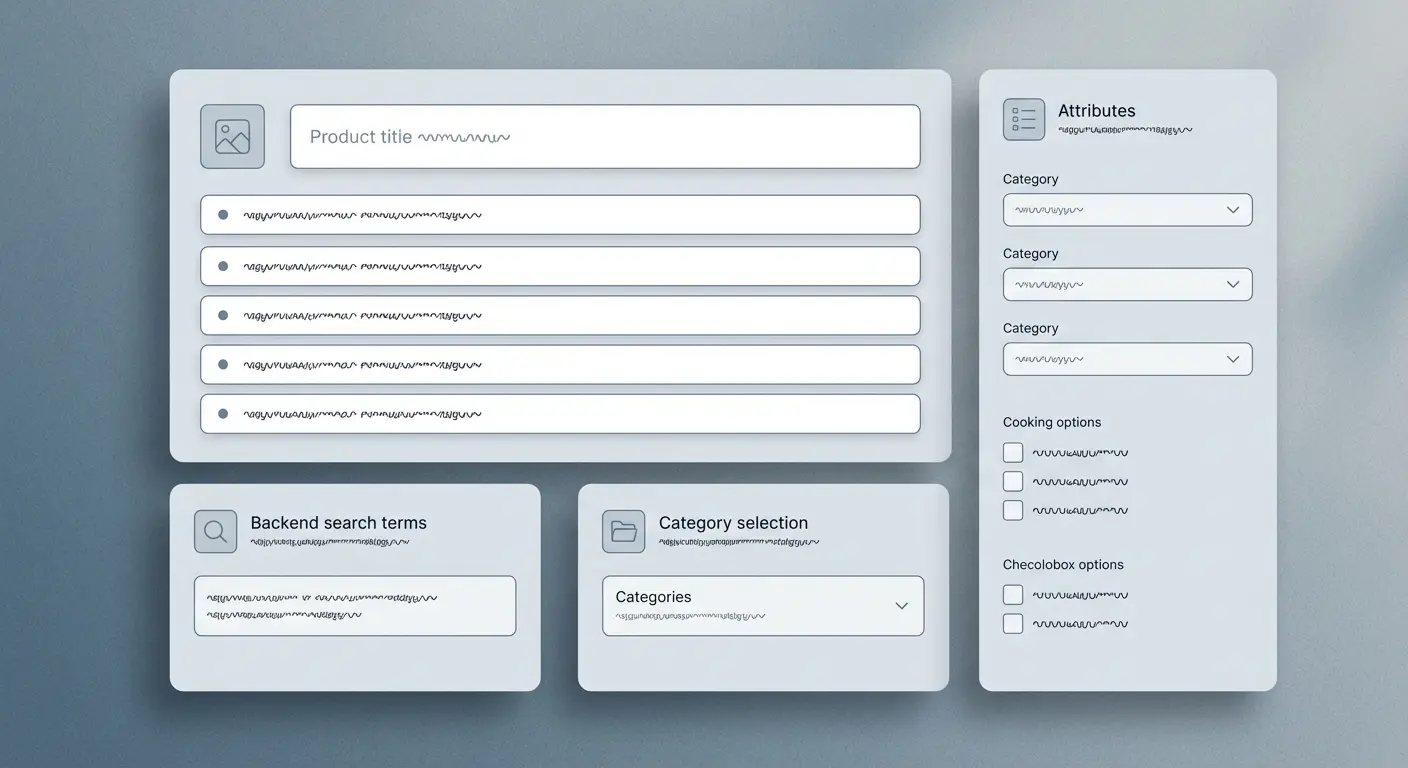
These are the components Amazon uses to understand what your product is and which searches it should be eligible to show for:
Title
Bullet points
Product description
Backend search terms
Category, subcategory, and browse node mapping
Attributes (size, color, material, compatibility, and other structured fields)
A+ content (may contribute to shopper understanding and conversion; indexing behavior can vary by placement and format)
A practical rule of thumb: if a term is not present in fields Amazon uses for matching, you may not rank for it consistently.
Also, repeating the same keyword many times is not a reliable ranking lever. In many cases, it can reduce readability and click-through. Coverage of relevant variations and clear alignment to shopper intent tends to outperform repetition.
Seller insight: coverage usually beats repetition. It is better to earn consistent placement for many tightly relevant phrases than to over-optimize a handful and weaken the listing’s clarity.
Performance Signals (The Placement Layer)

Once your listing is eligible to show, placement is influenced by how shoppers interact with it and how it performs relative to competing offers. Common performance-related amazon ranking factors sellers track include:
Click-through rate (CTR)
Conversion rate (CVR)
Sales velocity (recent and sustained)
Price competitiveness within the niche
Customer feedback signals (review count and rating, return patterns, customer dissatisfaction indicators)
Prime eligibility and delivery promise (often tied to fulfillment method and in-stock position)
Inventory stability and in-stock rate
If two listings are similarly relevant for a query, the one that earns stronger engagement and purchase outcomes tends to gain better placement over time.
How the Amazon SEO Algorithm Plays Out in Practice
Step 1: Indexing and Eligibility
You add “32 oz insulated water bottle” to your title and relevant fields. Your listing becomes eligible to appear for that phrase and close variants, depending on category and shopper filters.
You now show somewhere in results, but not necessarily high.
Step 2: Behavioral Evaluation
Amazon observes what happens when shoppers encounter your listing:
Do they click?
Do they buy?
Do they return it or generate dissatisfaction signals?
Do they leave reviews that indicate consistent satisfaction?
If your listing performs competitively for that query, it may earn more impressions. If it underperforms, it can lose placement.
Step 3: Momentum Effects

Sales and conversion trends can reinforce placement:
Higher placement can drive more impressions.
More impressions can create more sales.
More sales can help maintain placement.
This loop is fragile. Stockouts, sudden price changes, worsening delivery promise, or a shift in review quality can interrupt momentum.
Expectation vs. reality:
Expectation: once you hit page one, you are stable. Reality: rankings are recalculated continually, and visibility must be maintained through ongoing performance.
Where to Focus When You Want to Improve Amazon SEO
Improving amazon seo is rarely about rewriting everything. It is about diagnosing which layer is holding you back.
If You Are Not Ranking at All
This is often a relevance or catalog mapping issue.
Check:
Are primary keywords present in the title and supported by bullets?
Are backend search terms utilized without repetition or forbidden claims?
Is the product in the correct category and subcategory?
Are key attributes filled correctly (material, size, compatibility, pack count)?
Are you targeting high-intent long-tail phrases that match the product exactly?
This is foundational seo para amazon: keyword coverage, correct placement, and accurate catalog data.
If You Get Impressions but Few Clicks
That is usually a CTR problem.
Common causes:
Weak main image relative to top competitors
Price that looks uncompetitive at a glance
Low review count compared with the leaders
A title that is hard to scan on mobile
CTR can influence placement because shoppers must engage before a purchase can happen.
If You Get Clicks but Not Conversions
That is typically a CVR problem.
Investigate:
Is your value proposition weaker at the same price point?
Do bullets communicate differentiated benefits clearly?
Are common objections answered (size, compatibility, durability, what is included)?
Do reviews reveal consistent product issues you can fix or clarify?
Conversion performance is strongly tied to amazon seo ranking over time. Listings that convert poorly tend to lose visibility, even when keyword coverage is strong.
Practical Examples
Case 1: The Over-Optimized Launch
Hypothetical scenario:
A private-label seller launches a supplement. The listing is indexed for many phrases and PPC drives initial traffic.
Problem:
Conversion rate is 8% in a category averaging 18%.
Result:
After early PPC-driven visibility, organic placement stalls and declines.
Why?
Underperformance relative to competing listings signals that shoppers are not choosing this offer often enough when it is shown.
Fix:
Improve imagery and clarity, adjust the offer structure, and address product objections. Then scale traffic again once conversion stabilizes.
Note: review generation must follow Amazon policy. Incentivized reviews and review manipulation can lead to enforcement.
Case 2: The Stable Mid-Page Product
An established FBA seller sits around positions 12 to 18 for core keywords but cannot break into the top 5.
Data shows:
CTR slightly below top listings
CVR competitive
Review count lower than top competitors
Diagnosis:
A perceived trust and competitiveness gap.
Improvement plan:
Improve main image and pricing tests to lift CTR
Use targeted PPC to increase sales for the exact queries you want to climb
Improve customer experience and packaging inserts that request feedback appropriately, without incentives or gating, to support sustainable review growth
Result:
Climbs into the top 6 over several weeks.
Case 3: The Out-of-Stock Collapse

A seasonal product ranks top 3. Inventory runs out for 3 weeks.
When restocked:
Placement drops to page 3
PPC costs increase
Why?
Sales momentum and in-stock history weaken, and competitors continue collecting recent sales for the same queries.
Lesson:
Inventory stability is an underappreciated amazon ranking factors lever, especially in seasonal niches.
Common Misunderstandings About Amazon SEO
“More Keywords = Higher Rank”
More relevant coverage can improve eligibility and indexing. Placement still depends heavily on performance. Overstuffing can reduce clarity and hurt CTR and CVR.
“PPC Sales Don’t Help Organic Ranking”
Paid orders are still orders, and they can contribute to sales velocity and conversion history. However, PPC that brings mismatched traffic can reduce conversion rate, which can work against amazon seo ranking.
“Backend Keywords Are Optional”
Backend search terms can help capture synonyms, alternate spellings, and long-tail variations without cluttering the visible copy. They are often worthwhile, provided you follow Amazon’s guidance and avoid prohibited terms.
“A+ Content Doesn’t Affect SEO”
Direct indexing impact can be limited or inconsistent. Indirect impact through improved shopper understanding and higher conversion can be meaningful. Better conversion supports stronger placement.
Limits and Edge Cases Sellers Should Understand
Highly Competitive Head Terms
For extremely competitive keywords, performance thresholds can be high. You may need:
Strong review profile relative to incumbents
Sustained conversion performance
Strategic PPC to build sales history on specific queries
Competitive pricing or a clearly superior offer
Ranking is relative to competing offers, not absolute.
Seasonal Products
Off-season velocity declines can weaken placement. Some sellers maintain baseline sales with controlled ads, but the goal should be profitable demand maintenance, not artificial volume.
Premium Pricing Strategy
You can rank with a higher price if conversion remains competitive. Branding, creative, and offer structure must justify the premium. If conversion falls, Amazon may reduce impressions for key queries.
Catalog Changes and Suppressions
Large edits to titles, categories, or attributes can change indexing behavior and temporarily disrupt placement. Make changes deliberately and re-check keyword indexing after edits.
What Really Moves the Needle in 2026
For experienced sellers, consistent wins usually come from:
Conversion rate optimization before scaling traffic
Inventory stability and in-stock planning
Review quality and compliance-first review growth
PPC strategy aligned to the queries you want to rank for
Continuous testing of main image, price, and offer structure
amazon seo is not static. It is performance-based positioning inside a shopping marketplace.
If you want durable visibility, your listing has to earn it continuously.
Key Takeaways for Serious Sellers
amazon seo ranking depends on relevance and performance. Keywords help eligibility. Performance drives placement.
Conversion rate and sales velocity are among the most influential amazon ranking factors sellers can impact.
CTR is often the lever that helps break into top positions once conversion is competitive.
Backend search terms remain valuable for clean coverage of synonyms and long-tail variations.
PPC can accelerate momentum when traffic matches intent and conversion holds.
Stockouts can disrupt sales history and reduce placement. Inventory stability matters.
Sustainable results come from compounding performance, not keyword stuffing.
If your listing is not ranking where it should, do not only ask, “What keywords am I missing?”
Ask instead: “Is my listing outperforming the products above me for the same query?”
That is the question the amazon seo algorithm is effectively answering every day.