Amazon Removed Seller Contact on Critical Reviews

Olivia Reyes
What the feature was
For sellers who never used it, here is the short version:
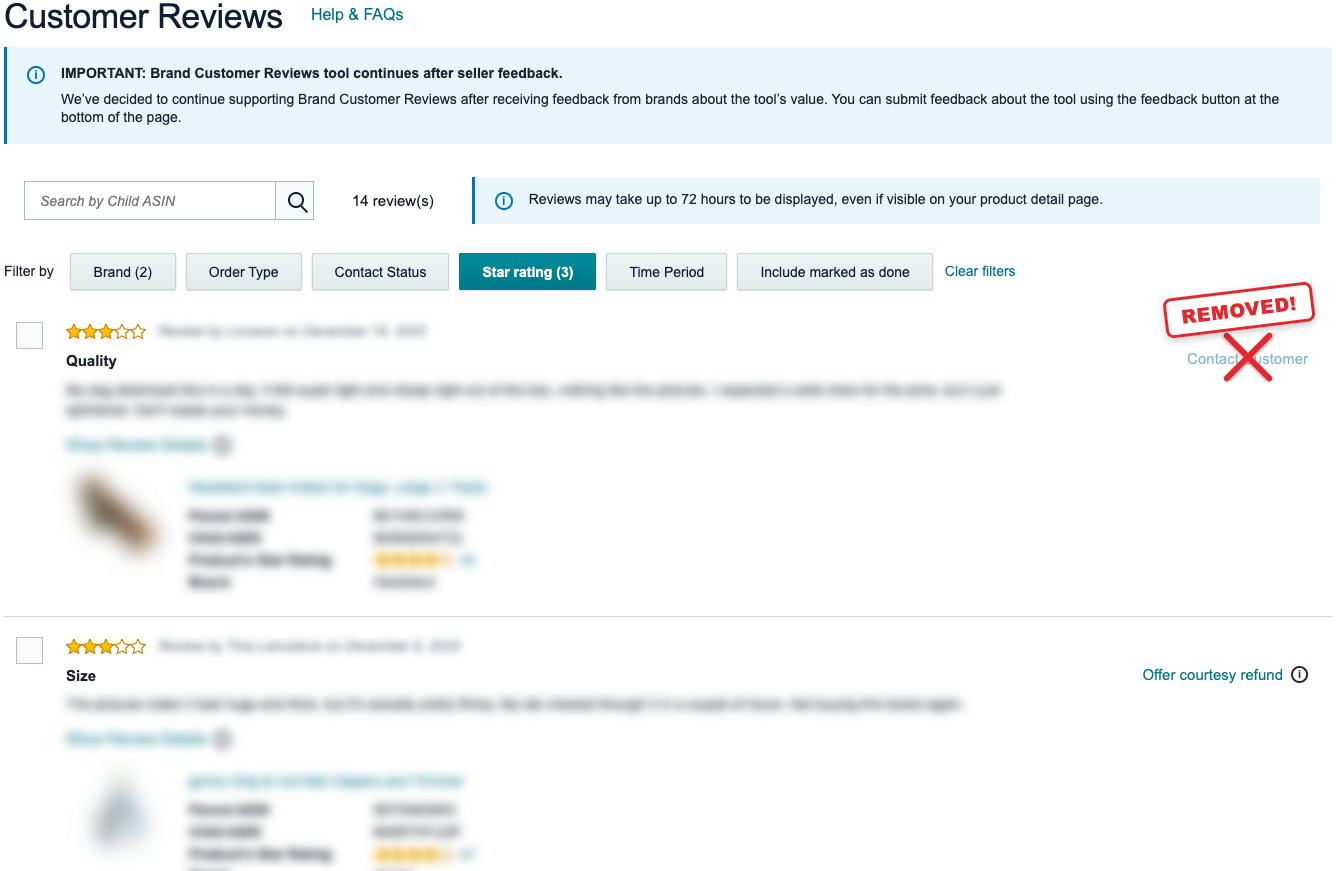
Brand Registry only. It lived under the Brands menu, on the Customer Reviews page in Seller Central.
Any verified-purchase review of 3 stars or fewer showed a "Contact Buyer" button.
Two locked templates: Courtesy Refund (offer a refund or replacement) and Customer Review (ask the buyer to explain the issue).
It ran through Amazon's messaging system. You never saw the buyer's email, and you could not edit the template text.
Asking a buyer to change or remove a review was always prohibited. That is review manipulation and can get an account suspended.
The point was post-sale recovery: fix the buyer's actual problem and let them decide whether to update the rating.
Don't mix up the channels
Amazon has several feedback systems. People lump them together, but the rules for each are different, and this change touches only one. Be clear on which is which.
Product reviews — about the product. Star rating on the detail page, attached to the ASIN. Every seller on that ASIN shares the same review pool. This is the only thing the new policy affects.
Seller feedback — about you as the seller, not the product (shipping, packaging, service). Tied to your account, shown on your seller profile. Separate removal rules: Amazon strikes feedback that is purely a product comment or that FBA was responsible for. Unchanged here.
Buyer-seller messaging — the order-related inbox, not a rating. This is the one channel still open: if the buyer messages you first, you can reply.
Request a Review — Amazon's automated, neutral request. It asks for a product review and seller feedback in one shot. Blind and templated. You cannot point it at a specific buyer.
Returns / A-to-z claims — operational outcomes, not feedback you respond to. They feed your performance metrics.
Voice of the Customer (VoC) — a dashboard, not a review system. It aggregates negative signals from the channels above into one health score per listing. More on it below.
For the rest of this article, "reviews" means product reviews on the ASIN.
What changed
The core of it:
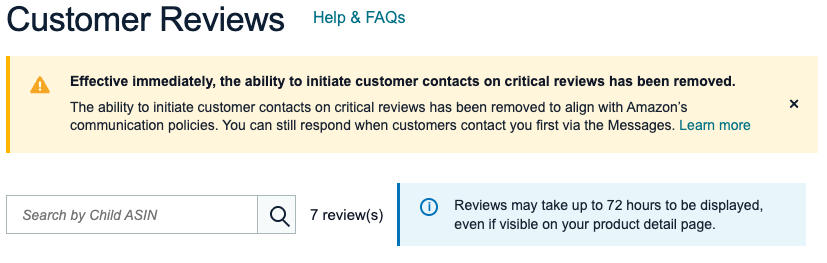
You can no longer initiate contact with a buyer because of a critical (1-3 star) review.
Per Amazon's clarification, the Customer Review template is the piece that was removed.
You can still reply if the buyer contacts you first through Messages.
Amazon's stated reason: keep reviews authentic so buyers trust them.
One caveat: the rollout is not uniform. The on-screen notice talks broadly about "initiating customer contacts," while Amazon's clarification points specifically at the Customer Review template, and some accounts still see refund or replacement options on certain reviews. Don't rely on that. Plan as if the whole proactive channel is gone.
What you can and can't do
Can't: initiate contact with someone over a 1-3 star review, by any route — not Messages, not a workaround. Side-channel outreach is a policy violation and a suspension risk.
Can: reply when a buyer messages you first about a problem. Do it fast.
Can: report reviews that break Amazon's Community Guidelines — profanity, off-topic content, spam, personal information, obvious competitor sabotage. Amazon removes policy-violating reviews. It will not remove a review just for being negative, so don't bother reporting those.
Can: use Request a Review on recent orders. Remember it asks for a product review and seller feedback at once, goes out blind, and can't target a specific buyer.
What to do now
The reactive tool is gone, so the work moves earlier in the process.
Cut defects and listing gaps. Most 1-stars trace back to a product fault, a damaged arrival, or a detail page that set the wrong expectations. Tighten QA on units that tend to arrive broken. Make photos and bullets accurate on size, fit, and box contents. Add clear setup instructions. A large share of bad reviews are really "I didn't understand how to use this," and that is a listing fix.
Mine competitors' reviews before you launch. A lot of review risk is decided before you ship a single unit. Run the competing listings through SoldScope's Listing Analyzer. It pulls the feedback on your competitors' products so you can see exactly what their buyers complain about: recurring defects, missing parts, unclear instructions, sizing that's off. Fix those problems in your own product at the design or sourcing stage, before launch, instead of shipping the same flaws and collecting the same 1-stars.
Build a review cushion with Vine. Proactive review generation matters more now, and Amazon Vine is the compliant way to do it. For Brand Registered sellers, Vine ships free units to vetted reviewers for honest reviews, up to 30 per parent ASIN. Use it on new launches. With only 2-3 reviews, one 1-star can pull your average from 5.0 down near 3. With 30 reviews behind it, the same 1-star barely moves it. Note: each parent ASIN can only be enrolled once, so time it for launch.
Check Voice of the Customer weekly. This is your early-warning system. It pulls returns, refunds, A-to-z claims, buyer messages, and reviews into one read per listing. Watch CX Health and your NCX rate (the share of orders that triggered a negative experience). When a listing turns orange or red, a defect or a misleading detail page is generating complaints, usually before the reviews pile up. Fix it there — pull bad inventory or correct the listing — before the ASIN gets dragged down or suppressed.
Make support easy to find. The only open channel starts on the buyer's side, so make sure they can reach you: compliant package inserts pointing to support, clear warranty info, and fast replies in Messages. That raises the odds a frustrated buyer contacts you instead of leaving a 1-star.
Bottom line
The reactive safety net for critical reviews is gone. What's left is prevention: better products, accurate listings, early-review coverage through Vine, and watching VoC so you catch problems before they become reviews. Don't try to work around the contact ban — that's an account risk. Move the effort upstream and keep selling.