What Is Amazon Haul? The Complete 2026 Guide for Sellers

Olivia Reyes
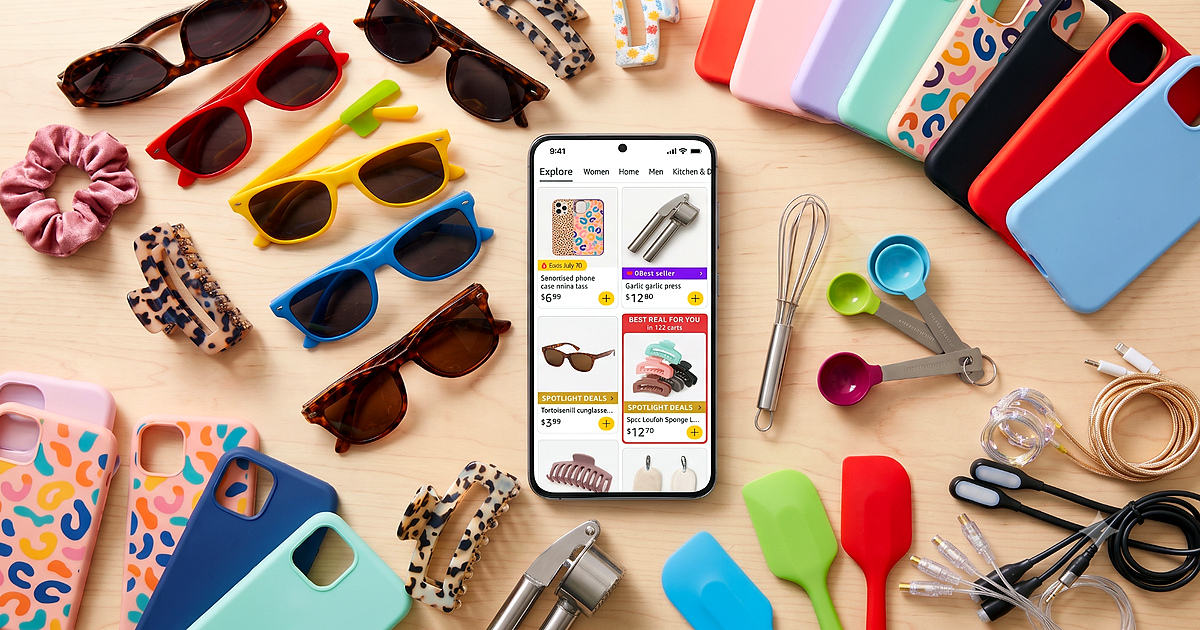
Table of contents
When Amazon launched Haul in November 2024, most industry commentators treated it as a defensive experiment: a hasty answer to Temu and Shein that would either quietly disappear or stay a curiosity buried inside the mobile app. Eighteen months later, the picture looks very different. Haul is out of beta, live in more than 25 countries, stocked with over a million items priced under $10, and for the first time it was folded directly into Prime Day 2026 with a 50%-off sitewide event.
At the same time, the ground under the entire ultra-low-price segment has shifted. The de minimis exemption that made the direct-from-China model possible is gone, tariffs have rewritten the math for every discount platform, and Amazon has quietly restructured how Haul inventory moves.
This guide breaks down what Amazon Haul actually is today: how it works, what changed after the tariff shake-up, how it stacks up against Temu and Shein, and whether you can sell on it (the question we get asked most).
Amazon Haul at a Glance
Amazon Haul is a separate storefront inside Amazon built around one rule: nothing costs more than $20. In practice, the catalog skews far cheaper than the cap suggests. Amazon reports over a million items priced under $10, a large share under $5, and a rapidly growing tier under $3. During special events, prices have dropped as low as $1, and even 11 cents for "hidden treasure" promotions.
The trade-off is delivery speed. Instead of the one-to-two-day Prime experience, most Haul orders arrive within one to two weeks, because the bulk of the assortment ships from overseas suppliers (predominantly China-based manufacturers) rather than from your nearest fulfillment center.
Three things separate Haul from a random discount app, and they're the reason it has pulled in shoppers who would never install Temu:
It lives inside your existing Amazon account. No new app, no new login, no new payment setup. Your Haul cart even syncs with your regular Amazon.com cart at checkout.
Every purchase is covered by Amazon's A-to-z Guarantee, the same protection you get on the main marketplace if an item arrives damaged, defective, or not as described.
Amazon screens Haul products for safety, authenticity, and regulatory compliance before they're listed, which is a meaningful difference from marketplaces where vetting is looser.
How to Find Amazon Haul
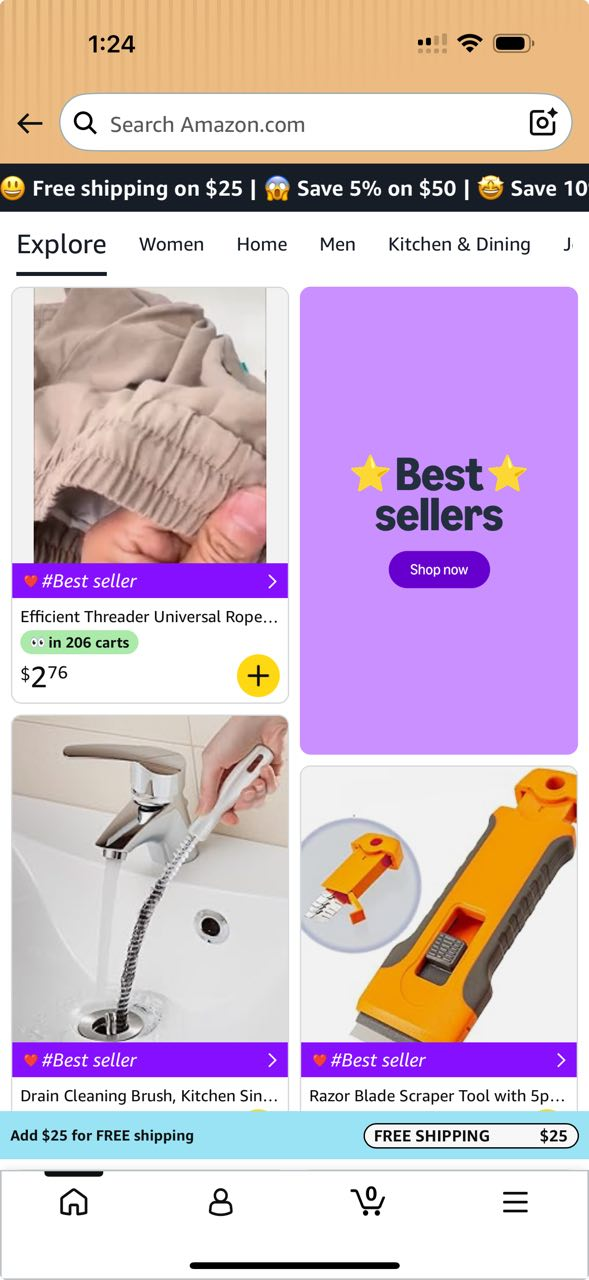
Haul started as a mobile-only experience, but that restriction ended back in the spring of 2025. Today there are several entry points, and none of them require a separate app:
Type "Haul" into the search bar of the Amazon Shopping app and tap the storefront suggestion.
Go to amazon.com/haul in any browser, desktop included.
Navigate through Shop by Department → Programs & Features → Amazon Haul.
If you don't see Haul (or its sister brand Bazaar, more on that below), it simply hasn't launched in your country's marketplace yet.
How Haul Differs From the Regular Amazon Store
The easiest way to understand Haul is to stop comparing it to Prime and start comparing it to a cross-border discount marketplace that happens to have Amazon's infrastructure behind it.
Regular Amazon | Amazon Haul | |
|---|---|---|
Price range | Anything | $20 max, most items under $10 |
Delivery | Same-day to 2 days with Prime | Typically 1-2 weeks |
Free shipping threshold | Prime membership or $35 (non-Prime) | Orders of $25+ (no Prime needed) |
Assortment | 300M+ products, all categories | Curated low-cost catalog: fashion, home, beauty, electronics accessories, kitchen, toys, sports, office |
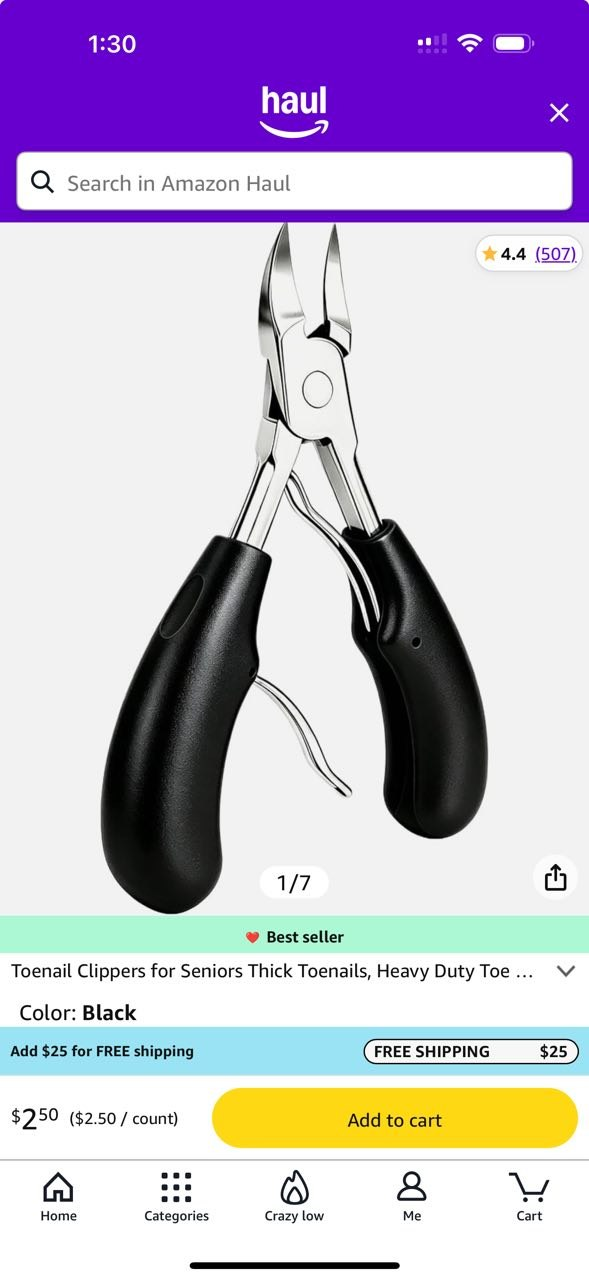
Listings | Full detail pages, A+ content, reviews | Simplified pages, fewer photos, lighter descriptions |
Bulk discounts | Rare | Built in: 5% off $50+, 10% off $75+ |
Prime badge | Yes | No. Prime isn't part of the experience |
The volume-discount mechanic deserves attention because it explains Haul's psychology. The storefront is engineered around the "haul" behavior familiar from TikTok unboxing culture: you rarely buy one item. You add a $3 phone stand, then chase the $25 free-shipping threshold, then notice you're only $12 away from the 5% discount tier. Average baskets behave accordingly.
Pricing, Shipping, and Returns: How an Order Actually Works
A single cheap item isn't really what Haul is built for. Orders under $25 carry a shipping fee (it was $3.99 at launch, and Amazon has kept small-order fees in place since), which effectively doubles the cost of a $4 gadget. Cross the $25 line and shipping is free, no Prime required.
Delivery estimates shown at checkout tend to be conservative. Amazon states most orders arrive within two weeks, and in practice many US orders land in five to eight days: goods from multiple sellers are consolidated overseas, flown in batches, cleared through customs, and handed to last-mile carriers.
Returns work on a shorter leash than the main store: Haul offers a 15-day return window (versus the standard 30 days on Amazon.com), with free returns on qualifying orders. Combined with the A-to-z Guarantee, this is the strongest buyer-protection setup in the ultra-budget segment. Temu and Shein can match the return windows but not the single trusted account, payment history, and dispute infrastructure.
One honest caveat that any fair review should include: quality is exactly what the price implies. Think dollar-store tier: functional, unremarkable, occasionally a pleasant surprise. Reviews are thinner than on the main marketplace, so social proof is limited, and packaging often arrives scuffed even when the product inside is fine.
From Beta Experiment to Global Storefront: A Short Timeline
November 2024. Haul launches as a US-only beta inside the Amazon Shopping app. Nine categories, a thin catalog, listings without bullet points, and heavy skepticism from the seller community.
February-April 2025. Amazon broadens the assortment with branded overstock and clearance-style deals (a move Temu and Shein never made) and extends Haul to desktop browsers.
May 2025. Two important things happen almost simultaneously. The US ends the de minimis exemption for shipments from China and Hong Kong, striking at the heart of the direct-shipping model. And inside Seller Central, Amazon introduces separate FBA capacity limits for Haul inventory, an early signal that Haul fulfillment was being rebuilt around Amazon's own warehouse network rather than pure factory-direct parcels.
August 2025. The de minimis suspension goes global: every low-value parcel entering the US now faces duties regardless of origin country.
November 2025. On its first anniversary, Amazon removes the "beta" label worldwide and reveals the scale of the expansion: selection up nearly 400% year over year, customer visits tripled since June, and availability in 25 locations. Haul operates under its own name in the US, UK, Germany, France, Italy, Spain, Japan, and Australia, while the same concept runs as Amazon Bazaar in Mexico, Saudi Arabia, and the UAE, plus a standalone Bazaar app across 14 more markets from the Philippines to Peru to Nigeria. The anniversary is celebrated with a two-day event featuring $1 items and 11-cent deals.
June 2026. Haul is integrated into Prime Day for the first time: 50% off sitewide on day one of the event (June 23), plus a $5,000 gift-card sweepstakes and category deals throughout the four-day sale. Amazon has confirmed plans to expand Haul to additional countries during 2026.
That trajectory, from "mobile-only US beta" to "global brand with two names and a Prime Day slot", is the clearest evidence that Amazon considers the experiment a success.
The Tariff Problem: How the End of De Minimis Changed Everything
For years, the entire Temu/Shein/Haul model rested on a US customs rule that let packages valued under $800 enter the country duty-free. Roughly 1.4 billion parcels used the exemption in its final year. That era is over: the exemption ended for China and Hong Kong on May 2, 2025, was suspended for all remaining countries on August 29, 2025, and a permanent statutory repeal is scheduled to cover every country by July 2027.
The immediate fallout hit Amazon's rivals hardest. Temu overhauled its shipping model within hours of the May deadline and began displaying import charges at checkout. Shein raised prices. Amazon, notably, ended up in a political firestorm of its own when a report claimed the company would display tariff costs next to prices. The White House called it "a hostile and political act," and Amazon clarified the same day that the idea had only ever been discussed for Haul, was never approved, and would not happen.
Haul's structural response was quieter and smarter: lean on the one asset competitors don't have. Amazon has increasingly routed Haul inventory through bulk importation into its US fulfillment network, where duties are paid on wholesale values at the container level rather than on individual retail parcels. Goods imported in bulk face more predictable tariff treatment than millions of individual direct-to-consumer packages, and Amazon's domestic logistics absorb the last mile. That is a large part of why Haul kept growing through 2025 while the pure factory-direct model was being squeezed.
Prices did drift upward across the whole segment (that's unavoidable when duties enter the equation), but Haul's sub-$10 core has held, and Amazon's November 2025 numbers (a growing under-$3 tier, tripled traffic) suggest the platform came through the tariff transition in better shape than its rivals.
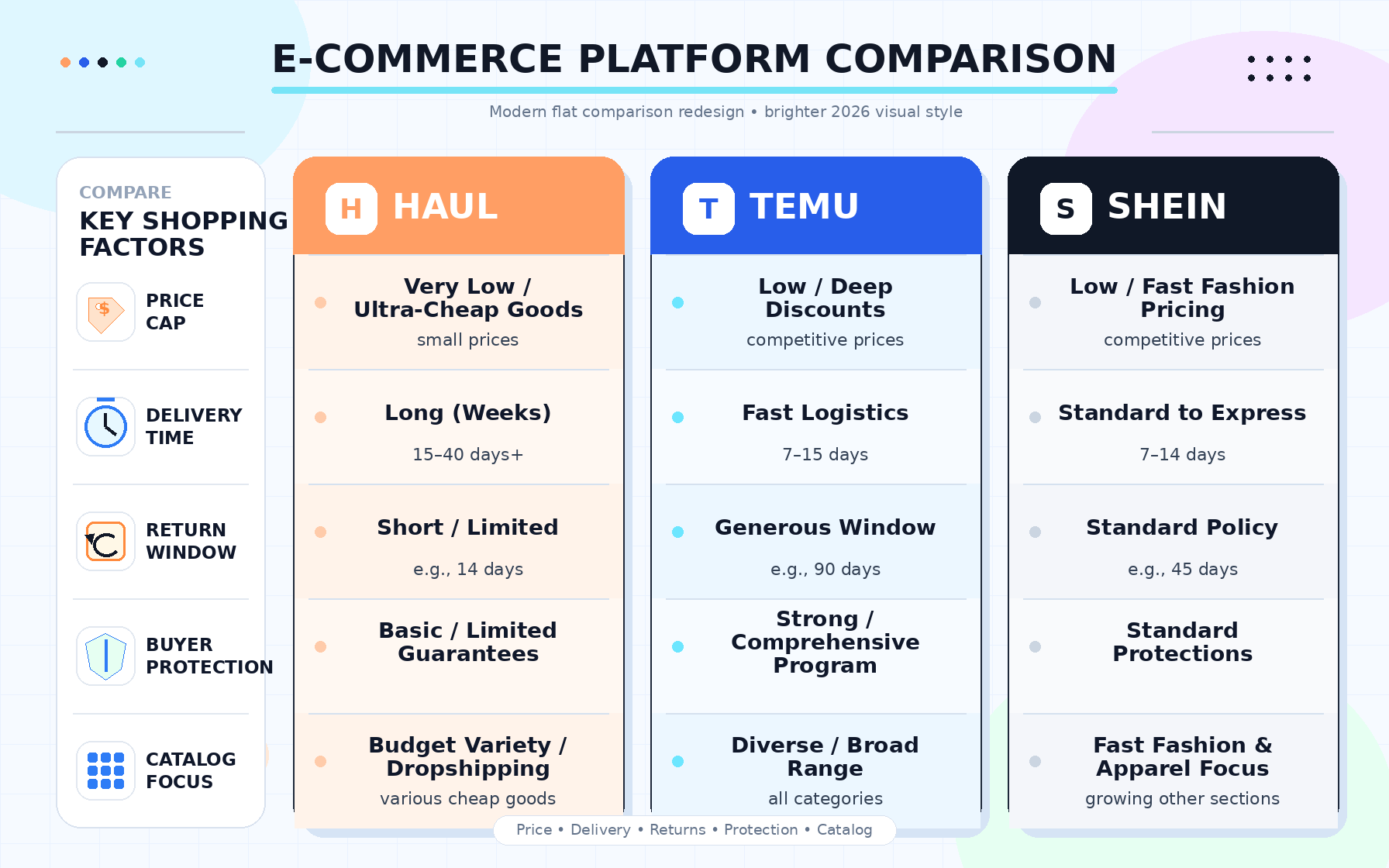
Amazon Haul vs. Temu vs. Shein: A Seller's View
From a seller's standpoint, these are not three interchangeable discount apps. Each plays a fundamentally different role in your strategy: one is a competitor you can't join yet, one is a channel you can enter today, and one only matters in a single vertical.
Haul is the closed club and the most direct competitive threat. You can't apply to sell on it, but its catalog sits one tap away from every Amazon shopper, wrapped in the trust of their existing account. That trust is the dangerous part: Haul converts budget-conscious buyers who would never install Temu, which means it pulls demand from inside the Amazon ecosystem, straight out of the search results where your generic sub-$20 listings live. Treat its assortment as a live map of where Amazon is anchoring price expectations.
Temu is the open door. Its seller program accepts applications, publishes its fee structure, and offers consignment and semi-managed models that most established sellers qualify for. If your goal is reaching the ultra-budget demographic today, this is the realistic route, with the obvious trade-offs of race-to-the-bottom pricing, thin margins, and a platform that controls far more of the relationship than Amazon does.
Shein matters only if you're in fashion. Its marketplace program exists, but the platform's depth in apparel, sizing data, and trend velocity makes it a specialist channel. Outside clothing and accessories, it's neither a serious threat nor a serious opportunity.
The strategic takeaway: Haul's real weapon against its rivals isn't price, since all three can hit $5. Its weapon is the trust gap. Amazon is betting that budget shoppers will accept a smaller catalog in exchange for a familiar account, familiar checkout, and real dispute infrastructure. Every quarter that bet keeps paying off, the invitation to sell on Haul becomes more valuable, and the pressure on unbranded sub-$20 listings on the main marketplace grows.
Can You Sell on Amazon Haul?
Here is the part most seller-focused articles get wrong, so let's be precise.
As of mid-2026, Amazon Haul remains invitation-only. There is no public application form, no opt-in checkbox in Seller Central, and no published fee schedule. Amazon curates the assortment by directly inviting sellers and manufacturers: historically concentrated among China-based factories that could hit the price points, and increasingly among sellers with strong fulfillment metrics as Haul shifts toward domestic inventory.
What you can do:
Express interest at interested-sellers@amazon.com. This is the official channel Amazon's own forum moderators point to. Include your seller credentials and describe your sub-$20 catalog and sourcing capability. Amazon reviews submissions but doesn't reply to most of them, so treat it as raising your hand, not applying.
Get your account invitation-ready. Everything publicly known about invited sellers points to the same profile: consistently competitive pricing on lightweight, low-cost SKUs, clean account health, reliable handling times, and no IP-complaint history.
Understand the operational reality if invited. Since May 2025, Haul inventory has its own FBA capacity limits, tracked in a separate Haul tab in the Capacity Monitor. Listings must be converted to Haul's simplified format, new products go through a 24-hour cross-border compliance hold before shipments can be created, and eligible products may be listed automatically across all Haul markets.
Beware of scams. Nobody can sell you "guaranteed Haul onboarding." Any paid course or service promising Haul access in 2026 is exploiting the information vacuum. The only door is Amazon's own invitation.
If your goal is simply to reach the same budget-shopper segment today, the pragmatic route is Temu's open seller program (or TikTok Shop), while keeping your Amazon account in invitation-ready shape.
Does Haul Threaten Existing Amazon Sellers?
Less than the 2024 panic suggested, but not zero, and the risk is unevenly distributed.
If you sell differentiated, branded, or bulkier products above the $20 line, Haul isn't your competitor; a customer choosing between two-day delivery of a $35 branded item and a two-week wait for a $7 lookalike was never really your customer at the margin. Sellers who ran this check against their own catalogs during Haul's first year mostly reached the same conclusion: outside a handful of generic niches, the overlap simply isn't there.
The exposure is real, however, for sellers of generic, lightweight, easily substituted goods: phone accessories, hair accessories, basic kitchen tools, unbranded apparel basics. Haul's catalog grew almost 400% in a year, and every new listing in those niches is a direct price anchor pulling customer expectations downward. Two practical defenses: first, track whether Haul now carries close substitutes for your hero SKUs and watch your conversion rate on price-sensitive keywords; second, invest in exactly what Haul listings structurally lack: reviews, rich content, brand story, and fast delivery. Those are the four levers a two-week generic import can't pull.
There's also an upside scenario worth monitoring: if Amazon keeps widening the invited-seller pool as Haul fulfillment moves domestic, Haul becomes a low-cost demand-testing channel, a way to validate a cheap SKU with minimal inventory before committing to a full FBA launch.