Amazon Suspension Prevention for Sellers and Teams

Sarah Johnson

Prevent Common Amazon Suspensions Before They Hurt Your Business
If multiple people touch your Seller Central account, listings, reimbursements, account health, and external traffic setup, suspension risk often starts in day-to-day operations long before it shows up in policy language. Most account problems are not caused by one dramatic violation. They come from access sprawl, overlapping virtual assistants, sloppy listing edits, weak documentation, and missed warnings that no one clearly owns. The practical fix is to treat suspension prevention as a systems problem: secure Amazon team collaboration platform access, tighter change control, recurring account checks, and recovery workflows that do not create new risk while solving old losses.

Where suspension risk actually starts
Experienced sellers usually know the obvious triggers: review manipulation, intellectual property complaints, prohibited claims, variation misuse, dropshipping violations, and poor merchant-fulfilled performance metrics. What often gets underestimated is the operational layer underneath those triggers.
A listing with a medical claim may get there because three different people edited copy from three different tools. A related-account review can begin because a freelancer logged into multiple seller accounts from the same device or network setup. A reimbursement issue can expand into a broader internal review when teams grant broad access to too many people and then lose track of who changed what. Suspension prevention is less about memorizing every rule and more about reducing the number of ways your business can accidentally appear non-compliant.
That is why sellers increasingly look for an all-in-one amazon seller safety dashboard or automated amazon account health audit software. Not because software replaces judgment, but because a good system can make drift visible earlier. The job is to surface risky changes, isolate access, keep evidence organized, and create a record of who did what.
For larger brands and agencies, scope matters. A solo seller can often manage risk with disciplined habits. A brand with in-house staff, agencies, freelancers, and international assistants usually needs a more formal amazon agency workspace for secure access and a clear approval process. More users means more opportunities for accidental policy exposure.
The tools matter less than the control model
When sellers evaluate a secure amazon team collaboration platform, they often focus on convenience first. That is understandable, but convenience is often where risk slips in.
The core idea is simple: not everyone who works on your business should have direct, broad, persistent access to Seller Central. There is a difference between needing work done and handing over the keys. A platform or process built for safe seller central access for agencies 2026 should reduce direct credential sharing, limit permissions where possible, create user-level accountability, and make overlap visible.

This matters most when you work with VAs or agencies across multiple accounts. One common failure mode is VA overlap, where the same contractor touches unrelated seller accounts in ways that may increase related-account risk. Amazon does not publish every linkage method, and sellers should avoid claiming they know the exact thresholds. The safer assumption is that overlapping access, devices, networks, browsers, and credentials can create unnecessary exposure. That is why the category behind a preventing va overlap suspension tool exists in the first place.
Expectation vs. reality is useful here:
Expectation: “My VA is experienced, so they know how to stay safe.” Reality: Even competent assistants can create risk if your operating model allows shared logins, uncontrolled device use, and undocumented account hopping.
Expectation: “My agency only needs admin access for a week.” Reality: Temporary full access often becomes long-term background access that no one reviews.
Expectation: “We’ll notice if something goes wrong.” Reality: You often notice after a policy warning, a listing takedown, or a related-account review.
A workable model for a multi-account management safety tool for sellers separates access by client, records activity where available, and reduces unmanaged logins. The exact tool matters less than the principles: least privilege, accountability, and periodic review of who still has access.
How a safer operating system reduces avoidable flags
The strongest suspension prevention setup is usually boring. That is a compliment.
Start with access control. Map every person who can affect account health: internal staff, agencies, catalog freelancers, PPC teams, reimbursement providers, and developers. Then ask a harder question: who really needs direct Seller Central access, and at what permission level? If your answer is “almost everyone,” your risk is probably already too high.
Next, separate workflows by function. Listing creation, reimbursement recovery, account-health review, and traffic tracking should not all depend on the same broad admin path. For example, if you use an amazon listing builder for cosmo and rufus ai, the safer pattern is controlled publishing and review rather than live, freeform edits by multiple contractors. AI-assisted listing creation can improve speed, but it can also introduce claims, compatibility language, or category-specific phrasing that creates compliance issues if no one reviews the final output.

Then build recurring checks. This is where automated amazon account health audit software can earn its keep. Useful audits are not just about checking the Account Health page once a week. They can also cover suppressed listings, stranded inventory, performance notifications, contribution conflicts, reimbursement gaps, missing invoices, and policy-sensitive listing language. The point is to catch issues while they are still operational problems, not formal enforcement events.
There is also a documentation layer that many teams neglect. If you sell branded products, your invoices, authorization letters, and supply chain records should be organized before you need them. If you rely on agencies, your approval trail for listing edits should exist before a claim arises. If you send external traffic, your attribution and landing-page setup should be documented before someone questions source quality or ad-to-listing consistency.
If an activity affects compliance, performance, or attribution, do not let it live only in Slack messages and verbal approvals. Informal decisions often become formal problems later.
Reimbursements, audits, and why recovery workflows can create risk
Recovery tools sound unrelated to suspension prevention until you look at how they are implemented.
Many sellers now use an automated fba refund and recovery service or an amazon fba reimbursement tool no commission to capture operational losses. That can be reasonable. Reimbursements and inventory discrepancies are real margin leaks, and manual claims take time. But the risk question is not “should I do recovery?” It is “how much access do I grant to do recovery, and how are claims monitored?”

If your recovery provider requires broad login access, can also edit core account settings, and has no clear boundary around what they touch, that is a governance problem. A safer setup is one where reimbursement workflows are narrow, visible, and reviewed periodically. The same logic applies to profit recovery and audit software 2026. Good software should help identify recoverable issues and operational errors without becoming another unmonitored actor inside the account.
This is one reason sellers look for an all-in-one amazon seller safety dashboard. In theory, one place for account health, reimbursement audit, listing checks, team permissions, and change monitoring reduces tool sprawl. In practice, consolidation only helps if the dashboard itself is permissioned properly and does not encourage excessive access concentration.
One platform can reduce chaos. One platform can also create a larger blast radius. Choose accordingly.
External traffic is useful, but attribution mistakes can bleed into compliance
Brands investing in off-Amazon traffic often think of it as a growth topic, not a safety topic. That is incomplete.
When you add creators, agencies, landing pages, attribution tags, and multiple ad accounts, you create more ways for product claims and promotional messages to become inconsistent with the listing. You also create more people and systems touching campaign links, storefront paths, and branded copy. That is where external traffic tracking for fba brands safety becomes relevant.
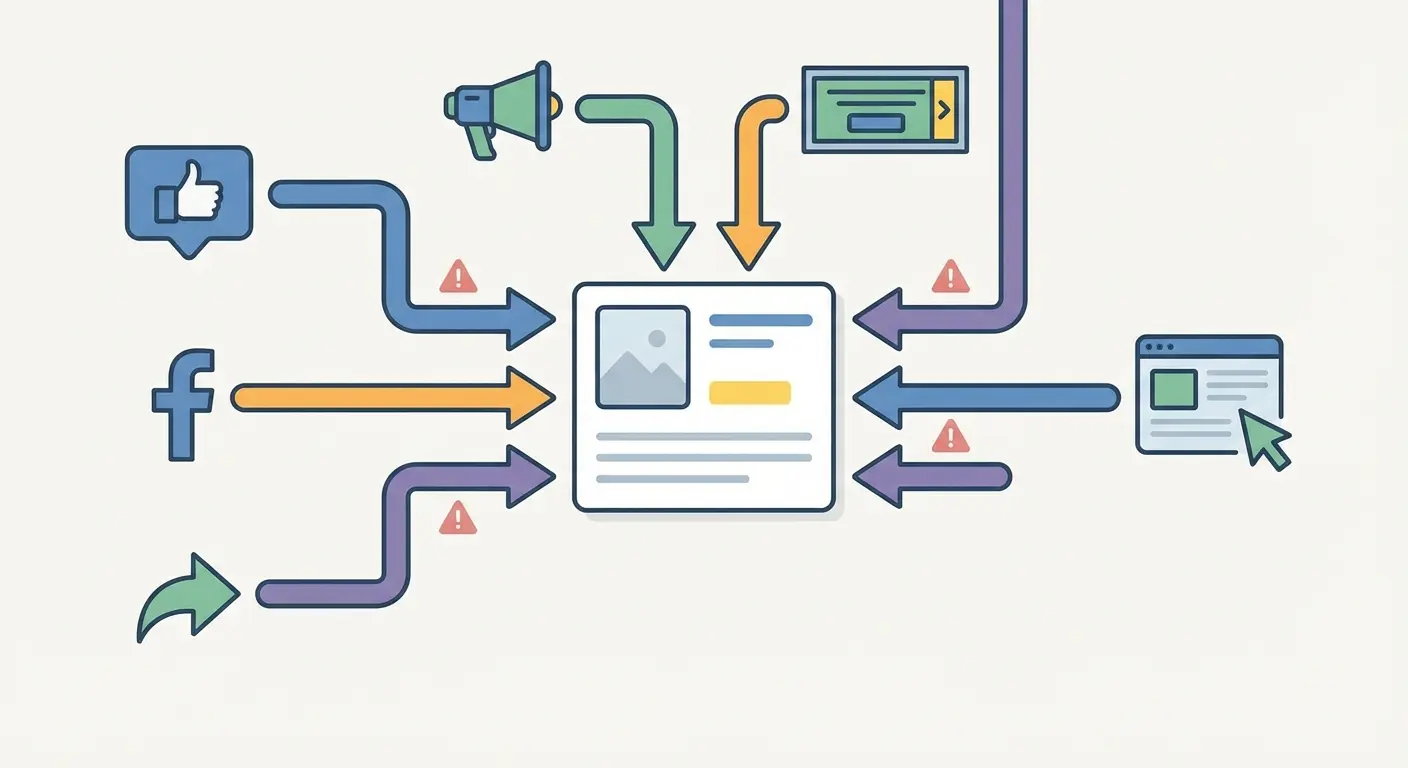
The safety issue is not that external traffic is inherently risky. It is that off-Amazon messaging can overpromise, target the wrong audience, or use wording your listing would not be allowed to use. Then the listing, ad, landing page, and customer expectation fall out of alignment. The result may be poor conversion quality, complaint spikes, higher returns, or policy review if the product positioning becomes problematic.
The reliable pattern is to connect tracking with copy governance. If external traffic teams can create landing pages or ad copy, they need the same claim standards as the listing team. Attribution without copy control is incomplete.
Three short scenarios that show where this breaks
A brand working with two agencies
Hypothetical case: a mid-sized FBA brand uses one agency for PPC and another for catalog work. Both are given broad access. A freelancer from the catalog agency also supports another seller in the same category. No one reviews access hygiene because “the agencies handle it.”
Nothing happens immediately. Then a listing change triggers a compliance warning, and during the scramble the brand realizes five external users still have account access, no one knows who published the risky language, and there is no clean record of approvals.
What would have helped: an amazon agency workspace for secure access, user-level activity visibility where possible, role separation, and a quarterly access review.
A reimbursement provider with too much reach
Hypothetical case: a seller hires an automated fba refund and recovery service to pursue missing inventory and damaged-unit reimbursements. The provider gets broad account access and keeps it indefinitely. Months later, the seller cannot quickly distinguish recovery-related actions from unrelated account changes when performance issues emerge.
What would have helped: restricted workflow scope, periodic permission review, and a reimbursement process tied into a broader automated amazon account health audit software setup.
AI listing speed without a compliance checkpoint
Hypothetical case: a brand adopts an amazon listing builder for cosmo and rufus ai workflow to accelerate catalog updates. The tool drafts useful copy, but no human with category-specific compliance knowledge reviews the final text. Several listings pick up claim language that might be normal in direct-to-consumer marketing but risky on Amazon.
What would have helped: mandatory final review, category-specific prohibited phrase lists, and a publishing process that separates drafting from approval.
The misunderstandings that get sellers into trouble
One common mistake is thinking suspension prevention is mainly about appeal readiness. Appeals matter, but prevention starts earlier with operational discipline. If your process is weak, you are just building a better fire extinguisher.
Another misunderstanding is believing account health equals the Account Health page. That page matters, but it is naturally limited. By the time a problem appears there, the upstream cause may have been live for days or weeks. A true safety process monitors change sources, documentation quality, and access behavior, not just Amazon’s visible alerts.
Sellers also overestimate trust as a control system. Trusted agencies, long-term VAs, and experienced consultants still need constrained access and review. Good people make mistakes, teams change, and subcontracting is often less visible than clients assume.
Finally, many sellers assume more software automatically means more safety. It can also mean more complexity, more credentials, and more disconnected workflows. A secure amazon team collaboration platform is useful only if it replaces bad habits rather than sitting on top of them.
Where even good systems have limits
No system eliminates suspension risk because some triggers come from customer behavior, rights owner complaints, automated enforcement, or category-wide policy shifts. Even disciplined sellers can face authenticity reviews, complaint spikes, or false-positive listing suppressions.
There are also practical limits to visibility. Third-party tools can help organize access, audits, reimbursements, and tracking, but they do not provide perfect insight into Amazon’s internal risk models. Be skeptical of any product implying it can guarantee account safety. The best a multi-account management safety tool for sellers can do is reduce obvious exposure and improve your ability to respond.
Complex organizations face another edge case: legitimate overlap. Aggregators, agencies, and enterprises may have valid reasons to operate across multiple accounts, regions, or brands. In those cases, the goal is not to avoid all shared infrastructure. It is to document ownership clearly, keep entities distinct where required, and avoid careless overlap in personnel and access practices.
There is also a tradeoff between speed and control. Tight permissions, approval gates, and audit trails can slow execution. That is real. The answer is not to remove controls, but to apply them where account-level risk is highest: login access, listing publication, account settings, compliance-sensitive copy, and high-impact service providers.
What seasoned sellers should actually do next
If you want to prevent common Amazon suspensions before they hurt your business, focus on the parts of the operation that create hidden exposure.
Audit every user, agency, VA, and service with account access. Remove anything stale.
Move toward a secure amazon team collaboration platform or amazon agency workspace for secure access that reduces direct credential sharing.
Treat VA and freelancer overlap as a real risk vector. A preventing va overlap suspension tool is useful if it supports separation and accountability, not just convenience.
Use automated amazon account health audit software to catch drift early, but pair it with clear ownership for fixes.
Keep reimbursement and recovery workflows narrow. An amazon fba reimbursement tool no commission or automated fba refund and recovery service should not become a backdoor to broad account control.
If you use an amazon listing builder for cosmo and rufus ai, require human review before publication, especially in sensitive categories.
Connect external traffic tracking for fba brands safety with messaging governance so ad copy, landing pages, and listings stay aligned.
Suspension prevention is rarely about one perfect policy memo. It is usually the result of a business that knows who has access, who can publish, who can recover money, and who is responsible when Amazon starts asking questions.