Flipping Amazon Deals: Strategy or Margin Trap?

Olivia Reyes

Flipping Amazon Deals: Smart Strategy or Slow-Motion Margin Trap?
Have you ever bought what looked like a 40% discount on Amazon, run it through an FBA calculator, and realized you are working for single-digit ROI after fees and price drops?

Flipping Amazon deals sits in a gray zone between sharp opportunism and capital mismanagement. Done well, it can generate consistent cash flow without building a brand. Done casually, it can tie up cash, increase the chance of IP-related disputes, and clog FBA storage with slow movers.
This is not a beginner’s overview. Here is how to think about flipping Amazon deals as a decision framework, not a hustle.
The Real Decision: Temporary Arbitrage or Repeatable System?
At its core, flipping Amazon deals is a form of retail arbitrage. You buy discounted products, sometimes from Amazon itself or other retailers, and resell them at a higher price if the market supports it after the discount ends.
The real decision is not “Can I make money on this ASIN today?” It is:
Is this a temporary pricing anomaly?
Or am I stepping into a structurally unstable listing?
Experienced sellers know the difference matters more than the headline discount.
Expectation vs reality:
Expectation: Buy during a Lightning Deal, wait for price recovery, relist at a historical average.
Reality: Other sellers had the same idea, the Buy Box price drops, and margin compresses quickly.
The strategic question is whether you are exploiting short-term mispricing, or entering a listing where price instability is normal behavior.
What Actually Matters (Ranked by Impact)
When evaluating flips, some factors consistently matter more than others.
1. Price Stability Over Time
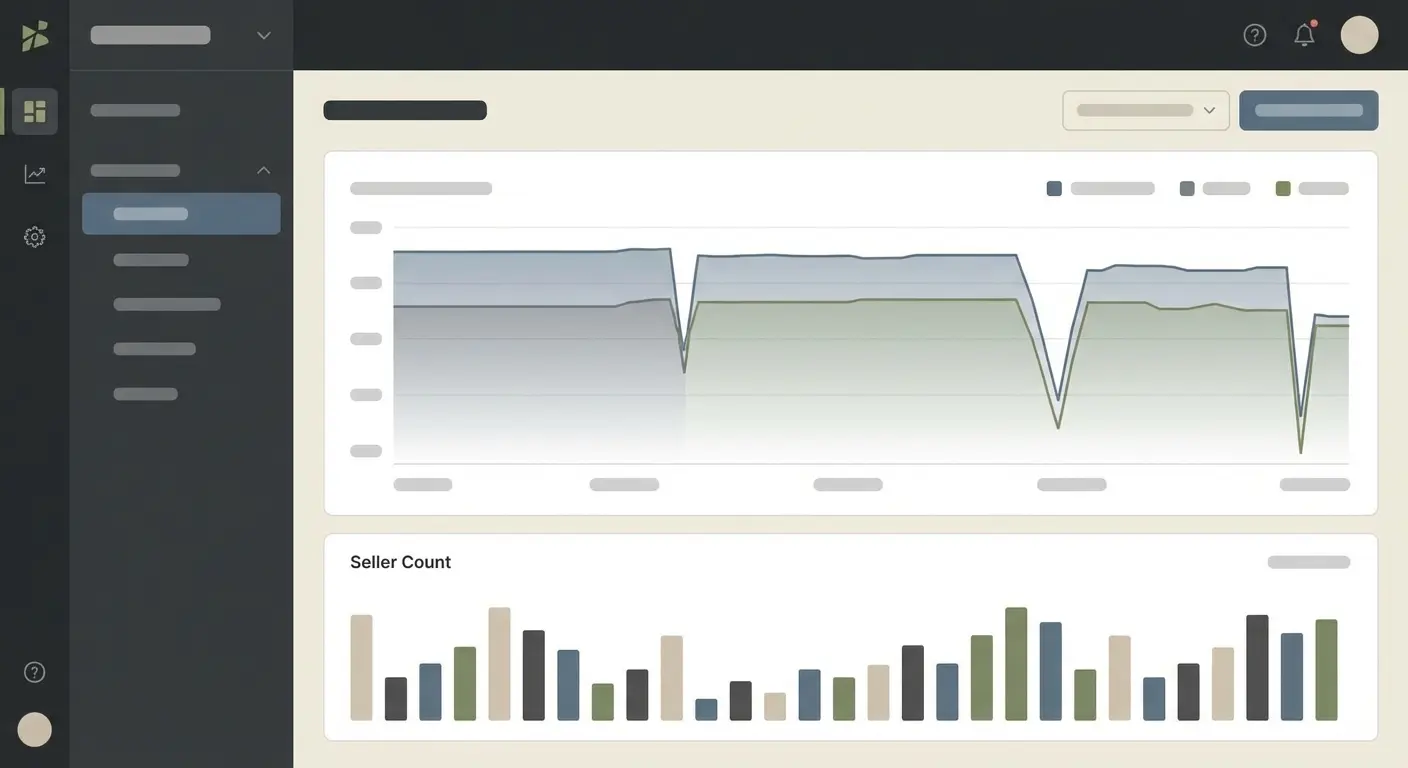
Before anything else, check long-term pricing patterns using tools to track Amazon price history. You are looking for:
Clear reversion after discounts
Limited volatility outside promotional windows
No consistent downward trend
If the “regular” price has been eroding for six months, you are not buying a dip. You are buying into a declining market price.
Seller insight: A listing that recovers cleanly after deals is often easier to trade than one with higher theoretical margins but chaotic pricing.
2. True Net Profit After All FBA Costs
Gross margin is not the decision point. You need to calculate true profit after FBA fees and other costs that hit the unit.
Use an fba revenue calculator net profit model that includes:
Referral fee
Fulfillment fee
Storage, based on a realistic holding period
Prep costs
Inbound shipping
Expected returns and customer-damaged units
Many sellers try to automate Amazon FBA profit calculation using integrated sourcing and analysis stacks. That can speed up screening, but you still need to sanity-check assumptions, especially storage duration, return rates, and Buy Box price.
If you are not consistently able to calculate true profit after FBA fees, you are making a pricing bet without knowing the downside.
3. Sales Velocity and Rank Behavior
An amazon sales rank tracker tool provides more than a single BSR snapshot. What you want is:
Consistent rank movement, not occasional spikes
Predictable daily or weekly sales patterns
No long flatlines that suggest intermittent demand
A product that sells three units per day with stable rank can be safer than one that sells twenty units during promo weeks and nearly zero otherwise.
Flipping works best when inventory turns fast. Capital velocity usually matters more than theoretical ROI.
4. Brand Gating and Listing Access
Many retail arbitrage mistakes happen before inventory is even shipped.
Always confirm how to check brand gating on amazon before buying. In Seller Central, attempt to add the ASIN and review whether:
You are approved in the category
You are approved for the brand
Additional documentation or approval is required
Being blocked after purchase is not a strategy problem. It is a cash flow problem.
5. Account Health and IP Risk
Avoid amazon ip complaints retail arbitrage by treating risk as a sourcing and documentation issue, not as a post-purchase customer service problem.
Higher-risk patterns often include:
Popular electronics
Premium beauty brands
Top toy brands during Q4
Categories where brands actively police distribution
Even authentic products can trigger complaints if a rights owner challenges your offer or if Amazon requests documentation you cannot supply. Retail receipts may not be enough in some escalations, especially if the brand or Amazon requests invoices showing a verifiable supply chain. If you cannot defend the purchase with documentation that clearly ties the units to a legitimate source, the risk profile increases.
A complaint can also restrict selling privileges on specific ASINs or brands and can delay disbursements in some cases, which changes the expected value of the flip.

6. Inventory Management Reality
Flipping Amazon deals creates inconsistent restock patterns. Once the deal is gone, it is gone.
Using amazon fba inventory management software becomes more important as SKU count increases. You need visibility into:
Aging inventory
Sell-through rates
Storage utilization
Capital locked per ASIN
Without tight tracking, arbitrage turns into a scattered pile of small bets you cannot evaluate clearly.
Scenario-Based Thinking: When Flips Make Sense (and When They Don’t)
Rather than rigid rules, think in conditional patterns.
If you have limited capital and want fast cash rotation, flipping can work when you focus on:
Small test quantities
Stable, mid-volume listings
30 to 60 day sell-through targets
The goal is velocity. You are trading margin depth for speed.
If you already run wholesale or private label, flipping may serve as a tactical cash-flow buffer. In that case, you can tolerate smaller positions because your core revenue does not depend on arbitrage stability.
However, if you are trying to build a predictable, scalable operation, Amazon-to-Amazon flips are harder to systematize. software for amazon to amazon flips can surface opportunities, but deal flow is inconsistent by nature and competition can be immediate.
If you cannot monitor price changes frequently, flipping becomes riskier. Price compression can happen quickly after major deals. If you are not adjusting repricing or exit decisions fast enough, margin can evaporate.
If your account health is already strained, adding retail arbitrage risk may not be rational. The incremental profit often does not justify extra enforcement exposure.
Common Failure Modes That Quietly Kill Margin
Experienced sellers rarely fail because they cannot find deals. They fail because they mismanage the second-order effects.

Buying Based on Percentage Discount
A 50% discount off MSRP means little if the market price has already shifted. Historical price and current competitive pricing matter more than MSRP.
Ignoring Seller Saturation
Before buying, check:
Current FBA seller count
Historical seller count trends
Whether Amazon Retail is on the listing
If 25 sellers jump to 60 during every deal cycle, expect Buy Box share to shrink and sales velocity to thin.
Overestimating Price Recovery
Not all listings bounce back. Some settle at a new lower price once enough sellers clear inventory, and that lower price becomes the market anchor.
Weak Documentation
Trying to avoid amazon ip complaints retail arbitrage after the fact is reactive. The real decision happens before purchase. If you would hesitate to submit your sourcing documents to Amazon in a performance-related request, reconsider the buy.
Treating Arbitrage Like a Brand
Flipping Amazon deals is transactional. Emotional attachment to ASINs leads to overbuying. Each SKU should justify itself independently on velocity, downside protection, and risk-adjusted return.
Decision Walkthrough #1: The Clean, Boring Flip
Hypothetical scenario:
You find a home goods product discounted 35% during a seasonal event.
You check:
Price history shows consistent post-sale recovery within two to three weeks.
An amazon sales rank tracker tool shows steady daily movement.
Seller count remains under 10 outside sale windows.
You can list the ASIN without approvals or extra documentation prompts.
You run it through an fba revenue calculator net profit model:
After referral, fulfillment, shipping, and prep, projected ROI is 28%.
Break-even price is below the recent non-sale range.
Estimated sell-through is within 30 days based on conservative demand assumptions.
You buy 20 units, not 200.
Price recovers as expected. You exit in four weeks.
What made this work was not the discount. It was price stability, manageable competition, and disciplined quantity.
Decision Walkthrough #2: The Attractive Trap
Hypothetical scenario:
A premium beauty product is discounted 45%.
You check tools to track Amazon price history. It shows high volatility, with large swings month to month.
Sales rank looks strong, but seller count jumps sharply during promotions.
You can submit a listing request successfully. However, sourcing is from a retail chain, not a distributor, and documentation strength may not match what a brand or Amazon could request later.
You run it through an fba revenue calculator net profit model:
Your fba revenue calculator net profit output shows 35% ROI at a past average price, but at the current competitive price, ROI drops to 8%.
This flip depends on:
Significant price recovery
No complaints or documentation challenges
Limited new sellers
Those assumptions are outside your control. An experienced seller either buys a very small test batch, or passes.
Building a Controlled Arbitrage Operation
If flipping Amazon deals is part of your strategy, systematize it.

Use amazon retail arbitrage software tools to:
Scan quickly
Filter by ROI thresholds
Surface price history
Preview fee impacts before you commit
Some sellers also rely on the best app for flipping amazon deals to speed up sourcing, especially when they are screening large catalogs. Speed helps, but it does not replace discipline.
To reduce errors, create a checklist that forces you to calculate true profit after FBA fees under conservative assumptions and then validate the output manually. A good workflow will also include a second pass to calculate true profit after fba fees using your own average prep, inbound, and return assumptions, not just app defaults.
For example, many operators implement:
Minimum 25% ROI under a conservative price assumption
Maximum 60-day hold target
No high-risk brands unless documentation is strong enough to defend
A cap on capital per ASIN as a fixed percentage of your arbitrage budget
For ongoing monitoring, pair your sourcing stack with tools to track Amazon price history so you can see when a listing stops behaving like a recoverable dip and starts behaving like a repriced-down market.
Inventory discipline is equally important. amazon fba inventory management software should flag aging units early. If a flip hits 75 to 90 days without recovery, consider lowering price to free capital instead of holding indefinitely.
To keep math consistent across your team, standardize a template that can automate Amazon FBA profit calculation while still allowing overrides for storage duration, expected returns, and liquidation assumptions. If you are building internal tooling, the goal is to automate Amazon FBA profit calculation without masking risk.
Some sellers also keep a separate sheet to automate amazon fba profit calculation across multiple potential exit prices, so repricing decisions are driven by numbers, not hope.
To handle deal math quickly in the field, many teams rely on a repeatable way to calculate true profit after FBA fees and then compare it against a minimum required cash-on-cash return.
If you mainly focus on Amazon-to-Amazon opportunities, keep a dedicated review lane for software for amazon to amazon flips, since the competition pattern and timing can differ from off-Amazon retail sourcing.
Finally, for sellers who like a single summary number, an fba revenue calculator net profit view is only useful if the assumptions reflect your real holding period and realistic Buy Box outcomes.
So, Smart Strategy or Risky Side Hustle?
It depends on how you frame it.
Flipping Amazon deals is smart when:
You treat each ASIN as a short-term capital allocation
You calculate true profit after FBA fees conservatively
You monitor price and seller count actively
You manage documentation and IP exposure carefully
It becomes risky when:
You rely on optimistic price recovery
You scale quantity before validating velocity
You ignore gating and complaint risk
You confuse discount size with opportunity quality
A simple rule many experienced sellers use: if the deal only works at the absolute historical high price, it probably does not work.
Arbitrage can generate cash flow, but it typically does not build durable brand equity. If you understand which game you are playing, flipping Amazon deals can be a tool in your portfolio rather than a slow drain on capital.