Good Better Best Strategy for Amazon Sellers

Olivia Reyes

How the Good Better Best Product Strategy on Amazon Drives More Sales
Are shoppers landing on your listing and defaulting to the cheapest option, even when your margins are thin and your premium version is clearly stronger?
That is often less about “price” and more about how the offer set is structured and compared.
The Good Better Best framework gives Amazon sellers a way to guide comparison, encourage trade-ups, and lift average order value without relying on constant discounting. When implemented carefully, it connects with your amazon pricing strategy software, variation architecture, bundling logic, and inventory planning.
This article breaks down how the model works within Amazon’s ecosystem, how to operationalize it with the right tooling, and where it can backfire if you overlook policy, catalog mechanics, or operational constraints.

What “Good Better Best” Really Means on Amazon
At its core, the Good Better Best strategy is structured choice.
You offer three tiers around the same core job-to-be-done:
Good: The entry version that solves the core problem.
Better: A version with meaningful upgrades.
Best: A premium offer with maximum perceived value and contribution margin.
On Amazon, this usually is not just “more features.” It is also about:
Anchoring perceived value
Controlling price comparison
Protecting margin through tiered differentiation
Increasing AOV (average order value)
A serious implementation often touches multiple systems:
An amazon listing variation builder or amazon parent child listing tool
amazon product bundling software
An automated amazon pricing tool or amazon dynamic pricing software
An amazon profit margin optimization tool
amazon seller aov increase software
An amazon catalog management service
The concept is simple. The execution is operational.
Why Three Tiers Change Buyer Behavior
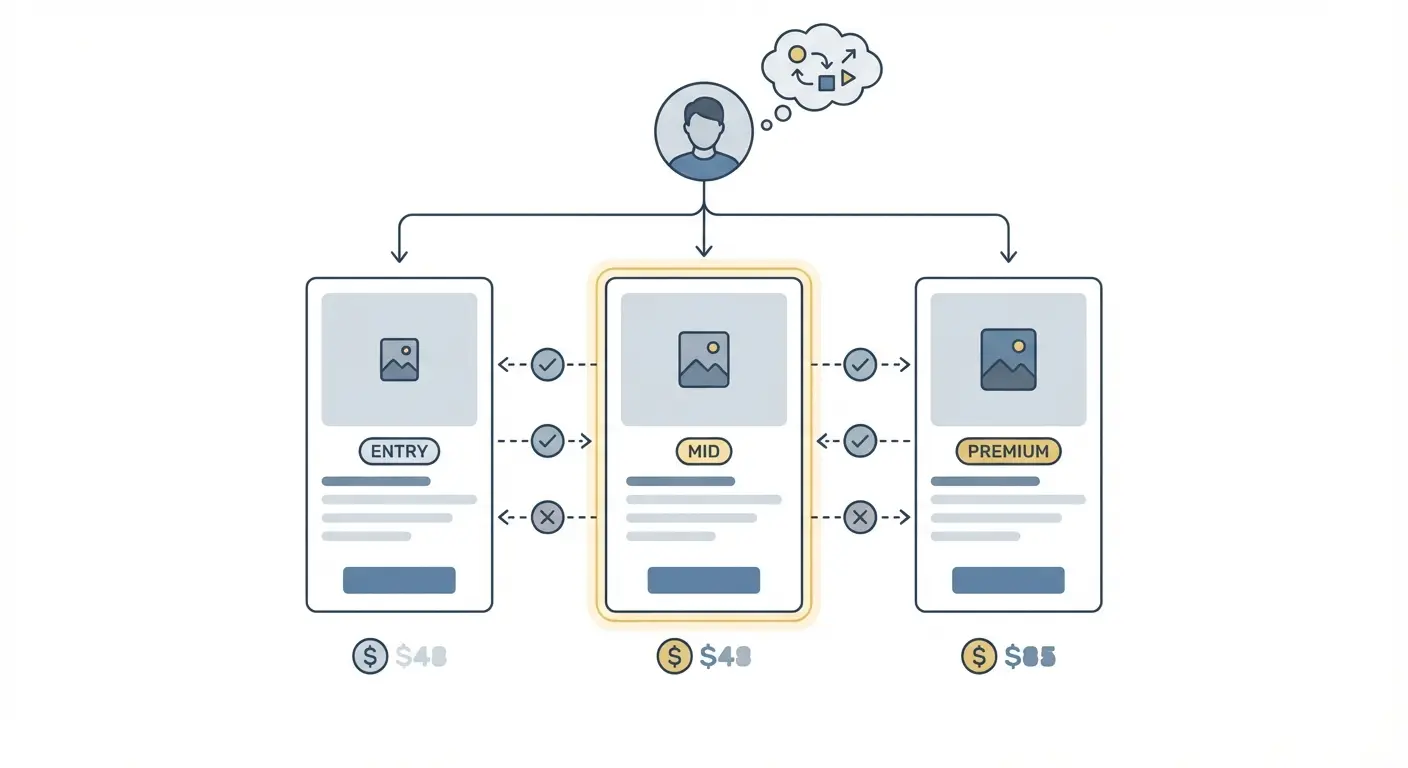
Three tiers work because they reduce cognitive load while keeping comparison intuitive:
The cheapest option feels low-risk.
The middle option often feels like the “sensible” choice.
The premium option can set a value anchor that makes the middle tier look efficient.
In many categories, the middle tier can become the primary revenue driver when the upgrades are obvious and the price ladder is coherent. Results vary by category, price point, and how clearly the shopper understands the differences.
Buyers rarely know absolute value. They respond to relative value. If your Better tier clearly improves on Good for a reasonable step-up in price, many shoppers will trade up. If Best is credibly superior and priced higher, it can support the ladder by anchoring the comparison.
Structuring It Inside Amazon’s Variation System
On Amazon, a clean implementation is often built with parent-child variation relationships when the products qualify under Amazon’s variation policies for the category and variation theme.
A dedicated amazon parent child listing tool or amazon listing variation builder helps you:
Keep reviews consolidated when the products are legitimately related
Support side-by-side comparison in the variation selection UI
Reduce catalog fragmentation and duplicate listing risk
Maintain clean internal structure for reporting and operations
The key decision is whether the tiers should live under one parent or be separate listings.
Single parent listing can work well when:
The core product is the same, and the difference is a valid variation in that category, such as size, count, pack quantity, or color.
The relationship complies with Amazon’s variation rules for the category.
Review aggregation is a priority, and the products are closely comparable.
Separate listings are often safer when:
The products are meaningfully different in form, function, or primary use case.
The category does not allow the variation theme you would need.
The tiers would require forced variation, which can trigger suppression or later separation.
An amazon inventory structure software layer can help map these relationships so you do not accidentally split demand across competing SKUs, or create complexity you cannot fulfill reliably.
Seller note: if your Better and Best tiers are not clearly differentiated, shoppers may not understand the upgrade path. Make the differences explicit in images, titles (within style guides), and bullets, while staying compliant with Amazon’s listing policies.

Using Bundles to Create the “Better” and “Best” Tiers
Many sellers do not need new manufacturing to build tiers. They need a clear offer architecture.
This is where amazon product bundling software can help operationalize the build, track components, and reduce fulfillment mistakes.
Instead of redesigning the core product:
Good: Core product only
Better: Core product plus one high-perceived-value accessory
Best: Core product plus a fuller accessory set, extended pack, or a higher-capacity configuration
Bundles can improve margin math because:
Accessories can carry higher markup than the hero item.
Bundles reduce direct apples-to-apples comparison.
Competitors cannot always undercut an identical offer set.
Bundles also increases complexity. You must:
Maintain accurate component inventory
Avoid stranded components
Forecast demand across tiers so one missing component does not break the ladder
An amazon catalog management service paired with inventory controls can reduce the classic failure mode of running out of one bundle component while sitting on excess base units.
Policy caution: ensure any bundle claims are accurate, avoid prohibited product claims, and follow Amazon rules for bundles and multipacks in your category. Do not create misleading pack counts or images that imply items not included.

Pricing Logic: Where Software Actually Matters
This model lives or dies on pricing gaps.
If the spread between Good and Better is too small, customers may trade up without meaningfully increasing contribution margin. If the spread is too large, customers may retreat to Good or exit.
An amazon dynamic pricing software stack, or an automated amazon pricing tool, can help you:
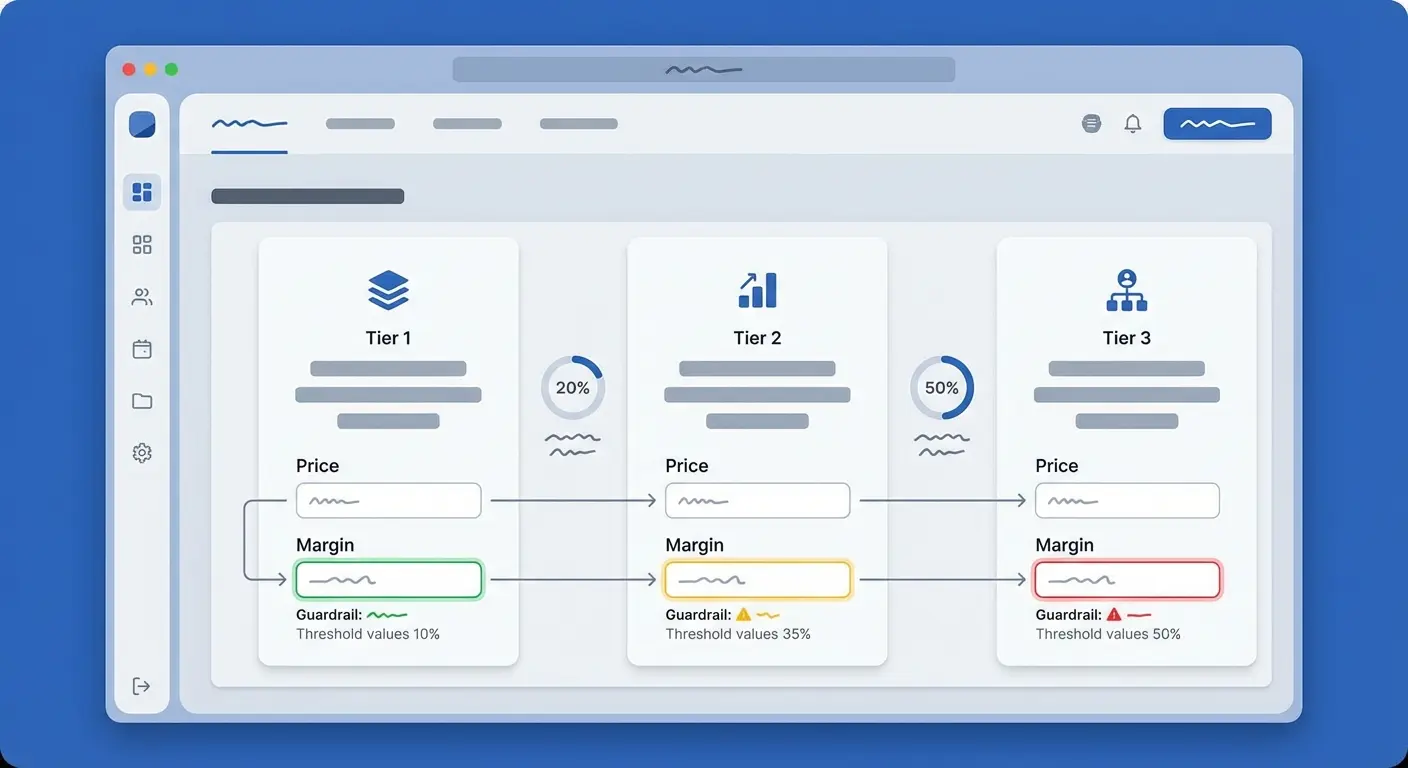
Maintain consistent percentage gaps between tiers
Respond to Buy Box dynamics where repricing is applicable
Enforce minimum price or margin guardrails based on your cost model
A common mistake is repricing each child ASIN independently. That can break the ladder psychology and create awkward gaps.
Instead, use amazon pricing strategy software to manage relationships across tiers, not just individual prices. Think in structured spreads:
Good: baseline
Better: baseline plus X%
Best: baseline plus Y%
Your amazon profit margin optimization tool should reflect real unit economics per ASIN, including referral fees, FBA fees, storage, returns, and advertising costs. Higher-priced tiers can sometimes tolerate higher ad costs, but that depends on conversion rate and contribution margin, not just price.
For wholesale and business pricing, b2b amazon pricing automation can help keep tier logic coherent for business customers who see quantity discounts or business-only pricing, while still honoring your overall ladder.
How This Strategy Increases AOV
The Good Better Best structure directly supports AOV because the upsell path is built into the shopping experience.
Without tiers:
One product
One price
One margin ceiling
With tiers:
A clear trade-up path that can lift blended order value
amazon seller aov increase software can help quantify the impact by tracking:
Upgrade rate from Good to Better
Revenue share by tier
Margin-weighted contribution by SKU, not just unit volume
The goal is not to push everyone to Best. The goal is to:
Capture price-sensitive shoppers at Good
Shift a portion upward
Raise blended margin and blended AOV across the offer set
Example logic (illustrative, not universal):
Good converts at 12%
Better converts at 9%
Best converts at 5%
Good might “win” on units, but Better and Best can improve total profit if their contribution margin per order is substantially higher.
Case Example: Private Label Kitchen Tool
Hypothetical scenario:
A seller offers a stainless steel garlic press.
Initial structure:
Single SKU at $19.99
Revised tier structure:
Good: Garlic press only
Better: Garlic press plus cleaning brush
Best: Garlic press plus brush plus silicone peeler plus storage case
They implement:
A clean parent-child structure using an amazon listing variation builder
Bundle logic through amazon product bundling software
Margin guardrails through an automated amazon pricing tool
Results to evaluate:
Does the Better tier become the primary revenue driver?
Does blended contribution margin increase?
Does advertising efficiency improve on higher-priced tiers?
PPC efficiency can improve if conversion stays healthy while revenue per click rises. It can also worsen if the tiering reduces conversion. Measure it rather than assuming it.

Case Example: Consumable Multi-Pack Strategy
Hypothetical supplement brand:
Original:
30-count bottle only
Good Better Best adaptation:
Good: 30-count
Better: 90-count (3-pack)
Best: 180-count (6-pack)
Instead of discounting heavily, they:
Maintain logical per-unit savings
Use amazon dynamic pricing software to keep consistent pack economics
Structure variations under one parent when the category’s variation theme supports count or pack size
The result is often a shift toward multi-pack purchases, improving:
AOV
Inventory turn predictability
Customer lifetime value assumptions for retention models
Forecasting becomes critical. amazon inventory structure software that maps pack relationships can reduce stockouts that collapse the ladder.
Common Misinterpretations That Hurt Sellers
“Good should be low quality.” Good should still solve the core problem. If Good disappoints, reviews and return rates can hurt the entire product family, especially if variations share a parent.
“The premium tier should be massively overpriced.” If Best feels indefensible, it will not anchor value. It has to be credible, clearly differentiated, and supported by the listing content.
“All tiers should be equally promoted.” Not necessarily. Many sellers bias ads toward Better if it balances conversion and contribution margin. Confirm with data.
“Repricing should treat each SKU independently.” That often breaks the ladder. Tier relationships need to stay coherent if you want the behavioral effect.
“Bundles are just higher-priced duplicates.” If the bundle does not create clear, defensible value, shoppers will default to Good or leave.
Where This Strategy Breaks Down
There are real limits:
Highly commoditized products If differentiation is minimal and competitors sell functionally identical items, tiering can be difficult without brand strength or unique assets.
MAP-restricted wholesale brands If your pricing flexibility is constrained by MAP policies or supplier agreements, it can be hard to create meaningful gaps.
Low price-point products At very low prices, the ladder may not move AOV enough to justify operational complexity.
Operationally weak backends Without reliable inventory tracking or an amazon catalog management service, the complexity can increase stockout risk and fulfillment errors.
Aggressive repricing environments If an automated amazon pricing tool follows competitor moves without protecting tier gaps and guardrails, the ladder can collapse.
In some categories, too many child ASINs can reduce clarity. If your variation set becomes crowded, shoppers may stop comparing and start exiting.
Decision Rules for Experienced Sellers
Before implementing Good Better Best, pressure-test the infrastructure:
Can you clearly articulate why each tier exists in the shopper’s mind?
Do you have margin headroom to create real differentiation?
Do your systems support relationship-based pricing logic?
Can your inventory operation handle bundles and multi-packs reliably?
Will review aggregation strengthen trust, or will one weak tier drag down the family?
If you cannot answer these confidently, fix the backend before adding complexity.
What This Looks Like in a Mature Amazon Operation
In advanced accounts, Good Better Best is not a listing hack. It is part of system design across catalog, pricing, and operations.
It integrates with:
amazon dynamic pricing software to protect spread logic
amazon profit margin optimization tool workflows to prioritize high-contribution SKUs
amazon catalog management service processes to maintain compliant variation structure
b2b amazon pricing automation to keep tier logic consistent for business buyers
amazon seller aov increase software to track blended impact, not just unit sales
At that stage, tiers become a portfolio strategy, not just a conversion tactic, and they work best when your catalog rules, costs, and inventory reality all agree.
Practical Takeaways for Sellers
Three structured tiers can outperform a single SKU when differentiation is real, visible, and policy-compliant.
The middle tier often becomes the revenue driver when anchored correctly.
Protect price gaps using amazon pricing strategy software, not manual, isolated edits.
Use an amazon parent child listing tool to maintain clean relationships, and an amazon variation management tool to keep variation data consistent as the catalog evolves.
Bundles can be a low-capex way to create Better and Best tiers, but amazon inventory structure software must support the component reality.
Track blended margin and AOV, not just conversion rate per SKU.
If your backend systems are weak, tier complexity will expose operational gaps quickly.
The Good Better Best strategy is not about adding options. It is about engineering comparison, then supporting that comparison with tooling that keeps pricing, catalog structure, and fulfillment aligned.