Sell Home Improvement Products on Amazon Profitably

Olivia Reyes

How to Sell Home Improvement Products on Amazon Without Bleeding Margin

Most sellers do not fail in Tools & Home Improvement because demand is weak. They fail because small technical errors compound over time. Common examples include an incorrect variation theme, missing compatibility details, an inaccurate bundle description, or poor prep for FBA fees on oversized units. By the time returns rise or a listing becomes suppressed, margin is already under pressure.
If you plan to sell home improvement products on Amazon, especially at scale, the real decision is not “Is there demand?” It is whether you can operate cleanly inside a technical, compliance-heavy category where mistakes can get expensive.
This guide breaks down how experienced sellers should think about Amazon home improvement category approval, listing structure, returns control, and long-term brand scalability.
What You’re Actually Deciding When Entering Home Improvement
On the surface, Tools & Home Improvement looks straightforward. Many subcategories are not gated for many sellers, and demand can be steady year-round. That accessibility increases competition and raises the cost of operational mistakes.
The real decisions sit beneath the surface:
Should you enter as a generalist tool seller or a tight niche brand?
Do you rely on FBA despite dimensional weight and storage costs?
How much technical documentation will you build into listings?
Do you centralize catalog control or risk fragmentation across marketplaces?
Do you need external expert Amazon account management to prevent structural issues?
Unlike impulse-driven categories, buyers here care about compatibility, measurements, voltage, materials, and installation constraints. One missing specification can raise return rates quickly.
Home Improvement rewards operational discipline. It punishes vague listings.
What Actually Matters Most (Ranked Criteria for Sellers)
When evaluating whether and how to scale in this category, these criteria tend to matter most in practice.
1. Listing Precision and Compatibility Clarity
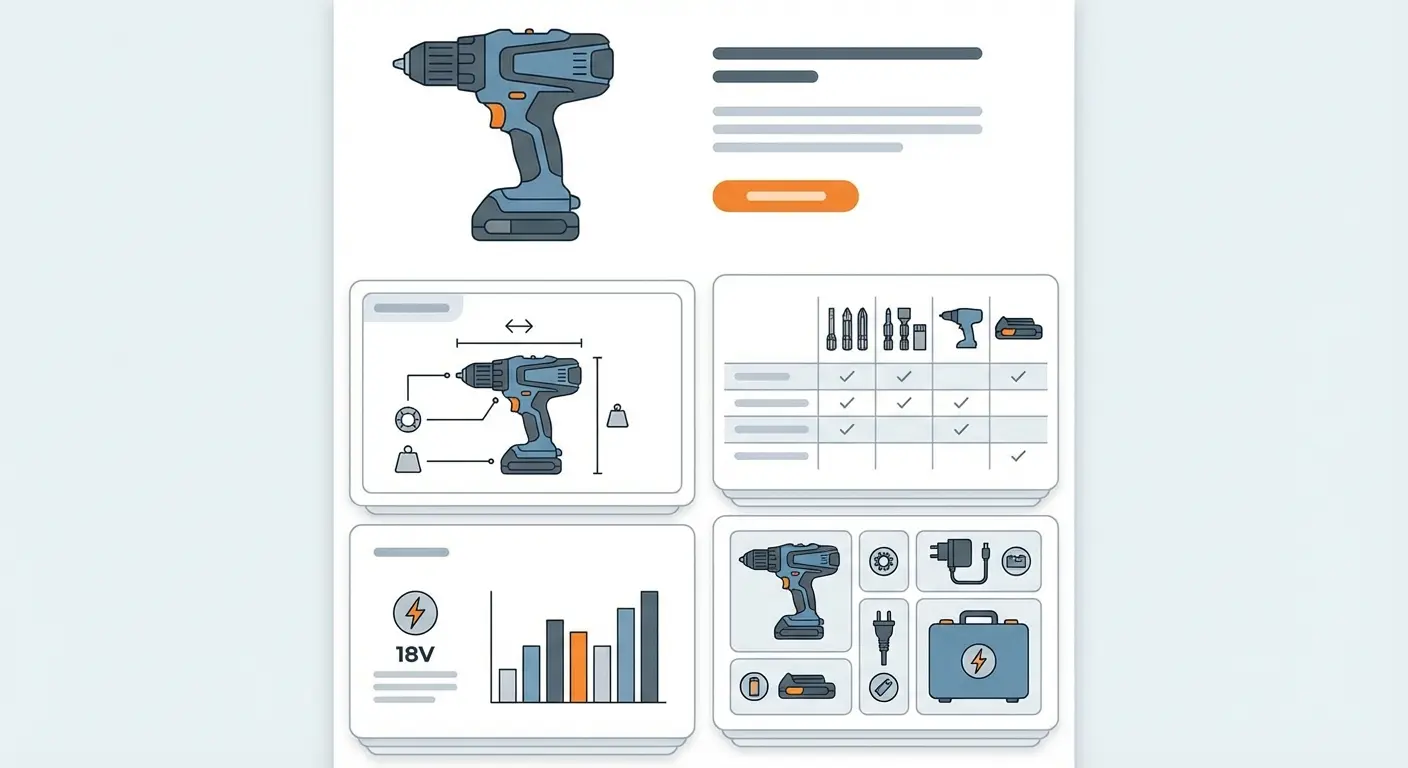
In tools, plumbing, lighting, and fixtures, ambiguity is a conversion and returns problem.
If your listing does not clearly state:
Dimensions, ideally with units stated consistently
Compatible models, fittings, or standards
Voltage, plug type, wattage, or amperage when applicable
Included components versus optional add-ons
Buyers will fill in the gaps. That often leads to “not compatible” returns.
Investing in Amazon home improvement listing optimization is not cosmetic. It is part of a returns and compliance strategy.
2. Return Rate Management and Post-Sale Friction
To reduce Amazon returns for tools, design listings backward from common failure modes:
“Didn’t fit”
“Not compatible”
“Too small” or “too large”
“Hard to install”
“Missing parts” or “not as described”
High-performing sellers often add:
Installation diagrams or step-by-step visuals in images
Clear “What’s in the box” graphics
Compatibility charts with model numbers or measurements
Close-up images of connectors, threads, or fittings
Use-case visuals showing the item installed
This reduces buyer misinterpretation, especially among DIY customers. It can also reduce negative reviews tied to misuse or incorrect expectations.
3. Catalog Structure and Variation Hygiene

Home Improvement brands frequently run into parent-child issues, duplicate ASINs, and misused variation themes. Over time, that can cause:
Review fragmentation across similar items
Detail page quality issues that reduce conversion
Attribution and reporting noise in ads
Confused shoppers who select the wrong option
If you have multiple sizes, finishes, wattages, pack counts, or compatible models, variation discipline matters. Some brands use Amazon catalog management services to unify attributes, eliminate duplicates, and fix Amazon broken variations without creating new data conflicts.
Catalog debt compounds. Clean structure early usually reduces the amount of rework later.
4. Fee Structure and Fulfillment Constraints

Heavy, bulky, or oversized products can materially change unit economics under FBA due to shipping weight, dimensional weight, and storage fees. Before scaling, evaluate:
Dimensional and shipping weight tiers
Storage cost exposure during slower seasons
Removal and disposal options for aging inventory
Damage rates and packaging performance in fulfillment
Some sellers split strategy:
FBA for compact, fast-moving SKUs
FBM for oversized, fragile, or slow-moving items
The right fulfillment mix is SKU-dependent. Prime eligibility can help conversion, but it does not automatically fix margin.
5. Compliance and Safety Positioning
Even when Amazon home improvement category approval is not a barrier for your account, compliance still matters. Amazon can request documentation, remove listings, or restrict sales when a product triggers safety or policy concerns.
Pay attention to:
Electrical certifications and safety documentation when applicable
Country-specific plug standards and voltage requirements for international marketplaces
Safety warnings and installation cautions that match the product’s real use
Recall exposure and supplier traceability
Correct condition classification, especially for used or refurbished inventory
Products that can cause injury or property damage can create account-level risk. Build compliance into sourcing, packaging, and product documentation rather than trying to patch it into the listing later.
6. Advertising Efficiency and Launch Sequencing
An aggressive Amazon product launch strategy without listing precision can burn budget quickly.
In this category, ad waste often comes from:
Broad targeting for highly specific products
Weak keyword segmentation between compatible and incompatible searches
Sending paid traffic to unclear or incomplete listings
Variations that split reviews and conversion signals
Clean catalog first. Scale ads second.
Many mid-sized brands use Amazon seller agency services to align catalog, ads, and backend attributes, especially when multiple markets or large SKU counts are involved.
Scenario-Based Thinking: When Each Strategy Makes Sense
If You Sell Technical or Compatibility-Sensitive Products
Products like faucet cartridges, electrical adapters, plumbing fittings, or replacement parts require extreme clarity.
In this case:
Put compatibility tables directly into images.
Use exact model numbers where allowed and accurate.
Avoid variation families that mix incompatible models.
The goal is not maximum traffic volume. It is qualified traffic that converts and stays satisfied.
If You Sell Heavy Tools or Equipment
For large power tools, storage systems, or garage equipment:
Run margin scenarios using FBA fees tied to size tiers and storage.
Evaluate a hybrid FBA and FBM approach.
Reinforce packaging to reduce in-transit damage.
Set reorder cycles based on sell-through so storage fees do not erase profit.
Growth without logistics modeling becomes expensive quickly.
If You’re Building a Niche Brand (e.g., Home Organization)

When trying to scale Amazon home organization brand, the biggest risk is catalog sprawl.
As SKU count grows:
Variation trees get messy.
International listings diverge.
Attributes become inconsistent across similar products.
If left unmanaged, ads often become less efficient because performance data fragments across near-duplicate listings.
Scaling here requires:
Standardized naming conventions
Clean parent-child architecture aligned with Amazon’s variation rules for the product type
Consistent backend attributes across marketplaces
Brand growth is operational growth.
If You’re Launching a New Tool Line
For new SKUs in a competitive space:
Start with fewer variations so early reviews and conversion signals concentrate.
Use long-tail, high-intent keywords aligned with real compatibility.
Focus on clarity over keyword stuffing.
Expand only after conversion stabilizes.
A disciplined Amazon product launch strategy prioritizes detail page readiness before aggressive expansion.
Pitfalls That Quietly Kill Home Improvement Sellers
Overusing Variations
Combining unrelated models under one parent to consolidate reviews can create compatibility confusion. That often leads to negative reviews that mention the wrong configuration.
Fixing this later can require splitting variation families. That can also change how reviews and sales history display across children, depending on how the catalog is restructured.
Ignoring Installation Friction

Many sellers assume buyers understand installation. In reality, skill levels vary widely.
If your product requires tools not included, state it clearly. If mounting hardware is optional or varies by configuration, show that distinction in both images and bullets.
Reducing cognitive friction reduces return requests.
Treating Catalog Cleanup as Optional
Broken listings, duplicate ASINs, and inconsistent attributes reduce discoverability and conversion. Eventually, brands must:
Fix Amazon broken variations
Merge or retire duplicate content when appropriate
Rewrite bullet points and specifications to match the physical product
Retrofitting this after scaling into multiple marketplaces is more complex and time-consuming.
Advertising Before Structural Stability
If conversion rate is unstable due to unclear listings, advertising magnifies losses. PPC should scale a system that already converts, not compensate for a weak one.
Neglecting International Differences
Electrical standards, measurement units, and compliance documentation vary across marketplaces. Copying a US listing into EU or UK marketplaces without localization can create confusion and increase the chance of policy or customer experience issues.
Cross-marketplace alignment requires intentional catalog governance.
Two Practical Decision Walkthroughs
Walkthrough 1: Mid-Size Tool Brand Considering FBA Expansion
A brand selling mid-priced power drills via FBM wants to move more volume into FBA to increase Prime-eligible offers.
Constraints identified:
Each unit is bulky.
Return rate is moderate.
Packaging is basic.
Listings do not clearly state voltage or included accessories.
Evaluation:
FBA fees tied to size and weight reduce contribution margin.
Prime can increase conversion, which may also increase absolute returns.
Unclear specs can amplify returns when traffic rises.
Mitigation approach:
Redesign packaging for durability and better fit.
Update listings with explicit voltage, region compatibility, and included accessories.
Test FBA on a subset of SKUs before migrating the full catalog.
Model return-adjusted profit, not just gross margin.
A hybrid approach may outperform a full FBA conversion.
Walkthrough 2: Home Organization Brand Trying to Scale Internationally
A storage solutions brand has 40 SKUs in the US and wants to expand to EU marketplaces.
Constraints identified:
Duplicate listings exist for similar items.
Variation trees are inconsistent.
Measurements are mixed or incomplete.
Titles and attributes are inconsistent across SKUs.
Evaluation:
International expansion multiplies catalog errors.
Advertising data fragments across duplicates.
Compliance and labeling differences may surface.
Mitigation approach:
Centralize and standardize catalog structure first.
Use Amazon catalog management services to unify attributes and enforce consistency.
Correct measurements and ensure units are clear and consistent per marketplace.
Align naming conventions before duplicating listings into additional regions.
Scaling after cleanup is usually smoother than scaling during cleanup.
What Experienced Sellers Internalize
Clarity reduces returns more effectively than reactive customer service.
Catalog discipline compounds over time.
Variation misuse creates long-term conversion and merchandising problems.
Heavy or oversized SKUs demand fulfillment modeling before scaling.
Ads amplify structural strength or weakness.
Compliance and safety positioning protect the account, not just the listing.
Scaling a Home Improvement brand is operational, not just marketing-driven.
When complexity exceeds internal bandwidth, Amazon seller agency services can complement in-house teams, and expert Amazon account management can reduce expensive structural mistakes.
Selling in Home Improvement is not about riding demand. It is about controlling technical detail at scale. If you treat it as a systems problem rather than a traffic problem, margin is easier to protect.