Selling on Amazon USA from Canada: Taxes and FBA

Sarah Johnson

How Canadian Sellers Can Start Selling on Amazon USA Without Getting Tripped Up by Taxes, Shipping, and FBA Choices
If your Amazon.ca business is stable but your move south keeps stalling, the issue usually is not lack of U.S. demand. It is the practical stack of decisions that appears all at once: account setup, tax forms, marketplace tax collection, cross-border shipping, NARF versus U.S. FBA, Section 321, returns, and whether your margins still work after all of that.
For most established Canadian sellers, expanding to Amazon.com is less about learning a new marketplace and more about redesigning your operating model for a larger one. Listings can often be adapted. The catalog logic is familiar. What changes is the logistics and compliance structure around each sale. This guide explains how to expand amazon ca business to usa market, what selling on amazon usa from canada taxes 2026 means in practical terms, and how to evaluate amazon narf vs sending inventory to us fba based on margin, speed, and operational complexity.
Why the U.S. expansion looks simple, but rarely is
One distinction matters early: selling on Amazon.com can be simple to enable, but selling profitably and cleanly from Canada takes planning.
Canadian sellers often do not need a completely separate seller profile to access Amazon.com. With Amazon’s North America unified account structure, many sellers can manage Amazon.ca, Amazon.com, and Amazon.com.mx under one account. That lowers the barrier to entry, but it can also create the false impression that U.S. expansion is mostly a listing exercise.
It is not. The harder questions are operational. How will orders reach U.S. customers? Who is the importer of record when inventory crosses the border? What customs treatment applies? Where will returns go? How will payouts be received? Which tax tasks does Amazon handle, and which remain yours?
A useful way to frame the move is in three layers:
Marketplace layer: account access, listings, pricing, reviews, ads
Movement layer: shipping from canada to us fba cost, customs, duties, prep, returns
Money layer: tax interview, marketplace tax collection, income reporting, FX and payouts
Most seller mistakes happen when one layer is planned without the others. A product that looks strong on Amazon.com can become weak once FBA placement, customs, shipping, and return handling are included.
Your starting point: what actually needs to be set up

A practical registering for amazon usa from canada checklist starts with separating what can be reused from what must be localized.
Account access is usually the easy part. Canadian sellers can often use the North America unified account structure to sell on Amazon.com without opening an entirely separate seller account. If you already have catalog history on Amazon.ca, tools such as Build International Listings may help copy listing content, but they should be treated as a starting point rather than a finished U.S. launch.
The setup areas that matter most are the following.
Tax identity and withholding forms
To sell on Amazon.com as a non-U.S. seller, you generally complete Amazon’s tax interview and provide the appropriate IRS form. Individuals commonly use W-8BEN. Entities commonly use W-8BEN-E. The purpose is to certify foreign status for U.S. tax documentation and withholding purposes where applicable.
This is separate from marketplace sales tax collection, and separate from your Canadian income tax reporting. Sellers often collapse all U.S. tax issues into one category, which creates confusion later.
Banking and payout structure
You need to decide whether to accept Amazon’s currency conversion into CAD or receive USD into a U.S.-compatible receiving account. For a small test, automatic conversion may be acceptable. For a scaled launch, many sellers prefer USD settlement through a cross-border banking setup or a virtual USD receiving account because exchange costs can add up over time.
Listing localization
A copied Canadian listing is rarely a finished U.S. listing. Measurements, spelling conventions, search terms, claims language, and competitive positioning often need changes. A listing that performs on Amazon.ca may still launch cold on Amazon.com because the search landscape is deeper and the review threshold is often higher.
Compliance review
Do not assume that because a product sells in Canada it is ready for the U.S. market. Category restrictions, labeling rules, safety documentation, and product-specific regulations can differ. This matters especially in supplements, children’s products, cosmetics, electronics, and products that make health or performance claims.
Before worrying about ad strategy, verify that your highest-potential SKUs are actually exportable, compliant, and margin-safe in the U.S. market. The wrong SKU mix is a much bigger launch problem than imperfect keyword targeting.
The decision that changes everything: NARF, FBM, or sending inventory into U.S. FBA
This is where most of the real strategy sits. The core question is not whether you can list in the U.S. It is how a U.S. customer will receive the item.
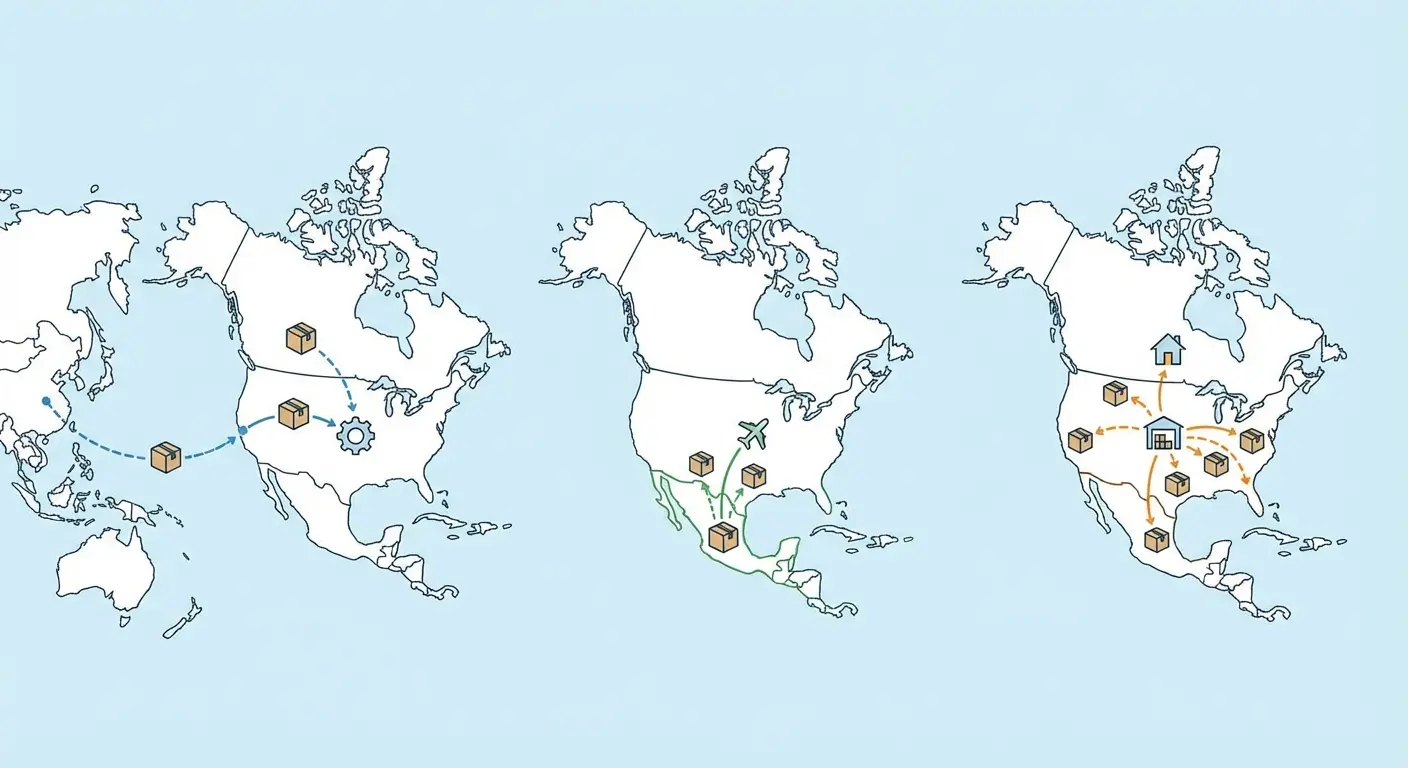
For Canadian sellers, there are three common paths:
Remote fulfillment through NARF
FBM from Canada
Bulk shipment into U.S. FBA
Each option has a different cost structure, service level, and compliance profile.
Option 1: NARF as a lower-commitment test
When sellers compare amazon narf vs sending inventory to us fba, NARF is often the lower-commitment first step. Remote Fulfillment with FBA, sometimes still referred to by sellers as NARF, allows eligible inventory stored in one marketplace to fulfill orders in another participating North American marketplace.
The attraction is obvious. You may not need to move stock into the U.S. upfront. That reduces operational complexity and inventory risk during testing.
The tradeoff matters just as much. Unit economics and customer experience may be less competitive than domestic U.S. FBA. Delivery speed can be slower. Product eligibility is limited. Not every SKU is a fit. Remote fulfillment can be useful for validating cross-border demand, but it is often not the final model for a serious U.S. scale play.
Expectation versus reality:
Expectation: "I can test the U.S. without changing much."
Reality: You can test, but convenience may come with weaker economics or less competitive delivery performance.
Option 2: FBM from Canada and the Section 321 question
For some sellers, especially those with lower volume, higher average selling prices, or made-to-order inventory, FBM from Canada is the most controllable path. That is where a canadian seller section 321 amazon guide becomes relevant.
Section 321 is a U.S. de minimis provision that generally allows qualifying shipments valued at not more than the current threshold to enter free of duty and tax. In seller discussions, this usually comes up in the context of direct-to-consumer shipments moving from Canada to U.S. buyers one order at a time.
The appeal is clear:
No immediate need to place bulk inventory into U.S. FBA
Potential duty relief on qualifying low-value shipments
Better cash flow control for slower-moving SKUs
A useful test model before deeper commitment
But there are important limits. Section 321 is not a universal margin shortcut. Eligibility depends on how the shipment is structured and processed. Rules and enforcement can change, and not all products or shipment patterns qualify. The shipment still has to move reliably. Transit time, carrier cost, tracking quality, and returns all matter. On Amazon, slower delivery can reduce conversion and Buy Box competitiveness, especially in crowded categories.
A good canadian seller section 321 amazon guide does not end with "use FBM and save duties." It asks whether the SKU can still win once delivery speed, customer expectations, and operational workload are included.
Option 3: Sending inventory into U.S. FBA for stronger delivery performance
For many serious U.S. expansion plans, shipping from canada to amazon us warehouse becomes the model that offers the strongest sales velocity after a SKU has proven itself. Inventory stored in U.S. FBA generally supports faster Prime delivery, a cleaner customer experience, and stronger Buy Box competitiveness.
That is why many sellers move from remote fulfillment or cross-border FBM into direct U.S. FBA once a product demonstrates repeatable demand.
The main complications happen upfront:
Customs and import documentation must be handled correctly
Duties and related import costs may apply
Prep and labeling need to meet Amazon requirements
Returns and removals need a workable destination
Inventory physically stored in the U.S. may affect your broader tax and compliance review
When estimating shipping from canada to us fba cost, do not price freight alone. Include prep, carton labels, brokerage or customs clearance costs, duties where applicable, U.S. inland transport, palletization if required, and the cost of poor inventory placement if your shipments are split across multiple fulfillment centers.
A useful rule of thumb is this: if a SKU is proven, replenishable, not highly seasonal, and competing in a speed-sensitive niche, U.S. FBA usually deserves serious consideration. If demand is uncertain, order frequency is low, or margins are fragile, test with a lighter model first.
What cross-border shipping really looks like in practice
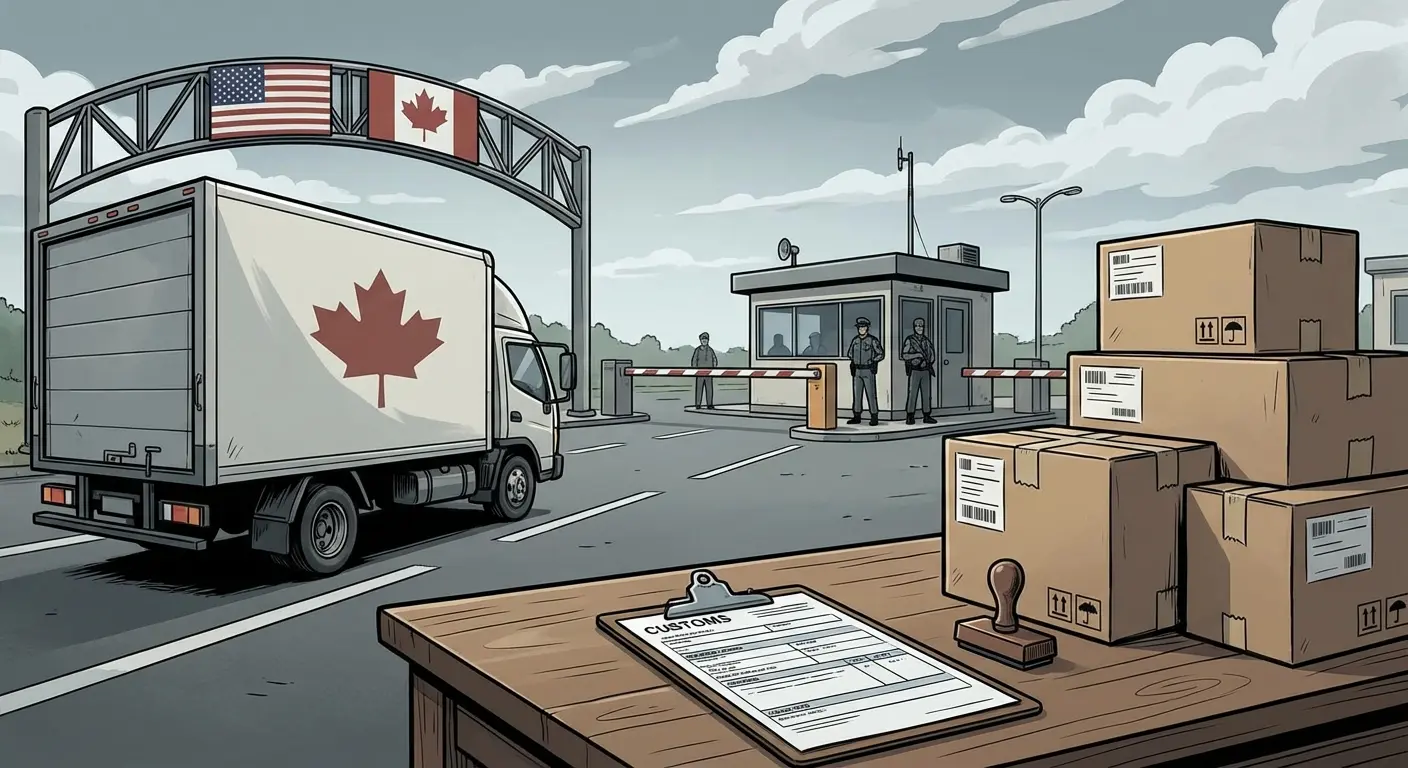
In practice, amazon fba cross-border shipping solutions means building a repeatable lane from your Canadian inventory point to the right U.S. destination with as few surprises as possible.
For bulk FBA replenishment, that usually means:
Correct commercial invoices
Accurate HS classification
Reasonable declared values
Clear importer-of-record handling
Prep standards aligned with Amazon requirements
A carrier or broker familiar with Amazon-bound freight
For direct fulfillment from Canada, it means:
A carrier mix that can meet delivery promises consistently
Landed-cost visibility at the per-order level
Reliable tracking uploads
A returns workflow that does not become a service problem
The most expensive cross-border issue is not always freight itself. It is inconsistency. One delayed shipment to FBA can stock out your best SKU. One weak FBM carrier lane can pressure your performance metrics. One customs documentation error can hold inventory at the border while ads continue to spend.
That is why strong amazon fba cross-border shipping solutions are usually simple by design. They prioritize repeatability over clever workarounds.
Taxes: what Canadian sellers usually misunderstand about the U.S.

The phrase amazon usa sales tax for canadian sellers causes confusion because it often gets mixed together with two other tax topics:
U.S. tax documentation and withholding forms
Marketplace sales tax collection and remittance
Canadian income tax reporting of U.S. profits
These issues are related, but they are not the same.
U.S. tax documentation
As noted earlier, Amazon’s tax interview and W-8 forms are about documenting your non-U.S. status for tax purposes. This is a setup requirement. It is not your complete tax strategy.
U.S. sales tax
Under marketplace facilitator laws, Amazon generally collects and remits sales tax on marketplace sales in many U.S. states. That is why sellers often hear that Amazon handles sales tax. In many cases, it does handle collection and remittance on marketplace transactions. Still, broad assumptions can be risky. Rules vary by state, product type, and business footprint, and non-marketplace sales can raise separate issues.
So when sellers ask about amazon usa sales tax for canadian sellers, the practical answer is often this: Amazon may collect and remit marketplace sales tax in many jurisdictions, but you still need to understand what Amazon is doing on your behalf, what records you should keep, and whether separate registration or filing questions apply to your situation.
Canadian income tax
If you are a Canadian resident business, profits from Amazon.com sales are generally still part of your taxable business income in Canada. Revenue from U.S. marketplace sales does not become invisible because the customer is in the United States. You still report the income in Canada and deduct eligible business expenses according to your circumstances.
For sellers evaluating selling on amazon usa from canada taxes 2026, the safest advice is simple: do not rely on one generic answer. Tax treatment depends on entity structure, inventory location, and whether your operating footprint creates additional obligations. Amazon can automate part of the marketplace tax side, but it does not replace tax advice tailored to your business.
Three realistic ways sellers expand, and when each works
Case 1: The cautious catalog test
A Canadian private label seller with 12 SKUs has two clear winners on Amazon.ca but little certainty on U.S. demand. The seller launches only selected SKUs, localizes the listings, and uses a lower-commitment fulfillment path before sending deep inventory into U.S. FBA.
This approach works when the main goal is demand validation. It is weaker when the category depends heavily on Prime-speed delivery from day one.
Case 2: The margin-first FBM model
A seller of higher-priced replacement parts chooses cross-border FBM from Canada because order volume is moderate, products are compact, and direct shipping economics remain acceptable. Section 321 treatment on qualifying shipments may help, and slower-moving SKUs do not yet justify U.S. warehousing.
This works when catalog breadth matters more than delivery speed. It starts to break down if customer expectations or Buy Box competition require faster domestic fulfillment.
Case 3: The proven-SKU FBA move
A seller with stable Amazon.ca demand sees similar search behavior on Amazon.com and sends only the top-performing replenishable SKUs into U.S. FBA. Longer-tail SKUs stay out until demand is proven.
This is often the cleanest scale path because it matches commitment to evidence. You do not need your entire catalog in U.S. FBA to have a serious U.S. launch.
Where sellers lose money even when sales go up
One common mistake is assuming that U.S. demand automatically improves profit. It often improves top-line revenue first, while margins get compressed by hidden operating costs.
Watch for these traps.
Copy-pasting the Canadian assortment
Some SKUs travel well. Others do not. Hazmat complexity, oversized dimensions, fragile packaging, or low average selling price can make a previously healthy SKU unattractive in the U.S.
Treating cross-border freight as one line item
When sellers ask about shipping from canada to us fba cost, they often mean linehaul only. In practice, landed cost includes much more than transportation.
Ignoring returns before launch
A cross-border return process built after launch usually becomes expensive and messy. Decide early whether returns go to a U.S. 3PL, prep center, or another domestic receiving point.
Assuming Amazon.com shoppers behave like Amazon.ca shoppers
Keyword demand, price tolerance, competition density, and review thresholds can all differ. The catalog overlap is real, but the market is not identical.
The edge cases that deserve extra caution
Some situations need slower planning.
If your products are regulated, ingestible, topical, electrical, or intended for children, U.S. compliance review should happen before launch, not after listing creation.
If your products are bulky or low-priced, U.S. FBA can still work, but only if replenishment and fee math are unusually strong. Cross-border shipping punishes weak unit economics.
If you have many long-tail SKUs with unpredictable demand, a hybrid model is often better than forcing everything into one fulfillment path. Put proven winners into U.S. FBA and keep uncertain or slower SKUs on a lower-commitment route.
If your business has a complex corporate structure or meaningful volume, get tax advice before assuming your U.S. footprint is fully handled by Amazon’s marketplace systems.
What experienced sellers should keep in mind before they launch
Expanding from Amazon.ca to Amazon.com is usually less about opening a new storefront and more about choosing the right operating model for each SKU.
Keep these points in view:
Use a focused registering for amazon usa from canada checklist that covers the tax interview, payout method, compliance review, listing localization, and returns planning.
When comparing amazon narf vs sending inventory to us fba, treat remote fulfillment as a testing path and U.S. FBA as the likely scale path for proven, replenishable winners.
A solid canadian seller section 321 amazon guide should include speed, carrier reliability, and returns, not just possible duty savings.
For amazon usa sales tax for canadian sellers, remember that marketplace collection often helps, but it is not the same thing as complete tax planning.
Estimate shipping from canada to amazon us warehouse as total landed cost, not just freight.
Build amazon fba cross-border shipping solutions around repeatability and error reduction, because customs mistakes and receiving delays can destroy margin.
The smartest way to expand amazon ca business to usa market is usually phased: validate demand, isolate winning SKUs, then deepen U.S. infrastructure where the numbers justify it.
If you make one decision especially well, make it this one: choose fulfillment based on SKU economics and customer expectations, not on what feels administratively easiest today. That single choice often determines whether your U.S. expansion becomes a growth channel or an expensive lesson.