Top Ecommerce Marketplaces for Brands

Sarah Johnson

The Top 5 E-commerce Marketplaces for Brands That Want Control, Margin, and Scale
Here is the uncomfortable question: are you choosing a marketplace because it fits your brand, or because it is the loudest option in the room?

Most experienced sellers already know how to sell on Amazon marketplace. Fewer have stepped back to ask whether Amazon is still the right core channel, how Amazon vs Walmart marketplace really plays out as both platforms evolve, or where platforms like eBay and social commerce actually outperform the default choice.
This breakdown looks at the top ecommerce marketplaces for brands through a strategic lens. Not traffic size. Not hype. But margin structure, control, operational drag, and long-term positioning. The goal is to help you choose the right marketplace for brand, not just chase incremental revenue.
The Five Marketplaces That Actually Matter for Brands
For most established FBA or FBM operators, the real conversation narrows to five:
Amazon
Walmart Marketplace
eBay
Etsy (for specific product types)
social commerce platforms (TikTok Shop, Instagram, Facebook Shops)
Each of these can be one of the best ecommerce platforms for sellers depending on your constraints. But they optimize for different outcomes.
Amazon optimizes for demand capture at scale. Walmart often optimizes for diversification and, in some categories, cleaner competitive dynamics. eBay often optimizes for flexibility and secondary inventory. Etsy often optimizes for niche and handmade positioning. Social commerce can optimize for discovery and audience development.
The mistake is assuming they are interchangeable.
What Actually Determines Marketplace Fit

Before comparing platforms, clarify the filters that matter at your level:
Contribution margin after marketplace-specific costs Referral fees are table stakes. The real difference often shows up in fulfillment fees, storage costs, ad dependency, return rates, and pricing constraints.
Control over brand and customer relationship Can you build a defensible brand asset, or are you mostly renting demand?
Operational complexity Does the platform increase SKU-level overhead, customer service load, compliance work, or inventory fragmentation?
Advertising dependency Is organic reach viable, or does paid acquisition become effectively required to maintain visibility?
Policy volatility and account risk How exposed are you to listing suppression, compliance shifts, or algorithmic visibility swings?
Second-order strategic effects Does the channel strengthen your DTC leverage, wholesale negotiations, or valuation story?
With that framework in place, you can evaluate each option more safely and more realistically.
Amazon: Scale Engine With Structural Tradeoffs

For many brands, Amazon remains a central pillar of marketplace strategy because of demand density. Any practical Amazon FBA seller guide still starts with the same premise: there are few places with comparable shopper intent at scale.
Where Amazon Wins
High-intent traffic at scale Amazon captures buyers late in the funnel. You are not convincing someone to want the category. You are competing to be chosen.
Logistics leverage via FBA Fulfillment by Amazon can reduce shipping friction, improve conversion through Prime eligibility, and offload parts of fulfillment operations. Results vary by category, size tier, and fee profile.
Conversion infrastructure Reviews, A+ Content (where eligible), Subscribe & Save (where eligible), Brand Registry (when you meet requirements), and advertising tools create a mature ecosystem that supports scaling.
Global expansion optionality Many sellers can expand internationally faster than building foreign logistics from scratch, but it still requires compliance, tax, and localization planning.
If your product converts well and can tolerate competitive pricing, Amazon can be a fast path to revenue concentration.
Where Amazon Pushes Back
Margin compression over time Between FBA fees, storage fees, returns, and increasing ad competition, margin pressure can be structural. It is not guaranteed for every SKU, but it is common enough to plan for.
Brand and customer-data limits Customers often remember buying “on Amazon,” and Amazon limits direct access to customer contact details. You can build brand assets on-platform, but you should not assume full customer ownership.
Policy and enforcement risk Listing suppression, compliance updates, category gating, and performance-related enforcement can disrupt revenue quickly, including for experienced operators.
Ad dependency creep In many competitive categories, organic rank alone may not sustain velocity. PPC often becomes defensive rather than purely incremental.
Cost and Operational Load
Expect continuous optimization work: listings, creatives, bid management, fee monitoring, inventory planning, and staying current with policy changes. Restock limits and storage thresholds can change, and they can affect planning.
Brands that use Amazon seller agency services often do so not because they lack knowledge, but because the workload compounds with scale and complexity.
Common Failure Modes
Expanding SKUs without validating ad efficiency at higher spend levels
Ignoring fee and storage changes until margins disappear
Treating Amazon primarily as a brand-building channel instead of a demand-capture channel
If a large share of your revenue depends on Amazon and margins are thin, your risk profile can be higher than it looks on a revenue dashboard.
Walmart Marketplace: Diversification With Growing Operational Maturity
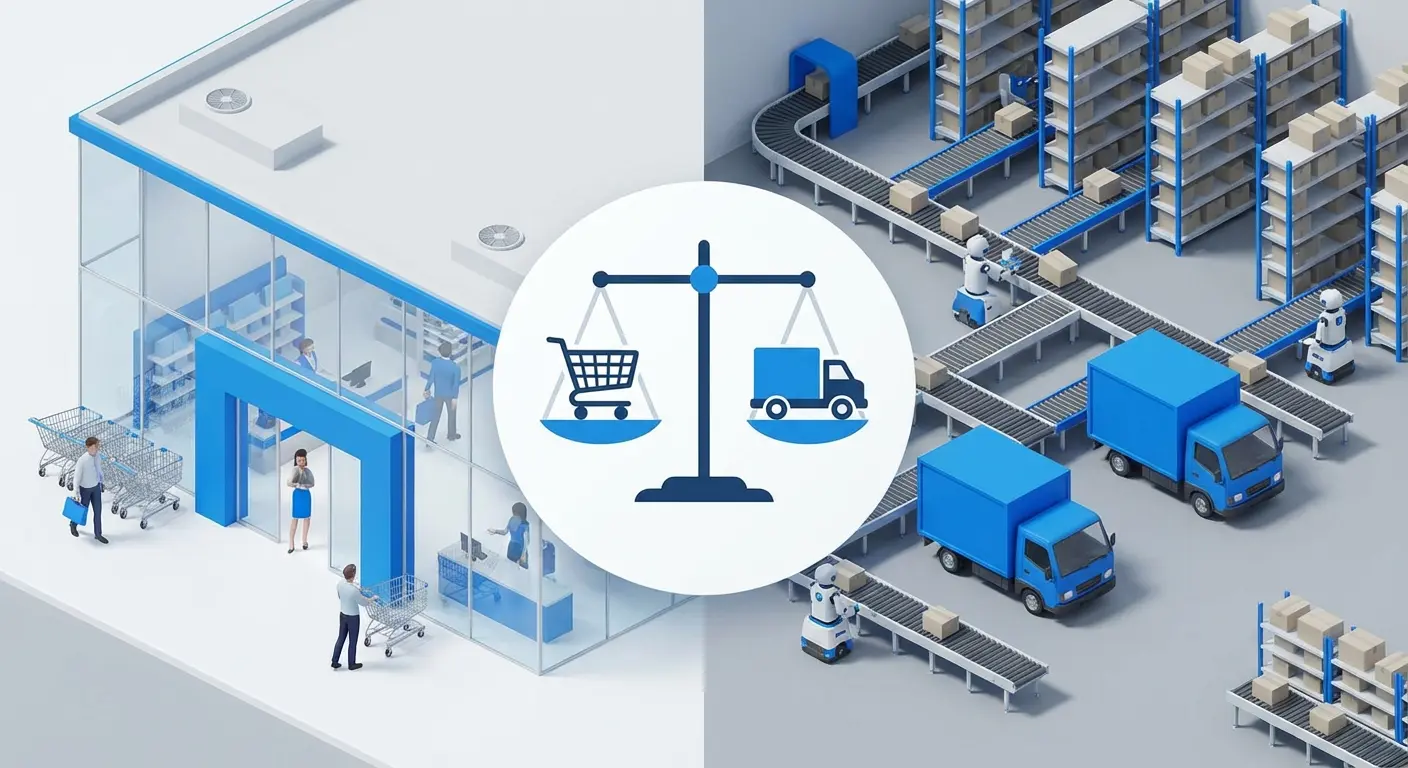
The Amazon vs Walmart marketplace comparison matters because Walmart Marketplace has expanded selection and improved seller tools, including fulfillment.
Where Walmart Wins
Less saturated competition in some categories In many categories, listing density can still be lower than Amazon. That can create opportunities for early movers, although competition is increasing.
Fee structure Walmart Marketplace typically does not charge a monthly subscription fee to sell, but it does charge referral fees by category and may charge for optional services.
Walmart Fulfillment Services (WFS) Walmart fulfillment services can provide fast delivery options and operational support, narrowing the gap with FBA for eligible items. Performance depends on product eligibility, network coverage, and inventory placement.
Price competitiveness expectations Walmart emphasizes competitive pricing, which can help reduce extreme price outliers. It can also force tighter pricing discipline than some brands expect.
Where Walmart Can Be Harder
Demand is smaller than Amazon in many categories Even strong placement may not match Amazon’s volume.
Onboarding and performance standards Approval can be selective, and performance metrics matter. Sellers should expect enforcement around cancellations, on-time delivery, and customer experience.
Fewer tools than Amazon in some areas Walmart’s advertising and merchandising capabilities have improved, but they may be less mature than Amazon’s depending on your use case.
Cost and Operational Load
WFS can simplify logistics, but it requires inventory allocation and inbound planning. Forecasting across channels increases complexity in a multichannel ecommerce strategy, especially if you need to avoid stockouts and prevent stranded inventory.
Common Failure Modes
Copy-pasting Amazon listings without Walmart-specific optimization
Underestimating Walmart’s emphasis on competitive pricing
Splitting inventory too early without reliable replenishment
Walmart can work well when you want diversification and your unit economics still hold under Walmart’s fee and pricing dynamics.
eBay: Flexibility for Specific Use Cases
The eBay vs Amazon selling comparison is often misunderstood. eBay is not a direct replacement for Amazon for most brands. It is usually a tactical channel with specific strengths.
Where eBay Wins
Flexible listing formats Auction and fixed-price options allow pricing experimentation.
Strong resale and refurbished markets eBay is strong in categories where condition variance matters and buyers expect a range of price points.
International reach Cross-border selling can be accessible, but you still need to manage shipping, returns, and buyer expectations carefully.
Inventory liquidation channel Overstock, returns (where policy-compliant), and older models can move without directly competing for Amazon Buy Box positioning, although price signaling can still affect your broader market.
Where eBay Often Falls Short
Brand-building limitations The marketplace structure emphasizes transaction over brand identity.
Price sensitivity Many buyers are comparison-driven and deal-focused.
Fee layering Final value fees plus optional promoted listings can erode margins.
Cost and Operational Load
Operationally, eBay can be lighter than running a high-ad-spend Amazon catalog, but it can be heavier on customer messaging and dispute handling, especially for FBM workflows.
Common Failure Modes
Treating eBay as a premium channel without category fit
Ignoring buyer protection and dispute workflows
Overextending into categories that lack eBay-native demand
For established brands, eBay is often complementary rather than a primary growth engine.
Etsy: Strong Fit for Handmade and Personalized, Weak Fit for Commoditized SKUs

Etsy belongs on the list of top ecommerce marketplaces for brands, but only under specific product conditions.
Where Etsy Wins
High-intent niche buyers Customers actively seek handmade, personalized, or vintage products.
Search behavior favors differentiation Distinctive products can stand out more easily than on broader marketplaces.
Built-in audience for creative goods You are often competing more on design, story, and customization than on logistics alone.
Where Etsy Breaks Down
Limited scalability for mass products If your product is easily commoditized, Etsy is usually not the right environment for margin protection.
Fee stacking Listing, transaction, payment processing, and optional ad fees can add up quickly.
Policy enforcement Etsy enforces rules around what qualifies as handmade, vintage, or craft supplies. Misalignment can lead to listing removal or account issues.
Cost and Operational Load
Operational complexity is moderate, but branding is constrained by platform templates. Etsy can be powerful when your product narrative is inseparable from craftsmanship, and weaker when your advantage is primarily operational efficiency.
Social Commerce: Discovery With Volatility and Operational Demands

Social commerce platforms are increasingly relevant in serious channel planning, but they are not set-and-forget.
Where Social Commerce Wins
Discovery-driven demand TikTok Shop and Instagram can create demand through content, not just capture existing demand.
Audience development You can build followers and retargeting pools. The degree of true ownership varies by platform and funnel design.
Creative leverage Strong creative can outperform larger competitors, especially early in a trend cycle.
Where It Gets Risky
Algorithm volatility Visibility can shift quickly based on content performance, policy changes, and platform priorities.
Operational intensity Consistent content creation is often required to sustain momentum.
Attribution complexity Tracking ROI across content, ads, affiliate or creator programs, and in-app purchases can be difficult.
Cost and Operational Load
Ad costs vary. A major cost is creative production and community management. This channel can be powerful, but it is rarely passive.
Matching Marketplace to Brand Constraints
Instead of asking which platform is “best,” ask which constraints you are optimizing for.
If your priority is maximum revenue scale and demand capture, Amazon is often the fastest lever.
If your priority is diversification with a second major marketplace, Walmart can be a logical pillar.
If your priority is inventory flexibility or secondary-market positioning, eBay can fit.
If your priority is handmade or personalized positioning, Etsy can be structurally aligned.
If your priority is brand equity and discovery, social commerce deserves planned investment.
Many advanced sellers operate a layered model:
Amazon as a core revenue engine
Walmart for diversification
eBay for secondary inventory
Social commerce for discovery and brand lift
Sequencing matters. Expanding before systems are stable often multiplies complexity faster than revenue.
Platform Selection in Context: Tools and Strategy
Marketplace expansion decisions also connect to your broader stack. The best ecommerce platforms for sellers are not always marketplaces. They can also be the infrastructure behind your catalog, operations, and analytics. For many brands, the differentiator is not the channel choice alone. It is execution across systems and teams inside a multichannel ecommerce strategy.
So How Should You Choose the Right Marketplace for Brand?
Start with a diagnostic:
Are your margins strong enough to sustain higher ad competition on Amazon?
Can you allocate separate inventory pools without triggering stockouts or long-term storage issues?
Do you have content capability for social platforms, either in-house or tightly managed?
Is your product differentiated enough for Etsy, or price-competitive enough for Walmart?
Then stress-test second-order effects:
If a top ASIN is suppressed, does your business wobble?
If Walmart pricing expectations force a lower price, does it trigger repricing pressure elsewhere?
If social CPMs spike, can you maintain content cadence and still hit contribution goals?
Recommendation, conditional:
For many established sellers, Amazon can remain the primary channel, but it is safer when it is not the only one.
Add Walmart once operational discipline is strong and margins allow WFS allocation.
Use eBay strategically, not aspirationally.
Invest in social commerce when brand equity is a long-term asset, not just a short-term sales spike.
Avoid expanding into three new marketplaces simultaneously. Platform complexity compounds operational error.
Marketplace Comparison at a Glance
| Platform | Best For | Margin Pressure | Brand Control | Operational Complexity | Strategic Role | |---|---|---|---|---|---| | Amazon | Scale and demand capture | Often high | Low to moderate | High | Core revenue engine | | Walmart | Diversification and margin balance | Moderate | Moderate | Moderate | Secondary pillar | | eBay | Resale, liquidation, niche | Moderate | Low | Moderate | Tactical channel | | Etsy | Handmade, personalized goods | Moderate | Moderate | Moderate | Niche primary | | Social commerce | Discovery and brand building | Variable | Moderate to high | High | Brand amplifier |
Final Positioning
There is no universal “best” answer. There is platform alignment with your margin structure, operational tolerance, and long-term brand ambition.
If you already know how to sell on Amazon marketplace, the strategic move is not necessarily abandoning it. It is deciding whether Amazon is your entire business model or one distribution layer within a broader system.
The strongest operators treat marketplaces as tools, not identities.