What Is Amazon Marketing Services (AMS)?

Olivia Reyes

What Is Amazon Marketing Services (AMS)? A Practical Guide to Amazon Ad Services for Sellers

If your organic rank slips by five positions and your sales drop 30%, is that a listing problem or an advertising problem?
For most experienced sellers, the answer sits inside Amazon Marketing Services, now part of Amazon Ads. Whether you still call it ams amazon, rely on amazon ad services, or manage spend through an amazon advertising service, advertising has become core infrastructure in many categories. It shapes visibility, sales velocity, and can influence organic placement indirectly.
This guide explains what Amazon Marketing Services is today, how it works in practice, and where it helps or hurts sophisticated sellers.
From AMS to Amazon Ads: What the Platform Really Is
Start with the core question: what is amazon marketing services?
Amazon Marketing Services (AMS) was the earlier name commonly used for Amazon’s self-serve advertising products. Over time, Amazon unified and expanded these offerings under the Amazon Ads and Amazon Advertising branding. Many sellers still say ams advertising out of habit, but in day-to-day seller conversations it usually refers to the current Amazon Ads ecosystem.
At a practical level, Amazon’s ad platform lets eligible advertisers pay for placements across Amazon-owned properties, including:
Search results pages
Product detail pages
Brand Stores
Some off-Amazon inventory, depending on ad product, eligibility, and settings
The most important distinction from external platforms like Google or Meta is intent. The amazon advertising service sits inside a marketplace where shoppers often arrive ready to buy, which changes the economics of each click.
When sellers ask how does amazon advertise, the simple answer is that it sells sponsored placements through auction-based, performance-driven ad products that appear throughout the shopping journey.
The Building Blocks of Amazon Ad Services

To understand ams advertising, focus on the major formats. amazon ads services are not one tool. They are a set of ad products that can play different roles in the funnel.
Sponsored Products
These are the backbone of most seller accounts. Sponsored Products promote individual listings and can appear:
In search results
On product detail pages, including competitor pages
In other merchandising placements Amazon controls
They typically run on a cost-per-click model. You bid on keywords or product targets, and you pay when a shopper clicks.
For many sellers, Sponsored Products drive the majority of attributed revenue from amazon ad services.
Sponsored Brands
These placements can appear in prominent search locations and may include:
Your brand logo
A headline
Multiple products, and in many cases video creative
They are often used to push traffic to a Brand Store or a curated landing experience.
Sponsored Brands can be used for brand building and for performance, depending on creative, targeting, and landing-page strategy.
Sponsored Display
Sponsored Display supports product targeting and audience-based targeting, depending on eligibility and settings. It can show:
On and around product detail pages
To shoppers who viewed related items
On some off-Amazon placements in certain configurations
This can resemble retargeting, but the available options depend on account type, marketplace, and feature access.
Amazon DSP (Advanced Use)
Amazon DSP enables programmatic buying of display and video using Amazon’s audiences and supply. It is often used by larger brands, aggregators, and agencies, but it can also be available to smaller advertisers through managed service or partners, depending on region and requirements.
For many FBA-focused operators, DSP is optional. For brands building broader reach, it can be a meaningful layer.
How Amazon Advertising Service Actually Works

At a high level, the amazon advertising service works like this:
You choose an ad product and targeting approach.
You set bids and budgets.
Amazon runs an auction for available placements.
In most CPC formats, you pay when someone clicks.
The auction is not purely “highest bid wins.” Amazon considers a mix of signals that can include:
Bid amount
Relevance between targeting and the advertised product
Expected click-through rate
Expected conversion likelihood
Other performance and shopper experience signals Amazon does not fully disclose
This is why listing quality and offer competitiveness can materially affect ad efficiency.
Automatic vs. Manual Targeting
Many sellers start with automatic targeting to discover search terms and ASIN placements that convert. Amazon matches your ad based on your listing data and shopper behavior signals.
Manual targeting gives direct control over:
Keyword match types (exact, phrase, broad)
Product targeting and category refinements
The mature approach is usually not either-or. It is using automatic campaigns for discovery and manual campaigns for control, then iterating based on search term and placement reporting.
Automatic campaigns are rarely “set and forget.” They work best as controlled discovery that feeds a disciplined negative keyword and query-harvesting process.
Why Advertising Can Influence Organic Placement
This is where experienced sellers pay attention.
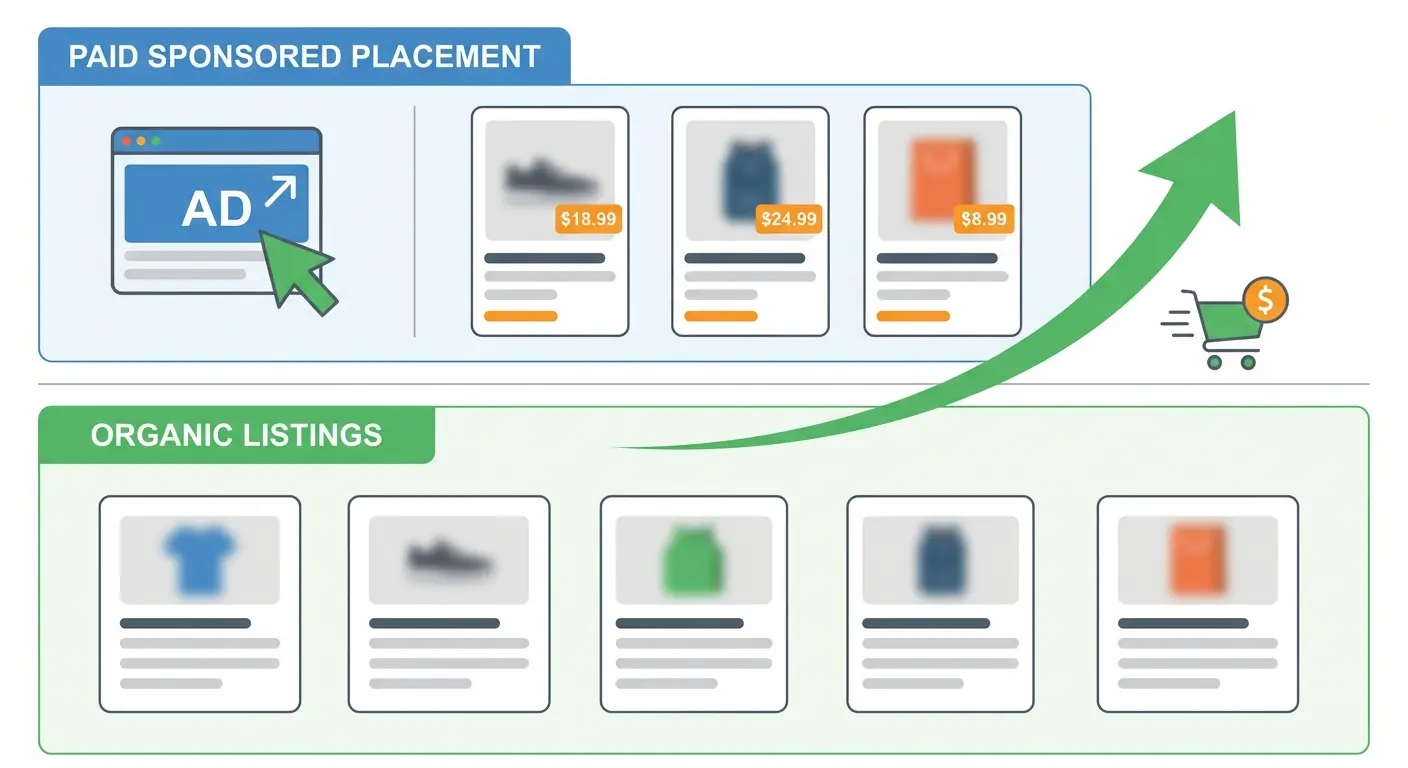
Amazon’s ranking systems are not fully transparent, and Amazon does not publish a single formula. In practice, organic placement tends to respond to sales performance and conversion signals. Paid traffic that converts can increase total sales, which can support stronger organic placement over time.
A common misconception is that ads directly change organic rank. They do not grant organic placement by themselves. Instead, advertising can contribute indirectly by supporting sales velocity, conversion, and shopper engagement.
If you pause amazon ads services in a competitive niche, organic placement can decline, especially when competitors occupy key sponsored positions and your total sales drop. It is not guaranteed, but it is a real risk worth modeling.
Three Real-World Scenarios
Case 1: Launching a New Private Label Product
You launch a garlic press in a saturated niche with minimal reviews and no ranking.
Without Amazon Ads, early visibility may be limited. You run:
Automatic Sponsored Products to identify converting search terms
Manual exact campaigns for proven high-intent queries
Product targeting on competitor listings
You may accept a higher ACoS early if your goal is data, initial sales, and review velocity while staying within Amazon’s policies.
In this scenario, ams advertising often functions as a discovery engine.
Case 2: Mature SKU With Stable Organic Position
You have a product sitting near the top of page one for a core keyword. Margins are solid.
You test turning off ads and sales drop. Organic placement may soften as competitors take more sponsored real estate and your total sales fall.
When you restart campaigns, CPC can be higher due to auction conditions and competitive pressure.
Lesson: advertising can protect market share, but the defensive value depends on category dynamics and how much of your volume is already organic.
Case 3: Low-Margin Wholesale Product
You sell branded wholesale items with thin margins.
You run Sponsored Products, but CPC pushes ACoS above break-even. Profit disappears.
In this case, amazon ad services may only make sense if:
Your cost of goods improves
You limit ads to defensive terms or selective placements
You use ads strategically for sell-through, while monitoring net margin and cash flow
Not every ASIN should be advertised aggressively. The math has to work.
Common Misunderstandings About AMS Amazon
“If ACoS Is Low, the Campaign Is Good”
Low ACoS can mean efficiency. It can also mean you are under-investing and leaving profitable volume behind. Efficiency matters, but so do incremental sales, margins, and rank defensibility.
“More Spend Equals More Rank”
Spend without conversion usually does not help. It burns margin and can signal weak shopper response. Traffic quality and offer strength matter more than raw spend.
“Sponsored Brands Are Only for Big Brands”
Smaller Brand Registered sellers can use Sponsored Brands to:
Control premium search placements
Funnel shoppers to a Brand Store
Cross-promote complementary SKUs
It can be performance-driven when built around strong creative and relevant targeting.
“Set It and Forget It”
Sustained performance typically requires:
Search term harvesting and query pruning
Negative keyword management
Bid and placement adjustments
Budget reallocation by SKU and lifecycle stage
Ignoring campaigns for weeks in a competitive category can lead to wasted spend or missed demand.
Where Amazon Ads Services Have Limits
It Cannot Fix a Bad Offer
If your product suffers from:
Weak reviews or poor rating distribution
Uncompetitive pricing or poor value perception
Low-quality images or unclear differentiation
Then PPC may drive clicks without conversions. Ads amplify what exists. They rarely fix fundamentals.
Data and Attribution Have Gaps
Amazon reporting is useful, but not perfect:
Some view-through and assist effects can be limited or format-dependent
Cross-channel impact from email, social, or external traffic may not be fully visible inside standard reports
Halo effects across variants and related SKUs can be difficult to attribute cleanly
Portfolio-level analysis often requires blending Amazon reporting with business-level margin and inventory data.
CPC Pressure Is Real in Many Categories
As more advertisers compete, auctions can become more expensive. The response is not always higher bids. Often the better levers are:
Improve conversion rate and offer quality
Tighten targeting and reduce waste
Expand into long-tail queries
Build brand demand that improves click and conversion efficiency
Eligibility and Access
Eligibility varies by marketplace and account type. Many sellers can access Sponsored Products with a Professional Seller account. Brand-focused formats often require Brand Registry, and some features can depend on region, category, and compliance history.
Compliance matters. Ads can be rejected for policy reasons, and repeated issues can create operational friction. Always align creatives, claims, and landing pages with Amazon’s advertising policies and product detail page rules.
How to Think About AMS Strategically

Instead of asking, “Should I run ads?” experienced sellers ask:
What role should advertising play at this lifecycle stage?
Am I defending rank, launching, scaling, or selling through inventory?
What is my break-even ACoS when I include true landed costs and refunds?
How does spend affect TACoS and total contribution margin, not just attributed revenue?
A practical heuristic:
New SKU: prioritize data, conversion feedback, and controlled velocity.
Scaling SKU: pursue profitable growth and defend key placements.
Mature SKU: protect core terms while watching incrementality.
Declining SKU: decide whether ads are preserving margin or delaying a needed repositioning.
Different ASINs can require different strategies under the same amazon advertising service umbrella.
What This Means for Serious Sellers
Amazon Marketing Services is no longer a shortcut. It is infrastructure.
When someone asks what is amazon ams, the surface answer is “Amazon’s advertising platform.” The operational answer is that it is the system governing paid visibility on Amazon, and it can influence competitive positioning through its effect on sales and conversion.
You can sell without mastering it. In many categories, you will compete against operators who treat advertising as a core profit system, not an optional add-on.