Amazon Gives Sponsored Listings an Extra Trust Signal

Ivan Talpa
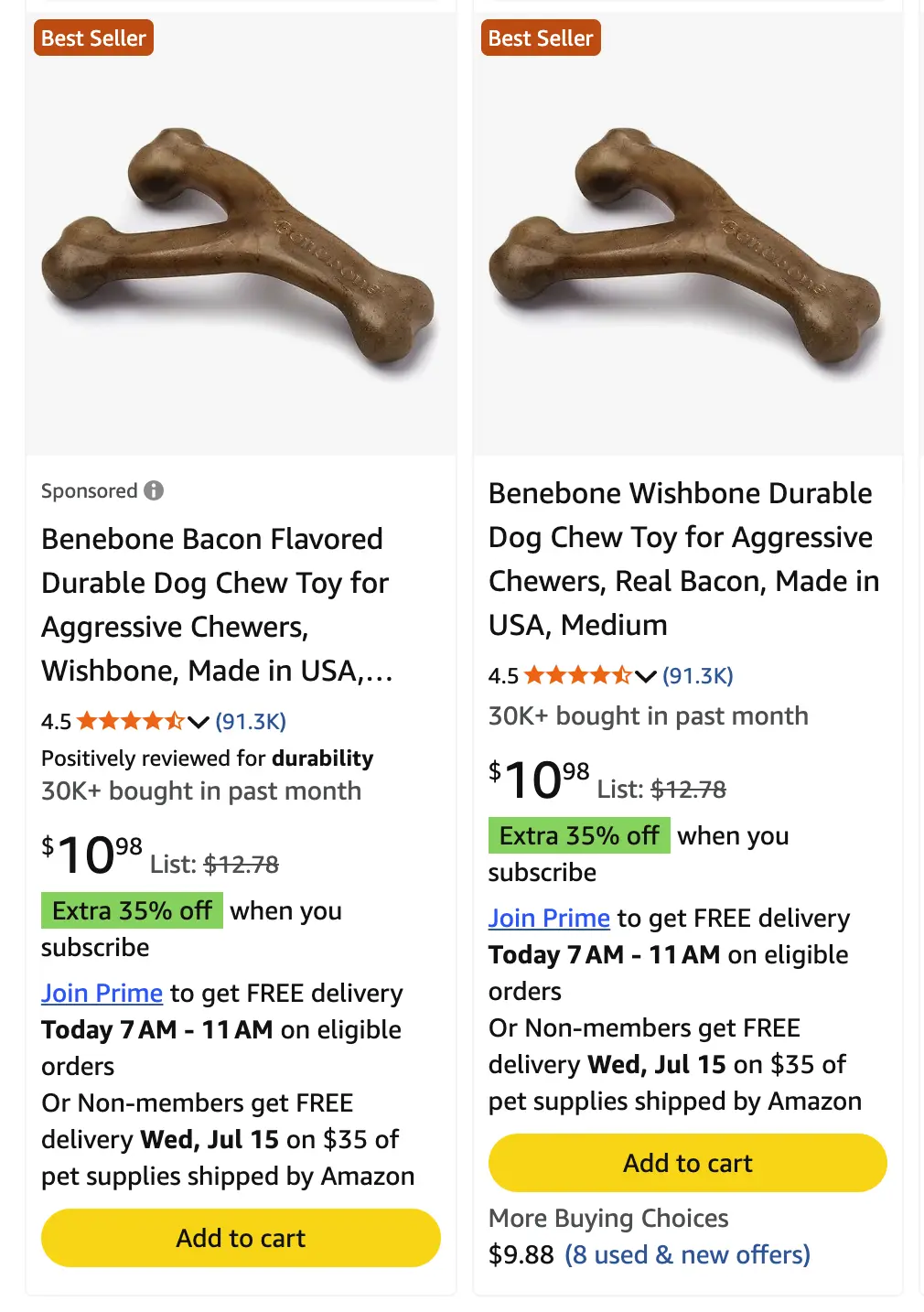
Same product. Same 4.5 stars. Same 91.3K reviews. Same $10.98. Two placements sitting next to each other in the same search result — and only one of them gets an extra line under the star rating:
"Positively reviewed for durability."
The listing with the line is the Sponsored placement. The organic listing right beside it gets nothing.
What that line actually is
It's an AI-generated review highlight — the same machinery behind the "Customers say" paragraph that's been on product detail pages since 2023. Amazon's model reads the review text on an ASIN, finds the attribute buyers mention most consistently and most positively, and compresses it into a few words.
What's new isn't the technology. It's where it shows up: in search results, above the fold, attached to a paid placement, at the exact moment a shopper is choosing between four visually identical products.
It's not a one-off
The obvious first reaction is that this is a fluke, or a test on one ASIN. It isn't. Sitting on top of a catalog of 1.2B+ products and 25M+ tracked keywords means a pattern like this can be checked at scale rather than guessed at, and it holds across a large sample of listings in different categories: the highlight appears on Sponsored placements and not on organic results — including cases where the same ASIN shows the line in its ad slot and nothing in its organic slot a few positions down.
That last detail is the important one. If the same product gets the line in one position and not the other, the trigger isn't the product or its reviews. It's the placement.
One honest caveat: this isn't from an official Amazon announcement, and Amazon rolls features out gradually and by category. What's described here is what's live in search right now. Go verify it on your own keywords — it takes two minutes.
Ads no longer just buy position
For years the mental model of a Sponsored placement was simple: you pay to appear higher, with the same listing everyone else sees. Rank was the product being sold.
That's no longer accurate. The ad unit is now a richer unit than the organic one. It carries an extra line of social proof that reads like it came from customers rather than from you — because it did. You're not just buying a better slot. You're buying a better-looking version of your own listing.
Two implications for sellers
1. Your reviews are now ad creative.
Nobody writes this line in Campaign Manager. There's no field for it, no bid, no toggle. Amazon's model mines it from what your buyers wrote. Which means the vocabulary your customers use to describe your product is now literally shaping how your ads look in search.
You can't control it, but you can influence it upstream. Buyers repeat the language a listing teaches them. If your title, bullets, A+ content, and images consistently name durability, buyers write about durability, and durability is what the model has to work with. If your reviews cluster around a weakness instead, you get no line at all — and no line while a competitor has one is a gap that costs you clicks before anyone reaches your detail page.
2. Paid vs. organic CTR is no longer an apples-to-apples comparison.
The standard read on a sponsored placement outperforming its organic counterpart is that targeting is working. Now part of that gap can simply be that the ad displays more. "The ad is working" and "the ad looks better" are two different things, and they're currently tangled together in your reporting.
This matters most when you're deciding whether ad spend on a keyword is incremental — the classic case of cutting spend on a term where you already rank organically. If the organic version of that listing shows less than the paid version did, the traffic doesn't transfer cleanly. Expect to lose more than the rank difference alone would predict.
What to do this week
Search your own top keywords. Find your Sponsored placement. Which attribute did Amazon pick for you? A premium product tagged "positively reviewed for value" is not the message you want leading your ad.
Check your top three competitors. If they carry the highlight and you don't, that's a conversion gap that happens before the click.
Audit the attributes your listing teaches. Pick the three to five you actually want buyers repeating, and name them explicitly and consistently across title, bullets, A+ content, and image copy.
Track sponsored and organic positions separately. SoldScope's free Amazon Keyword Tracker shows where an ASIN sits in both, so you can see the two versions of your listing side by side.
Recheck monthly. The highlight shifts as your review mix shifts. A run of complaints about one attribute can quietly take the line away.
Bottom line
Amazon keeps handing paid placements the better-looking version of your listing, and most sellers have no idea it's happening. You can't buy the highlight and you can't write it. What you can do is influence the language your customers use, stop treating paid and organic click-through as a clean comparison, and go look at what Amazon has decided your product is known for. That last one is a ten-minute job, and most sellers still haven't done it.