What Is the Impact Score?

Olivia Reyes
The Impact Score in SoldScope Listing Builder shows how much SEO ranking potential a specific part of your listing is capturing from your Keyword Bank.
You will see it displayed in this format:
Impact: 2202.91 / 3966.78
3966.78 is the total ranking potential of your entire Keyword Bank.
2202.91 is the amount of that potential currently captured by the specific listing section.
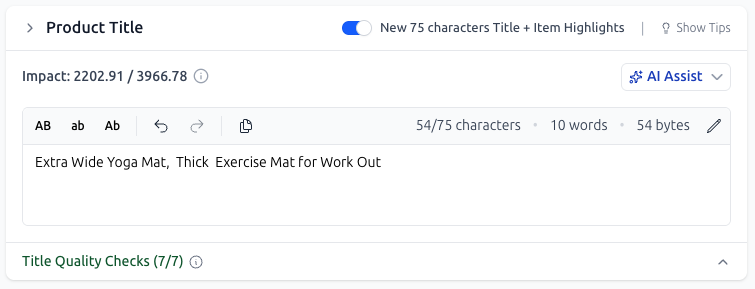
In this example, the section is capturing approximately 55.5% of the total potential available in the Keyword Bank.
The Impact Score is not simply based on how many keywords appear in your listing. It also considers:
Keyword Search Volume
Match quality
Keyword placement
Keyword repetition
Whether the same keyword has already been captured in a stronger section
Where You Can See the Impact Score
Impact is used throughout Listing Builder to help you understand both individual keyword value and overall listing optimization.
Listing Sections
Each major listing section displays its own Impact value, including:
Product Title
Item Highlights
Bullet Points
Description
Generic Keywords
This makes it easy to see how much SEO potential each part of the listing is contributing.
Keyword Tables and Tabs
Impact is also shown at the individual keyword level inside Listing Builder's keyword views.
This allows you to understand how much SEO value a specific keyword contributes after its Search Volume, match type, placement, and other scoring factors are taken into account.
Competitors Leaderboard
The Competitors Leaderboard also uses Impact to compare the SEO coverage of your listing with competing listings.
This makes it possible to see not only which competitor uses more keywords, but how much ranking potential those keywords actually represent.
How Keyword Potential Is Calculated
Every keyword in your Keyword Bank receives a base SEO potential based on its Search Volume.
The Impact Score uses:
Keyword Potential = √Search Volume
The square root of Search Volume is used instead of raw Search Volume.
This means high-volume keywords are still more valuable, but one or two extremely large keywords cannot dominate the entire score.
For example:
Search Volume 10,000 → Keyword Potential 100
Search Volume 100 → Keyword Potential 10
The first keyword has 100× more Search Volume, but only 10× more potential in the Impact Score calculation.
This helps the score reward broad, relevant keyword coverage instead of allowing a few extremely high-volume keywords to mask weak optimization across the rest of the Keyword Bank.
Match Quality Matters
The Impact Score evaluates how closely a keyword in your listing matches the keyword from your Keyword Bank.
Different match types receive different weights:
Match Type | Weight |
|---|---|
Exact Match | 100% |
Close grammatical / word-form variation | 90% |
Broad Match | 50% |
Broad Match with word-form variations | 30% |
No Match | 0% |
For example, if the Keyword Bank contains:
stainless steel tongs
Using that exact phrase receives more credit than having the individual words distributed separately throughout the section.
The stronger the match, the more of that keyword's potential is captured.
Keyword Placement Matters
The Impact Score also considers where a keyword appears in the listing.
Different listing sections have different weights:
Listing Section | Weight |
|---|---|
Product Title | 1.0 |
Item Highlights | 1.0 |
Generic Keywords | 0.9* |
Bullet Points | 0.7 |
Description | 0.3 |
This means that the same keyword can contribute different amounts of Impact depending on where it appears.
For example, an Exact Match in the Product Title can receive full location credit, while the same match in the Description is limited by the Description's lower section weight.
Even if every keyword in your Keyword Bank were perfectly matched in the Description, that section would have a theoretical ceiling of approximately 30% of the total Keyword Bank potential.
This is why individual sections are not expected to reach 100%.
*Generic Keywords are handled separately in parts of the underlying calculation and can be included or excluded from certain overall statistics.
Each Keyword Is Counted Only Once
This is one of the most important concepts behind the Impact Score.
A keyword may appear in several parts of your listing, but its SEO potential is credited only to the strongest location where it appears.
For example, suppose the keyword:
stainless steel tongs
appears as an Exact Match in:
Product Title
Bullet Points
Description
The Impact Score will credit that keyword to the Product Title, because the Title has the strongest section weight.
Repeating the same keyword again in Bullet Points or Description does not generate additional Impact.
The SEO value has already been captured by the stronger placement.
This prevents keyword duplication across multiple sections from artificially inflating the score.
How Keyword Stuffing Affects the Impact Score
The Impact Score also accounts for excessive keyword repetition.
Repeating the same words too many times within a section can reduce the amount of Impact they generate.
The current repetition multipliers are:
Highest Word Frequency | Multiplier |
|---|---|
1× | 1.0 |
2× | 1.0 |
3× | 0.8 |
4× | 0.5 |
5× or more | 0.2 |
For example, repeating the same important word five or more times within a section can reduce the effective contribution of affected keywords to 20% of their normal value.
This means repeatedly forcing the same keywords into a listing will not artificially increase Impact.
The scoring model rewards strong, natural keyword coverage rather than keyword stuffing.
How the Impact Score Is Calculated
At a simplified level, the contribution of a keyword can be represented as:
Keyword Potential × Match Weight × Section Weight × Repetition Penalty
Where:
Keyword Potential = √Search Volume
The Impact Score evaluates the locations where a keyword appears and identifies the placement that produces the strongest result.
The keyword's effective potential is then credited to that section.
At the section level:
Section Impact = Σ Effective Potential of Keywords Assigned to the Section
The number shown on the right side of the Impact indicator represents the potential of the entire Keyword Bank:
Total Keyword Bank Potential = Σ √Search Volume
Example: Impact 2202.91 / 3966.78
Suppose your Keyword Bank has a total potential of:
3966.78
And your Product Title currently captures:
2202.91
Listing Builder will display:
Impact: 2202.91 / 3966.78
This means the Product Title is currently capturing approximately:
55.5% of the total SEO potential represented by your Keyword Bank.
It does not mean that 55.5% of your keywords are present in the Title.
Different keywords have different potential.
A relatively small number of strong, high-demand keywords can therefore contribute significantly more Impact than a large number of low-volume or weakly matched keywords.
Why Can a Section Have Low Impact?
A low Impact value does not necessarily mean that the section is poorly optimized.
There are several possible reasons.
The keywords are missing
Important Keyword Bank terms may simply not be present in that section.
The match quality is weaker
Keywords may be present as Broad Matches rather than Exact Matches, reducing the amount of potential captured.
The section has a lower weight
Bullet Points and Description have lower section weights than Product Title and Item Highlights.
The keywords were already credited elsewhere
A keyword may appear in the section but receive no additional Impact because it has already been captured in a stronger location.
For example, a low Description Impact can simply mean that many of your most valuable keywords are already being credited to the Product Title or Item Highlights.
Excessive repetition reduced the score
If the same words are repeated too frequently, the repetition penalty can reduce their effective contribution.
How to Improve Your Impact Score
The goal is not to maximize the Impact of every section independently.
Instead, you should aim to capture as much of your Keyword Bank's total SEO potential as possible across the listing.
To improve Impact:
Prioritize important keywords in higher-weight sections.
Use Exact Matches when they fit naturally.
Cover a broad range of relevant Keyword Bank terms.
Avoid unnecessarily duplicating keywords already captured in stronger sections.
Use Bullet Points and Description to expand coverage rather than simply repeating the Title.
Avoid excessive repetition and keyword stuffing.
In practice, your highest-priority keywords will generally deliver the most value when placed naturally in the Product Title or Item Highlights, while lower-priority and additional relevant terms can be distributed across the remaining sections.
Impact Score vs. Listing Power Index
The Impact Score and Listing Power Index (LPI) use the same underlying concept of keyword potential, but they answer different questions.
The Impact Score helps answer:
“How much SEO potential is this section or keyword contributing?”
The Listing Power Index helps answer:
“How much of my entire Keyword Bank's SEO potential has this listing captured overall?”
At a simplified level:
Listing Power Index = Total Captured Potential / Total Keyword Bank Potential × 100
For example, individual Impact values can show you where your ranking potential is coming from, while LPI gives you a single overall measure of how effectively the listing is using the opportunities available in your Keyword Bank.
Together, these metrics help you understand both how well your listing is optimized overall and where its SEO strength is coming from.